Intralobular duct (Latin: ductus intralobularis)
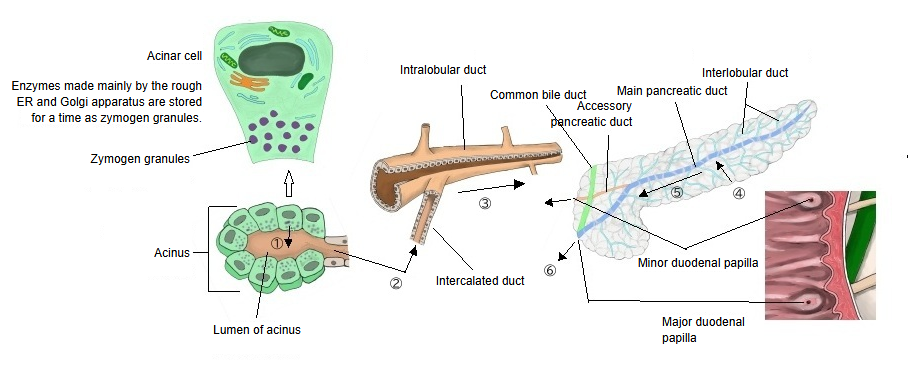
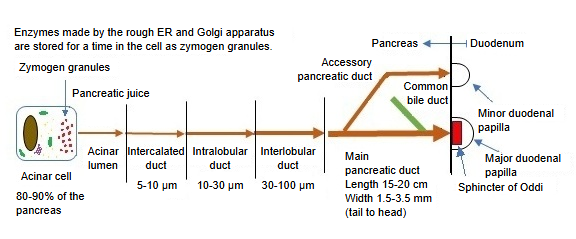
The intralobular duct is one of the ducts that carry the pancreatic juice in the pancreas, a gland with both endocrine and exocrine parts; running inside a lobule, it receives the juice from the intercalated ducts.
Pancreatic juice: a body fluid containing digestive enzymes and electrolytesGland: the pancreas has both endocrine and exocrine functionsFrom the intralobular ducts the juice flows on through the interlobular ducts into the main pancreatic duct (see pancreatic duct)Lining: a single layer of cuboidal epithelium, taller than the flat cells of the intercalated duct; in the pancreas roughly 10–30 µm across (sources differ on the exact sizes)
· Ducts of the same name are also found in the salivary glands, where the intralobular ducts are mainly the striated ducts, and in the mammary gland.
Reference websites
[Wikipedia]
· Pancreas, Wikipedia.
[Websites with illustrations]
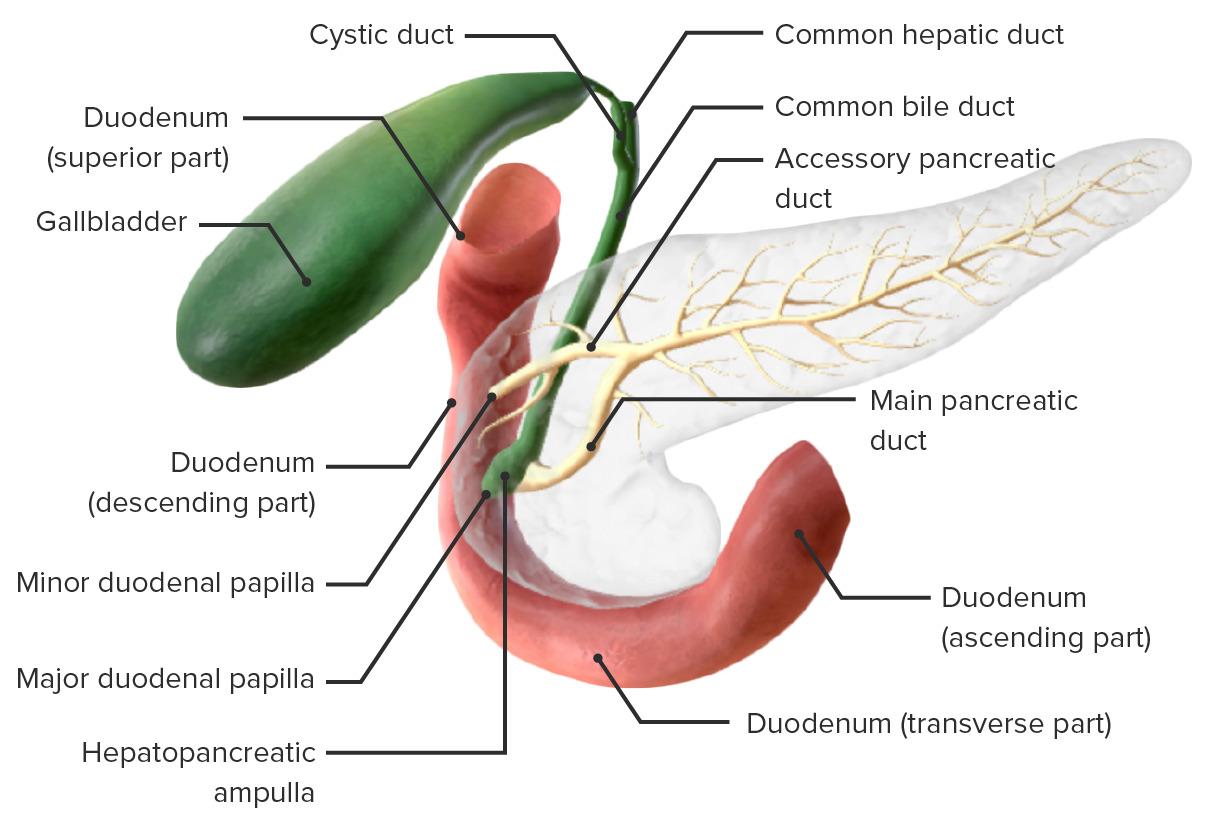
· Model of the pancreatic ducts (figure) (Lecturio)
Related terms
- Pancreatic juice
- Interlobular duct
- Intercalated duct
- Pancreatic duct
- Main pancreatic duct
- Acinar cells
- Centroacinar cells
- Serous gland
- Salivary glands
References and sources
- Further reading: Pancreas, Wikipedia.
- Further reading: Exocrine gland, Wikipedia.
- Federative International Programme for Anatomical Terminology (FIPAT). Terminologia Anatomica, 2nd ed. (TA2), 2019.