Macrophage (Latin: macrophagocytus)
Also called Histiocyte (in connective tissue)
One of the white blood cells that protect the body against outside invaders such as viruses and bacteria, and against cancer cells.
More details
Macrophages are white blood cells that develop when monocytes circulating in the blood leave the vessels, enter the tissues and mature there.
They are amoeboid cells, larger than the monocytes they come from, with a very strong power of phagocytosis: they take foreign matter in the body into themselves and break it down with digestive enzymes. Hence the name "macrophage" ("big eater"); they are also called phagocytes.
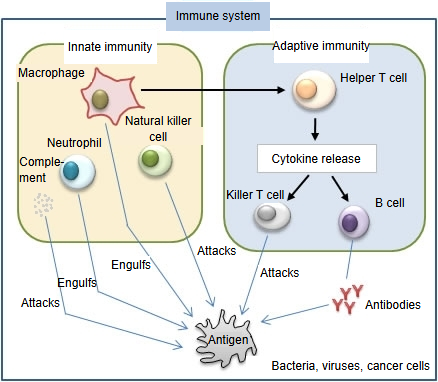
They are found in almost the whole body, but are especially numerous in the lungs, the liver and the spleen. Besides phagocytosis, they pass information about foreign matter to helper T cells and so activate the immune system. Their secretions include the following.
| 1 | Proteases | Enzymes that split peptide bonds; mediators of tissue damage in acute inflammation |
| 2 | Coagulation factors | Factors of blood clotting |
| 3 | Complement | Complement proteins |
| 4 | Cytokines | Growth factors, IL-1 (interleukin-1), tumour necrosis factor (TNF) |
| 5 | Nitric oxide | Chemical formula: NO |
Macrophages ultimately develop from haematopoietic stem cells in the bone marrow; some tissue macrophages are laid down before birth and renew themselves locally. They are found especially in connective tissue (where they are also called histiocytes), the lungs (alveolar macrophages), the liver (Kupffer cells), the spleen, lymph nodes and bone marrow. The cell is large and irregular, with many surface folds, an oval or kidney-shaped nucleus and a cytoplasm rich in lysosomes and vesicles. An engulfed particle is enclosed in a phagosome, which fuses with lysosomes to form a phagolysosome where it is digested; indigestible residue remains as a residual body. Macrophages belong to the innate immune system, like neutrophils and mast cells, but link it to adaptive immunity (B lymphocytes, plasma cells, T cells) through antigen presentation. Osteoclasts and microglia are related cells of the same family.
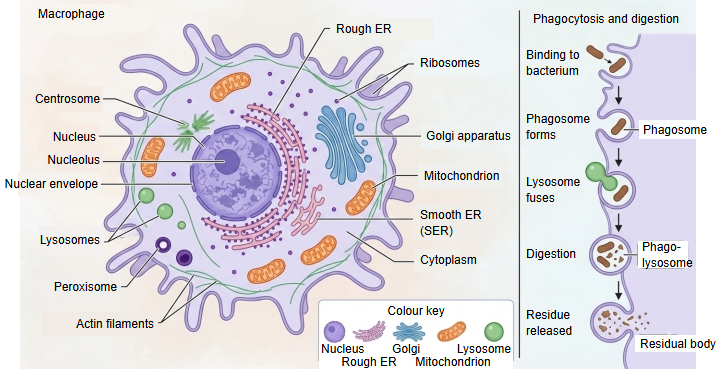
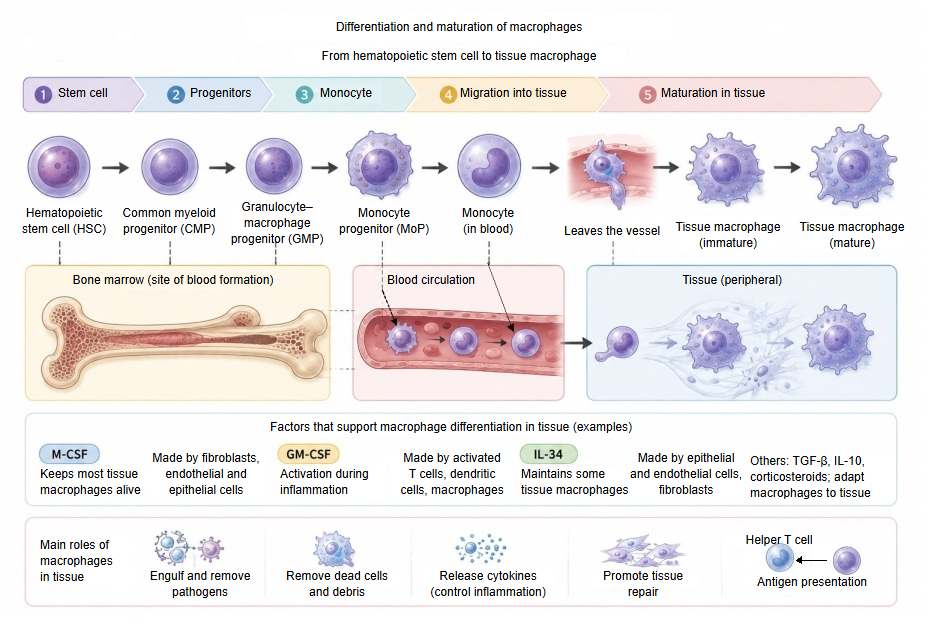
⇒ Website with a photograph of a macrophage
Related figures
 Innate and adaptive immunity
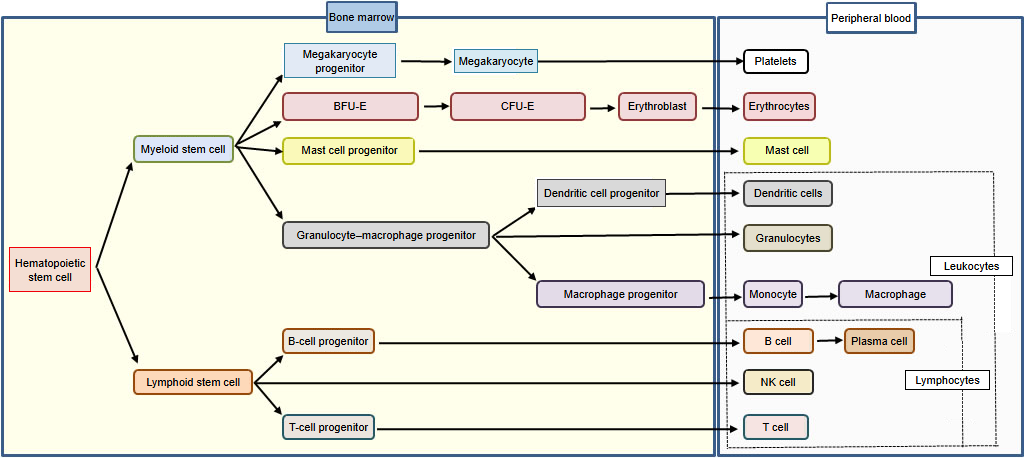 Blood cell lineages (diagram)

Related terms
References and sources
- Further reading: Macrophage, Wikipedia.
- Federative International Programme for Anatomical Terminology (FIPAT). Terminologia Anatomica, 2nd ed. (TA2), 2019.