Neuron (Latin: neuron)
Also called the nerve cell
Overview
· The other cell component of nervous tissue is the neuroglia (glial cells), which support the neurons. Neurons pass their signals to other neurons, muscle cells or gland cells at synapses.
of the
nervous
system
- Cellular elements
- Neurons : also called nerve cells. Function: transmitting information. Structure: cell body + processes.
- Neuroglia (glial cells) : also called glia. Function: support and nutrition of the neurons and other tasks. Smaller than neurons but about as many or more (older texts give up to ten times as many).
- Non-cellular elements : extracellular matrix (the material filling the spaces between the cells), blood vessels, cerebrospinal fluid, connective tissue (around the peripheral nerves). Many sources do not count these non-cellular parts in the make-up of the nervous system.
Structure
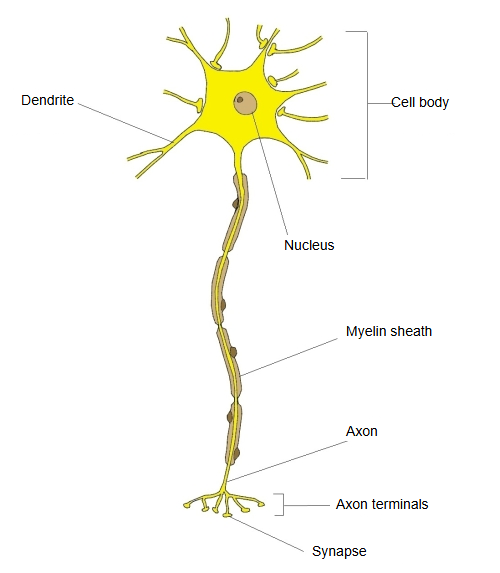
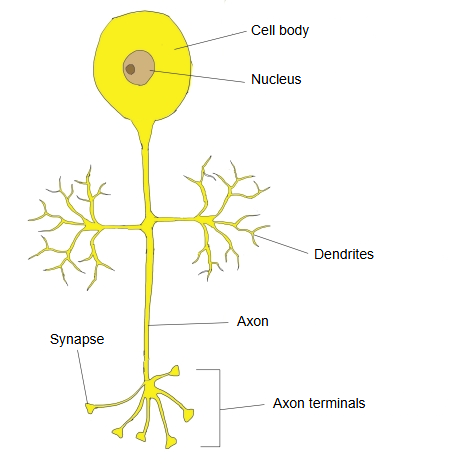
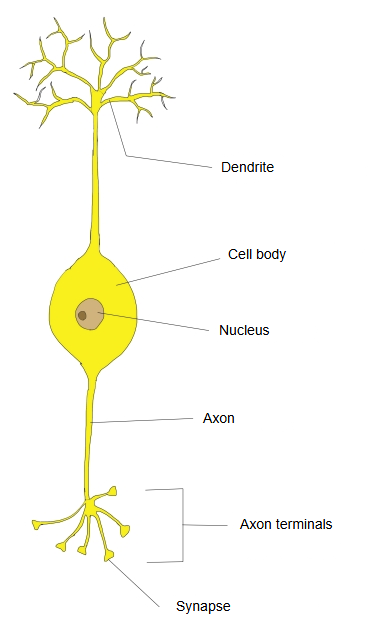
A neuron can be divided into the cell body, which holds the organelles (the nucleus, mitochondria and others), and the processes that project from it.
of a
neuron
- Cell body : the enlarged part holding the nucleus, mitochondria and other organelles.
- Processes
- Dendrites : short processes that receive information from other cells; as a rule several, sometimes only one.
- Axon : one long process that branches at its end into axon terminals and passes the information on; myelinated or unmyelinated.
Classification
· Basic classification by shape (after the English Wikipedia article Neuron):
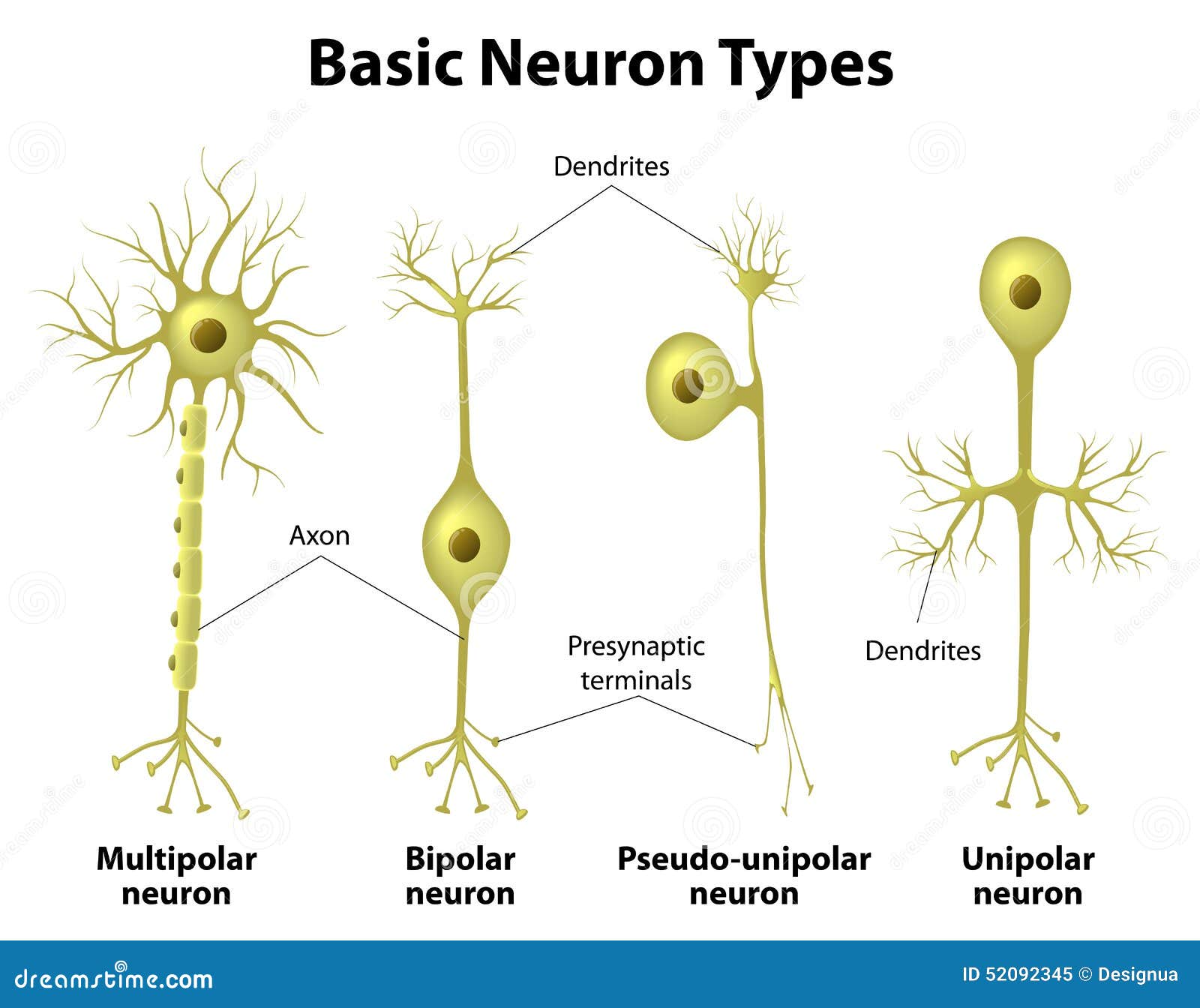
Neurons are classified by the way their processes leave the cell body.
of
neuron
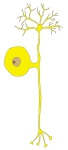
- Unipolar neuron : one process leaves the cell body. Found in the central nervous system of invertebrates; true unipolar neurons are rare in humans.
- Bipolar neuron : two processes leave the cell body, one at each pole. Found in the retina, the olfactory epithelium and the cochlear and vestibular ganglia. Share: a few % of all neurons or less.
- Multipolar neuron : many processes (many dendrites and one axon) leave the cell body; more than 99% of the neurons of the central nervous system. Found in the cerebral cortex, the spinal cord and the autonomic ganglia. Share: over 90% of all neurons.
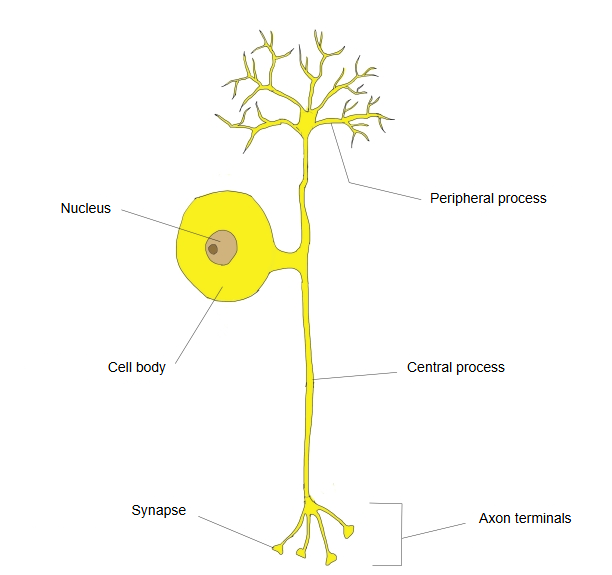
- Pseudounipolar neuron : one process leaves the cell body and divides in two (a peripheral and a central process); the signal can bypass the cell body. Found in the spinal ganglia and the sensory ganglia of the cranial nerves. Share: a few % of all neurons or less.
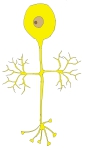 Unipolar neuron
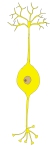 Bipolar neuron
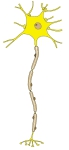 Multipolar neuron
 Pseudounipolar neuron
Reference websites
[Wikipedia]
· Neuron, Wikipedia.
[Websites with illustrations]
· Multipolar neuron (illustration) (learnzoology)

· Four types of neuron (illustration) (Dreamstime)
· Inside the cell body of a neuron (illustration) (Wikimedia Commons)

· Four types of neuron (illustration) (learnzoology)

Related terms
- Tissue
- Central process
- Multipolar neuron
- Unipolar neuron
- Mitral cell
- Nervous tissue
- Glial cell
- Cell body
- Dendrite
- Axon
- Synapse
- Pseudounipolar neuron
- Interneuron
References and sources
- Further reading: Neuron, Wikipedia.
- Federative International Programme for Anatomical Terminology (FIPAT). Terminologia Anatomica, 2nd ed. (TA2), 2019.