Central process
Also called the central axon of a sensory neuron or the central branch
The central process is one of the two branches into which the short process from the cell body of a pseudounipolar neuron divides soon after it leaves; it is the shorter branch, running towards the dorsal horn of the spinal cord.
Cell body: lies in the dorsal root ganglion of a spinal nerve (or a sensory ganglion of a cranial nerve, whose central process enters the brainstem)Towards the central nervous systemPseudounipolar neuron: receives signals from the sense organs of the skin and other tissuesThe other branch is the peripheral process
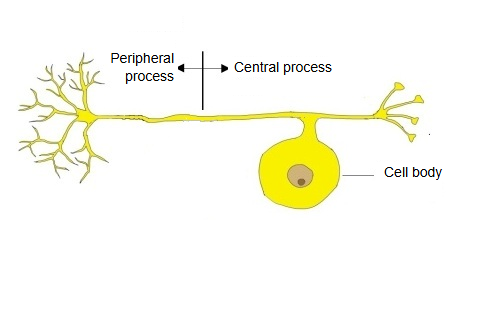
The central process, like the peripheral process, is either myelinated or unmyelinated: when the peripheral process is myelinated (or unmyelinated), so is the central process.
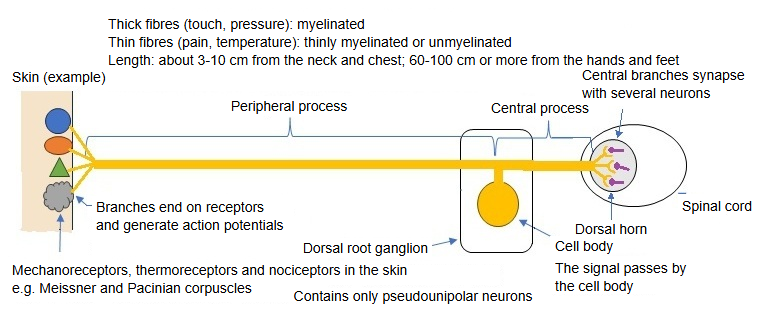
Thick fibres (touch, pressure, muscle stretch): myelinated; thin fibres (pain, temperature): thinly myelinated or unmyelinated
| Kind of sensation | Peripheral process | Fibre class | Examples of receptors |
|---|---|---|---|
| Touch (fine touch, vibration, pressure, position sense of the skin) | Myelinated | Aβ | Meissner corpuscles, Merkel discs, Pacinian corpuscles, Ruffini endings |
| Stretch and tension of muscle (deep sensation) | Myelinated | Aα (Ia, Ib), Aβ | Muscle spindles, Golgi tendon organs |
| Sharp pain, cold | Myelinated (thin) | Aδ | Free nerve endings |
| Dull pain, warmth | Unmyelinated | C | Free nerve endings |
The central process is much shorter than the peripheral process; it is shortest at upper cervical levels and longest for the lower sacral and coccygeal roots, which descend in the cauda equina.
Sources differ on the figures
In a pseudounipolar neuron, the place where the action potential is generated lies near the ending of the peripheral process, not next to the cell body; the central process only carries the impulse on to the centre. In this the neuron differs from most other neurons.
In multipolar and bipolar neurons it arises at the axon hillock (initial segment), between the cell body and the axonLike the peripheral process, the central process is structurally an axon; the two are often regarded as one axon divided into two branches
Signal pathway
Information from the receptors in the skin and muscles is turned into action potentials close to the ending of the peripheral process;
in the spinal (dorsal root) ganglion it passes the cell body without a synapse and continues into the central process, which then runs through the dorsal root;
in the dorsal horn of the spinal cord it forms synapses with second-order neurons. Many touch and position fibres also send a branch up the dorsal column to the medulla oblongata, and others take part in spinal reflexes.
Signal pathway
Receptor
Receptormechanical, thermal or chemical stimulus
Receptor potential
End of the peripheral process
Action potential
Impulse-generating zone
Central process
Dorsal root ganglionthen the dorsal root
Spinal cord
Dorsal horn
From the receptor to the spinal cord
Skin, muscle, etc.
Receptorsthe endings of the peripheral process are in contact with the receptors (no real gap) and pick up mechanical, thermal and chemical signals
Receptor potential
End of the peripheral processmechanically, thermally or chemically gated ion channels respond to the stimulus
Action potential
Impulse-generating zonea little nearer the centre; a receptor potential above threshold is turned into action potentials by voltage-gated ion channels
Action potential
Dorsal root ganglionholds the cell bodies of the pseudounipolar neurons; the signal passes the cell body
Central process
Spinal cordsynapse in the dorsal horn
Organs and tissues where pseudounipolar neurons pick up signals
| Organ / tissue | Stimuli sensed | Examples of receptors | |
|---|---|---|---|
| 1 | Skin | Touch, pain, temperature | Pacinian corpuscles, Meissner corpuscles, free nerve endings, TRP channels |
| 2 | Skeletal muscle | Stretch and contraction of the muscle, pain | Muscle spindles (Ia fibres), nociceptors |
| 3 | Joints | Joint angle, pressure, pain | Receptors in the joint capsule, free nerve endings |
| 4 | Tendons | Muscle tension | Golgi tendon organs (Ib fibres) |
| 5 | Periosteum | Pain, pressure | Free nerve endings |
| 6 | Internal organs | Distension, pain, chemical stimuli | Free nerve endings (visceral afferent fibres) |
| 7 | Blood vessels | Blood pressure, blood flow, chemical stimuli | Baroreceptors and chemoreceptors (carotid sinus, carotid body) |
Related terms
- Neuron
- Multipolar neuron
- Peripheral process
- Pseudounipolar neuron
- Dorsal root ganglion
- Spinal ganglion
- Spinal cord
- Primary afferent fibers
- Axon
References and sources
- Further reading: Pseudounipolar neuron, Wikipedia.
- Further reading: Dorsal root of spinal nerve, Wikipedia.
- Federative International Programme for Anatomical Terminology (FIPAT). Terminologia Anatomica, 2nd ed. (TA2), 2019.