Saltatory conduction
Saltatory conduction is the way an electrical signal is conducted along a myelinated nerve fibre; it is 10 to several hundred times faster than other ways.
Myelinated nerve fibre: a nerve fibre with a myelin sheathOther ways: the continuous conduction of unmyelinated nerve fibres
Saltatory conduction comes from the interplay of the myelin sheath and the nodes of Ranvier between its segments.
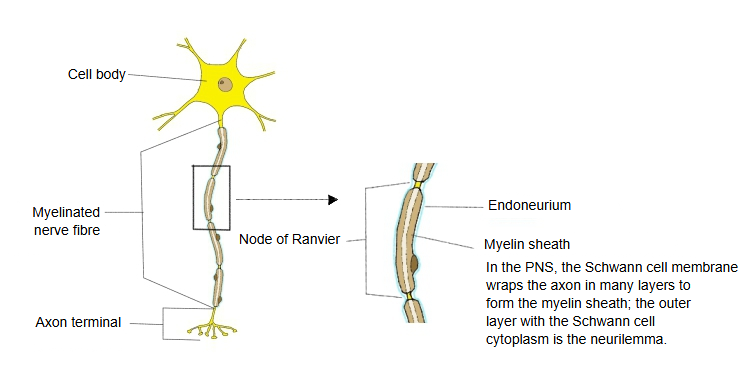
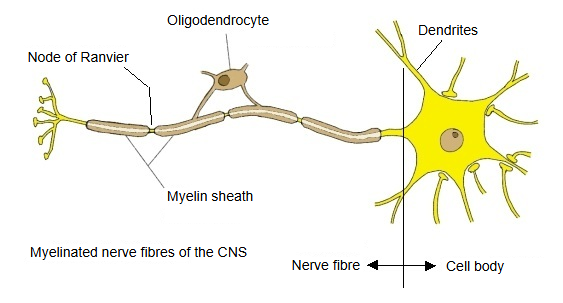
Myelin sheath: two kinds of glial cells wrapped round the axon: oligodendrocytes in the central nervous system and Schwann cells in the peripheral nervous system
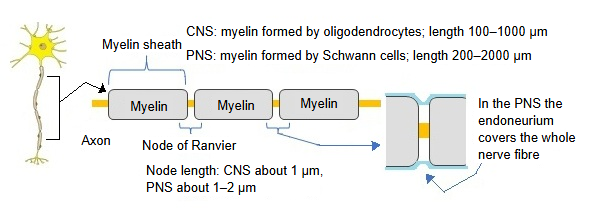
| Myelin sheath | + Node of Ranvier | ⇒ Saltatory conduction |
|---|---|---|
| · An insulator: a stack of fatty membranes. · The axon under the myelin has almost no ion channels. = ions cannot pass in or out = the electrical signal hardly leaks away ⇒ fast conduction. | · Voltage-gated ion channels (sodium and potassium channels) are packed densely here. · The action potential (electrical signal) is generated here. | · When the nerve is stimulated, the sodium channels open, sodium ions flow in and the membrane potential changes (= an action potential). · This electrical change passes quickly under the myelin to the next node of Ranvier, which fires in turn. · Conduction is roughly 10 to several hundred times faster than in an unmyelinated fibre, and uses less energy. |
· Even with saltatory conduction, the speed of the signal differs with the type of nerve fibre.
The thicker the axon, the faster the conduction. Some typical examples:
| Myelinated | ||
| Type of nerve fibre | Example | Conduction speed |
| Aα fibres (myelinated) | Motor nerves to skeletal muscle | about 80–120 m/s |
| Aδ fibres (myelinated) | Pain (sharp pain) | about 5–35 m/s |
| Unmyelinated | ||
| C fibres | Pain (dull pain) | about 0.5–2 m/s |
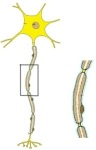 Myelinated nerve fibre of a peripheral nerve
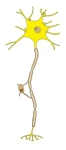 Myelinated nerve fibre of the central nervous system
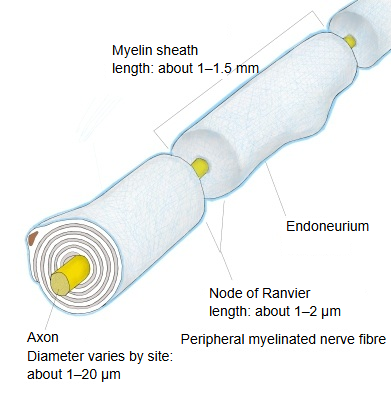
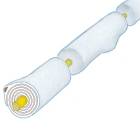 Myelin sheath of a peripheral nerve (with the endoneurium)
Related terms
- Node of Ranvier
- Myelinated nerve fibre
- Unmyelinated nerve fibre
- Axon
- Nerve fibre
- Schwann cell
- Endoneurium
References and sources
- Further reading: Saltatory conduction, Wikipedia.
- Federative International Programme for Anatomical Terminology (FIPAT). Terminologia Anatomica, 2nd ed. (TA2), 2019.