Tendinous adductor canal
Also called: tendinous part of the adductor canal
The tendinous adductor canal is the lower part of the adductor canal, the part covered by the vastoadductor membrane.
Adductor canal: the passage that leads the femoral artery, femoral vein and a nerve (saphenous nerve) down from the femoral triangle towards the adductor hiatus; the nerve leaves the canal before the hiatus
· The name is used in some textbooks, but it is rarely found elsewhere; it is not part of Terminologia Anatomica.
Adductor
canal
canal
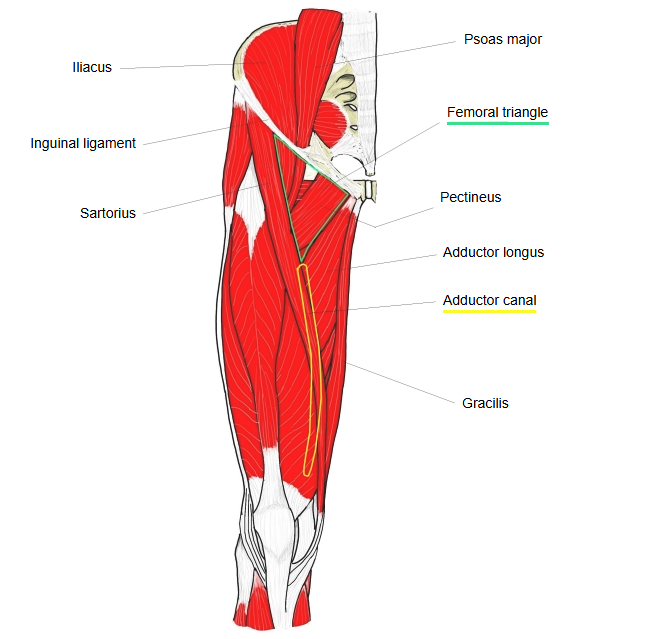
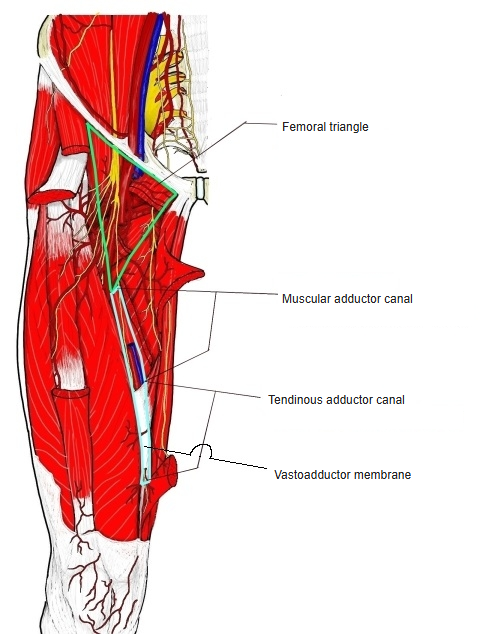
- Muscular part : the upper part, bounded by adductor longus, vastus medialis and sartorius
- Tendinous part : the lower part, covered by the vastoadductor membrane
In the tendinous part the vastoadductor membrane stretches from the tendon of adductor magnus to vastus medialis and forms the anterior wall, with sartorius lying on it. The femoral artery and femoral vein run through it to the adductor hiatus, where they pass to the back of the knee.
 Right thigh muscles (anterior)
 Muscular and tendinous parts of the adductor canal
Related terms
- Adductor canal
- Femoral triangle
- Adductor magnus
- Vastus medialis
- Sartorius
- Femoral artery
- Femoral vein
References and sources
- Further reading: Adductor canal, Wikipedia.
- Further reading: Adductor hiatus, Wikipedia.
- Federative International Programme for Anatomical Terminology (FIPAT). Terminologia Anatomica, 2nd ed. (TA2), 2019.