Intra-ocular muscles
Also called: intrinsic muscles of the eye
ocular
muscles
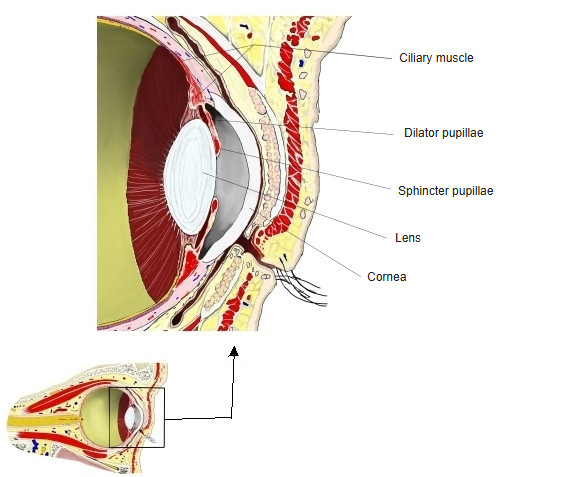
- Ciliary muscle : surrounds the lens and adjusts its thickness
- Sphincter pupillae : runs in a ring in the iris and narrows the pupil (a muscle of the iris)
- Dilator pupillae : runs radially in the outer part of the iris and widens the pupil (a muscle of the iris)
The ciliary muscle lies in the ciliary body; by changing the shape of the lens it focuses the eye for near and far vision (accommodation). The sphincter and dilator pupillae are the muscles of the iris. All three are controlled by the autonomic nervous system: the ciliary muscle and the sphincter pupillae by parasympathetic fibres relayed in the ciliary ganglion, the dilator pupillae by sympathetic fibres.
Some sources divide the ocular muscles broadly into the intra-ocular muscles and the extra-ocular muscles, but others do not count the intra-ocular muscles among the "ocular muscles" at all, probably because they are smooth muscle.
Below are the "ocular muscles" in that narrower sense; some sources also leave out the last one, the levator palpebrae superioris.
- Recti : superior rectus, inferior rectus, medial rectus, lateral rectus: they move the eyeball
- Obliques : superior oblique, inferior oblique: they move the eyeball
- Levator palpebrae superioris : raises the upper eyelid
- Nerve supply : oculomotor nerve: superior, inferior and medial rectus, inferior oblique and levator palpebrae superioris; trochlear nerve: superior oblique; abducens nerve: lateral rectus
The following classification, on the other hand, divides the ocular muscles broadly into the extra-ocular muscles (striated muscle) and the intra-ocular muscles (smooth muscle).
muscles (9)
- Extra-ocular muscles (6)
- Recti : superior rectus, inferior rectus, medial rectus, lateral rectus
- Obliques : superior oblique, inferior oblique
- Intra-ocular muscles (3) : ciliary muscle, sphincter pupillae, dilator pupillae
- Other muscles in the orbit : levator palpebrae superioris, orbitalis, superior tarsal muscle, inferior tarsal muscle
Related terms
References and sources
- Further reading: Intrinsic eye muscles, Wikipedia.
- Federative International Programme for Anatomical Terminology (FIPAT). Terminologia Anatomica, 2nd ed. (TA2), 2019.