Tympanic canaliculus (Latin: canaliculus tympanicus)
Also called the tympanic nerve canaliculus.
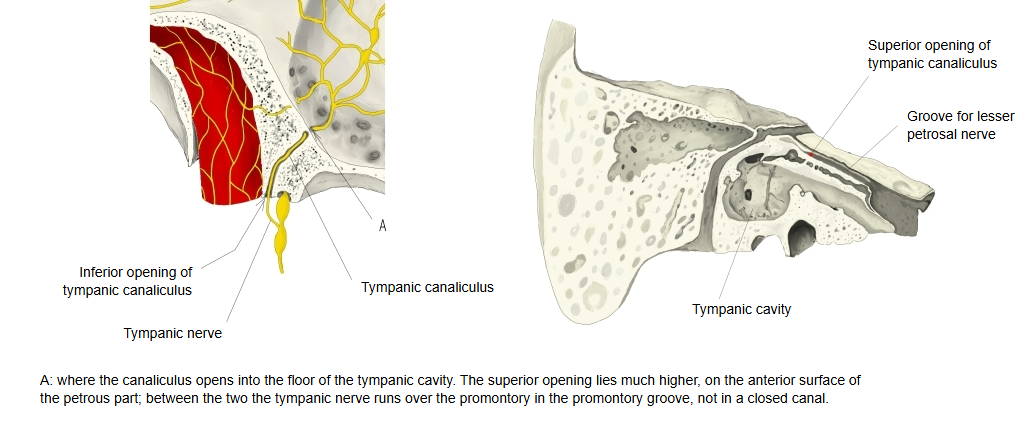
It is the passage of the tympanic nerve, a branch of the glossopharyngeal nerve, and opens as a small hole in the petrous fossula. It begins at the inferior opening of the tympanic canaliculus. After entering the tympanic cavity, the nerve runs upwards in the groove of promontory on the medial wall, where it forms the tympanic plexus; its continuation, the lesser petrosal nerve, then pierces the roof of the cavity and runs on in the groove for the lesser petrosal nerve. That exit is the superior opening of the tympanic canaliculus.
· It is sometimes called the tympanic nerve canaliculus.
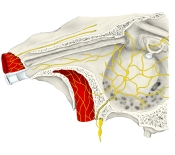 Left tympanic cavity (anterolateral view)
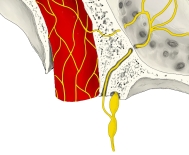 Tympanic canaliculus (enlarged)
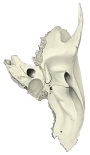 Left temporal bone, inferior view
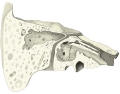 Section of the right tympanic cavity
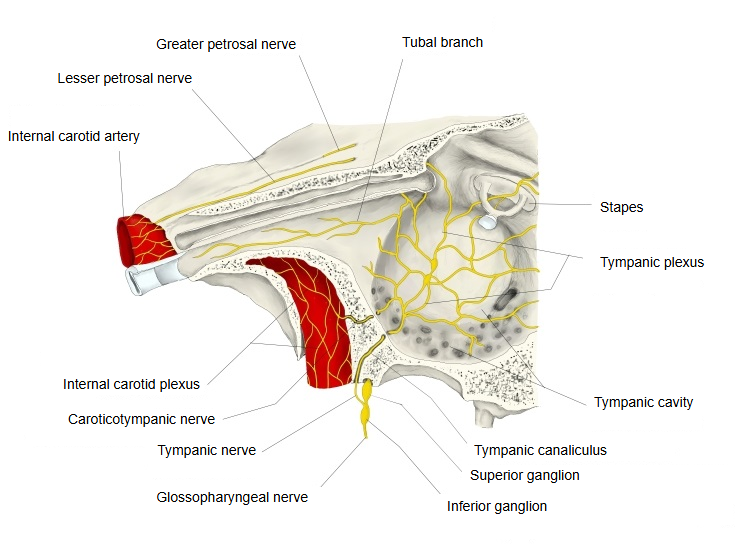
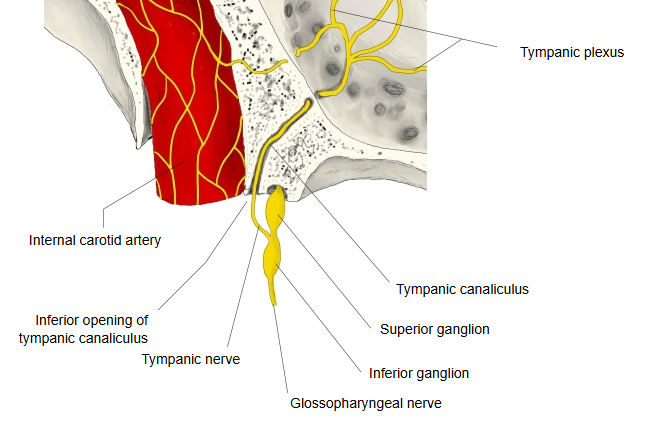
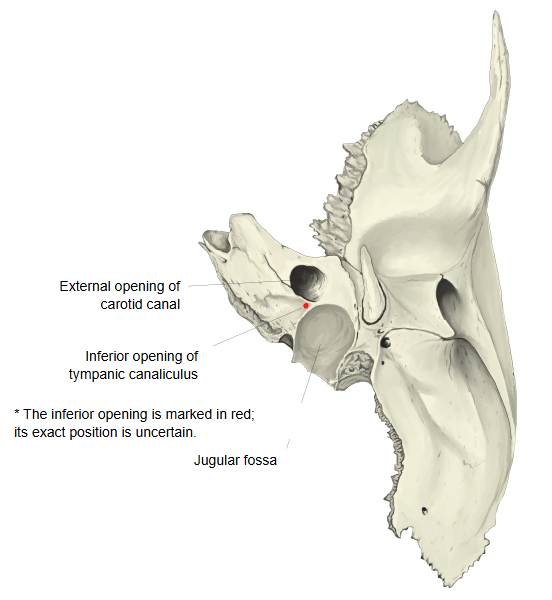
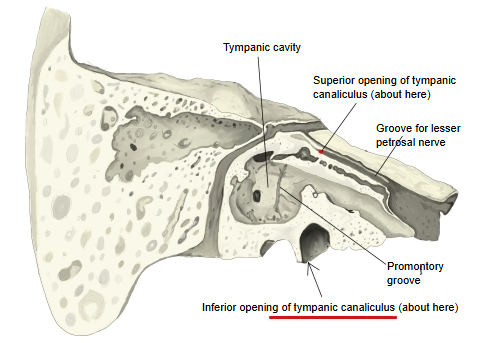
The opening of the canaliculus in the petrous fossula is called the inferior opening of the tympanic canaliculus.
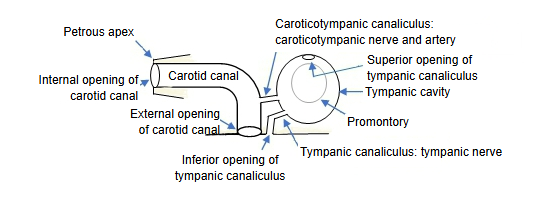
 Left temporal bone (around the jugular fossa)
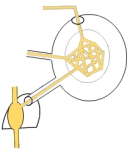 Tympanic nerve and plexus (diagram)
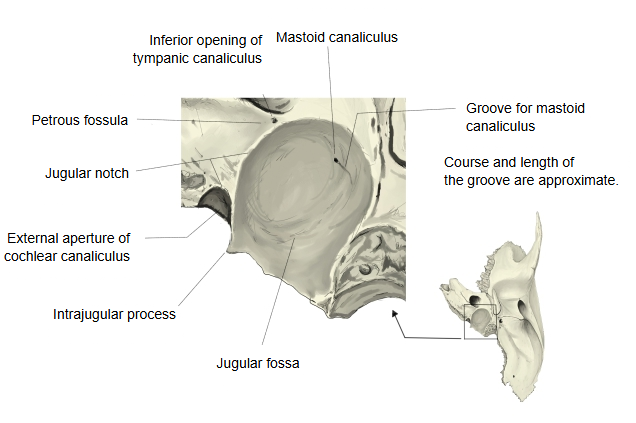
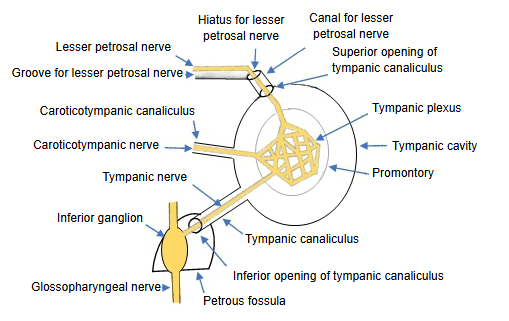
It is a minute canal that passes from the inferior surface of the petrous part, between the jugular fossa and the carotid canal, to the floor of the tympanic cavity. It lies in the wedge of bone that separates the jugular fossa from the carotid canal and carries the tympanic branch of the glossopharyngeal nerve. Close to it, the caroticotympanic canaliculi lead from the carotid canal into the tympanic cavity.
Note: a "canaliculus" should be a tube. But when the superior opening, which leads into the groove for the lesser petrosal nerve, is counted as one of its openings, the tympanic canaliculus would run from the inferior opening, where the tympanic nerve enters, all the way to the superior opening. The bony tube itself, however, does not seem to reach that far: between the floor and the roof of the tympanic cavity the nerve runs over the promontory, not in a closed canal.
Reference websites
[Wikipedia]
· Tympanic canaliculus, Wikipedia.
· Tympanic nerve, Wikipedia.
[Websites with illustrations]
· Left temporal bone, inferior surface (Gray's Anatomy, fig. 141) (Wikimedia Commons)

· Photograph of the skull base around the carotid canal and jugular fossa (Medscape)

Related terms
- Inferior opening of tympanic canaliculus
- Superior opening of tympanic canaliculus
- Petrous fossula
- Tympanic plexus
- Groove of promontory
- Caroticotympanic canaliculi
- Tympanic nerve
References and sources
- Further reading: Tympanic canaliculus, Wikipedia.
- Further reading: Tympanic nerve, Wikipedia.
- Federative International Programme for Anatomical Terminology (FIPAT). Terminologia Anatomica, 2nd ed. (TA2), 2019.