Iliococcygeus (Latin: musculus iliococcygeus)
- Overview
- Illustrations
- Origin / insertion
- Action
- Nerve / blood supply
- Reference websites
- (Wikipedia, websites with illustrations)
- Related terms
Overview
- Back (21)
- Thorax (11)
- Abdomen (6)
- Pelvis (4)
- Levator ani (1) : parts: pubococcygeus, puborectalis, iliococcygeus
- Coccygeal muscles (3)
- Perineum (10)
· A thin, fan-shaped sheet: the widest and most lateral part of the levator ani. With the other parts it forms much of the pelvic floor, holds up the pelvic organs like a hammock and helps to keep the rectum closed.
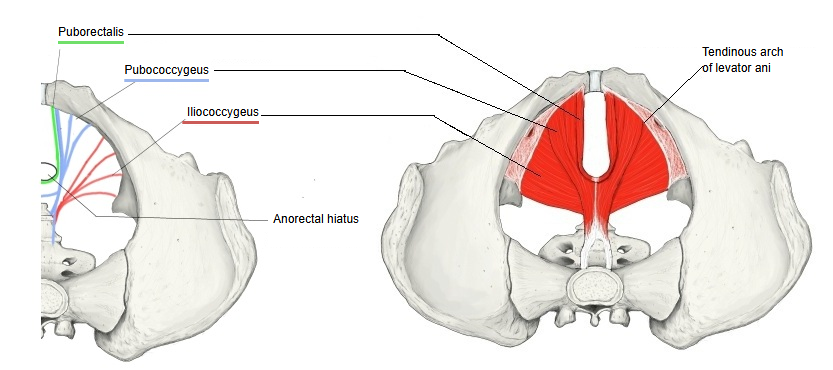
⇒ Classification of the muscles of the perineum
Illustrations
More figures: Multi-muscle illustrations: Abdomen and perineum · Muscles of the trunk (list)
Origin / insertion
[Origin] : the tendinous arch of the levator ani from its back part, and the ischial spine.
Tendinous arch of the levator ani : a line-like thickening of the obturator fascia on the side wall of the pelvis.
[Insertion] : the last two segments of the coccyx (coccygeal vertebrae) and the anococcygeal body, where the fibres of the two sides meet.
Action
With the rest of the levator ani it supports the pelvic organs and resists rises in pressure in the abdomen (as in coughing or straining); it raises the pelvic floor.
Nerve / blood supply
· Nerve : nerve to the levator ani (mainly S4, sometimes also S3 or S5), which runs on the pelvic (upper) surface of the muscle and enters it from above. Sources differ on an additional supply from the pudendal nerve (inferior rectal nerves).
· Arteries : branches of the internal iliac artery: the inferior gluteal artery, the internal pudendal artery and the inferior vesical artery.
· Veins : follow the arteries to the internal iliac vein (internal pudendal vein).
Reference websites
[Wikipedia]
· Iliococcygeus, Wikipedia.
[Websites with illustrations]
· Levator ani (Kenhub)
Related terms
- Pelvic diaphragm
- Pelvic floor
- Tendinous arch of levator ani
- Obturator fascia
- Anococcygeal body
- Levator ani
- Pubococcygeus
- Puborectalis
- Coccygeus
- Nerve to the levator ani
References and sources
- FIPAT. Terminologia Anatomica, 2nd ed. (TA2), 2019: musculus iliococcygeus.
- Iliococcygeus, Wikipedia.