Reference Lines and Planes of the Human Body
Reference lines
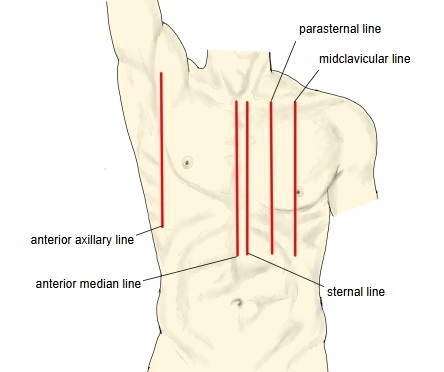
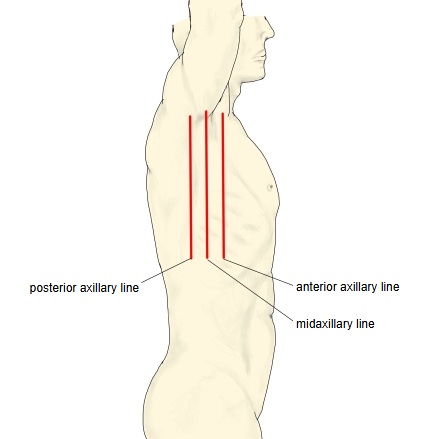
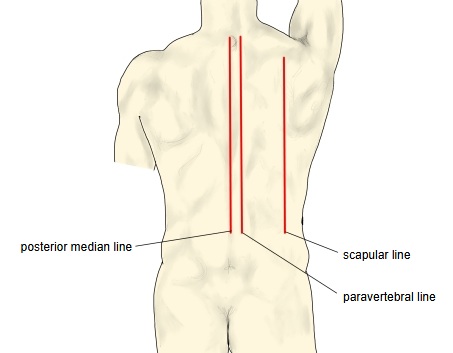
Vertical reference lines on the trunk. They are used to describe the position of structures and findings on the surface of the chest and back.
| No. | Line | Description |
|---|---|---|
| 1 | anterior median line | The line through the middle of the sternum |
| 2 | sternal line | The line along the lateral margin of the sternum |
| 3 | parasternal line | The line midway between the sternal line and the midclavicular line |
| 4 | midclavicular line | The line through the midpoint of the clavicle |
| 5 | anterior axillary line | The line along the anterior axillary fold (formed by the pectoralis major) |
| 6 | midaxillary line | The line midway between the anterior and posterior axillary lines |
| 7 | posterior axillary line | The line along the posterior axillary fold (formed by the latissimus dorsi) |
| 8 | posterior median line | The line through the spinous processes of the vertebrae |
| 9 | paravertebral line | The line at the level of the transverse processes of the vertebrae |
| 10 | scapular line | The line through the inferior angle of the scapula |
Planes
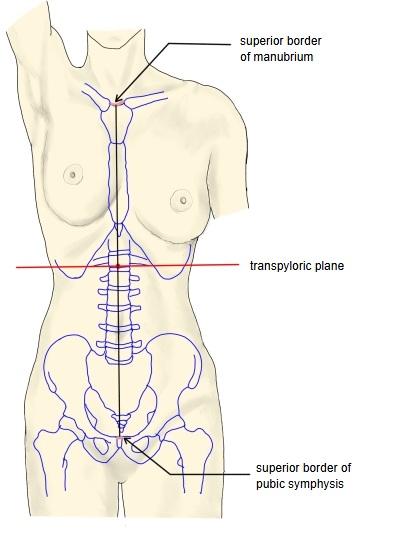
Standard horizontal planes through the abdominal cavity.
| No. | Plane | Description |
|---|---|---|
| 1 | transpyloric plane | The plane midway between the superior border of the manubrium of the sternum and the superior border of the pubic symphysis |
| 2 | subcostal plane | The plane through the lowest point of the costal margin |
| 3 | supracrestal plane | The plane through the highest points of the iliac crests |
| 4 | intertubercular plane | The plane at the level of the tubercles of the iliac crests (hip bone) |
| 5 | interspinous plane | The plane at the level of the anterior superior iliac spines |
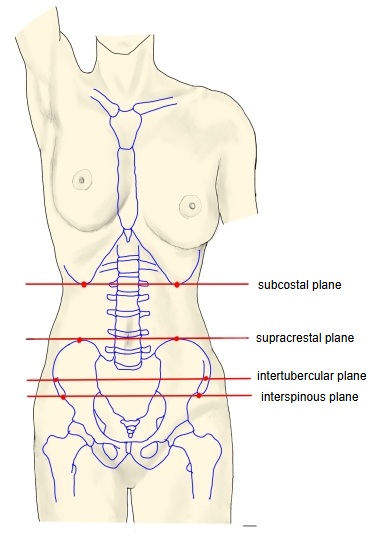
Landmarks on the back
The spinous processes of the vertebrae serve as landmarks on the back of the body.
| No. | Landmark | How to find it | Figure |
|---|---|---|---|
| 1 | Spinous process of the 7th cervical vertebra (vertebra prominens) | The prominence at the base of the neck; easy to see and to feel | 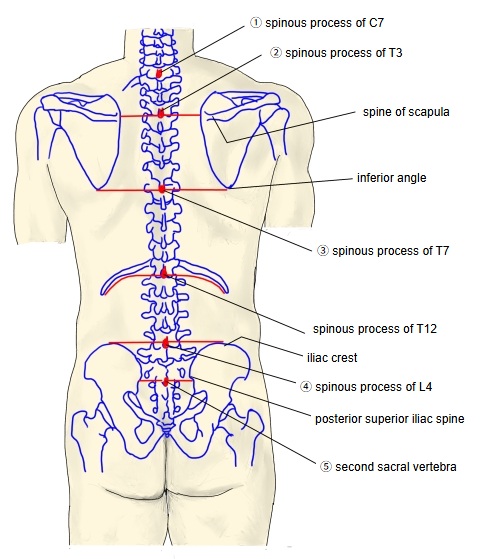 |
| 2 | Spinous process of the 3rd thoracic vertebra | At the level of the line joining the right and left spines of the scapulae | |
| 3 | Spinous process of the 7th thoracic vertebra | At the level of the line joining the right and left inferior angles of the scapulae | |
| 4 | Spinous process of the 12th thoracic vertebra | Just below the 12th rib | |
| 5 | Spinous process of the 4th lumbar vertebra | At the level of the line joining the highest points of the right and left iliac crests | |
| 6 | Median sacral crest (spinous process of the 2nd sacral vertebra before fusion) | At the level of the line joining the right and left posterior superior iliac spines |