Adrenaline
Also called the epinephrine
· In the United States it is called epinephrine, the name also used for the drug.
[Synthesis]
Adrenaline is made from noradrenaline, which in turn is made, by the action of enzymes, from tyrosine (one of the amino acids).
Enzymes act at each step.
[As a hormone]
It is secreted into the blood from the medulla of the suprarenal gland, the inner part surrounded by the cortex, and is carried to its target organs.
[As a neurotransmitter]
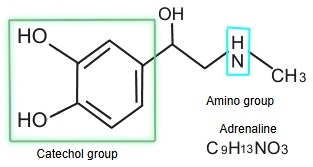
Adrenaline is a monoamine neurotransmitter, with one amino group, and also a catecholamine neurotransmitter, with a catechol group.
- Serotonin
- Histamine
- Catecholamine neurotransmitters
- Dopamine
- Noradrenaline
- Adrenaline
* It is not certain that this list includes every monoamine neurotransmitter.
[Function]
Adrenaline is called the hormone of "fight or flight", the state in which the sympathetic nerves are excited. It causes stress responses in organs throughout the body, the responses needed when an animal must defend itself from an enemy or catch its prey:
· Responses that increase the blood supply to the organs of movement:
· Stronger contraction of heart muscle
· Widening of the blood vessels of the heart, liver and skeletal muscle
· Narrowing of the blood vessels of the skin and mucous membranes
· Reduced movement of the digestive tract
· Responses that make gas exchange in breathing more efficient:
· Relaxation of the smooth muscle of the bronchi
· Responses that raise the sensitivity of the sense organs:
· Widening of the pupils
Related terms
- Noradrenaline
- Dopamine
- Hormone
- Neurotransmitter
- Monoamine neurotransmitters
- Sympathetic nerve fibers
- Endocrine secretion
References and sources
- Further reading: Adrenaline, Wikipedia.
- Federative International Programme for Anatomical Terminology (FIPAT). Terminologia Anatomica, 2nd ed. (TA2), 2019.