Complement
Also called Complement system
Complement is a group of proteins circulating in the blood that forms part of the immune system and acts when invaders such as bacteria and viruses enter the body.
More details
Complement proteins normally circulate in the blood in an inactive form. When bacteria or other invaders enter the body, they are activated in a chain reaction, either by antibodies bound to an antigen or directly by the surface of the microbe, and they strengthen the immune response.
This is the classical pathway. Complement can also be activated without antibodies (see Activation below).
Components
The complement system is made up of more than 50 proteins and protein fragments, including proteins of the blood serum and proteins and receptors bound to cell membranes. Most of them are made in the liver by the hepatocytes, and together they make up about 10% of the globulin fraction of the serum.
The main components are named with C (for complement) and a number, C1 to C9, though some have other names. Fragments are marked with a small letter, as in C1q or C3b, and complexes of several components are written together, as below.
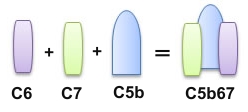
Besides C1 to C9, other proteins such as factor B and factor D, regulators in the blood and regulators and receptors on cell membranes take part in the activation and control of complement. All of these together are called the complement system.
system
- C1–C9 : complement proteins
- Factor B, factor D, etc. : other complement proteins
- Regulators in the blood : factor I, factor H, C4b-binding protein (C4BP), C1 inhibitor, properdin
- Regulators and receptors on cell membranes : CR1, CR2, CD46, CD55
Functions
Complement has several functions; in strengthening the immune response, the following three are the main ones.
| Function | Components involved | |
|---|---|---|
| 1 | Opsonization of the antigen Complement binds to the antigen (for example a bacterium) and makes it easier for phagocytes to engulf it. | C3b, C4b |
| 2 | Destruction of the bacterial cell membrane Complement components join into the membrane attack complex, which opens a pore in the membrane of the target cell; fluid flows in and the cell bursts (lysis). | C5b, C6, C7, C8 and several C9 (C5b-9) |
| 3 | Chemotaxis of neutrophils and other cells Calls neutrophils and other white blood cells to the site of infection; these cells have receptors for complement fragments on their surface. | C5a, C3a |
Activation
There are three pathways that activate the complement system:
| 1 | Classical pathway | Starts when C1 (its C1q part) binds to the Fc part of IgM or IgG antibodies bound to an antigen. |
| 2 | Alternative pathway | Starts from slow, spontaneous activation of C3 in the plasma and is amplified on the surface of microbes; no antibody is needed. |
| 3 | Lectin pathway | Starts when a lectin (mannose-binding lectin) binds sugars on the surface of microbes; no antibody is needed. |
Reference websites
[Wikipedia]
· Complement system, Wikipedia.
Related terms
References and sources
- Further reading: Complement system, Wikipedia.
- Federative International Programme for Anatomical Terminology (FIPAT). Terminologia Anatomica, 2nd ed. (TA2), 2019.