Body fat
The fat present in the body.
More details
In everyday use the term usually means the stored fat (depot fat) under the skin and around the internal organs. Fat is also carried to the cells of the whole body in the bloodstream (blood lipids), and strictly speaking this is body fat too.
- Stored fat (depot fat)
- Subcutaneous fat
- Visceral fat
- Blood lipids
Body fat percentage
The proportion of fat in the body.
There is no universally agreed standard: different authorities recommend different values.
Types
Stored body fat lies in the adipocytes of adipose tissue and is of two kinds: subcutaneous fat, under the skin, and visceral fat, around the internal organs.
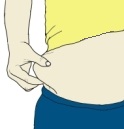
Subcutaneous fat
The fat in the subcutaneous tissue, the layer beneath the skin: the fat that can be pinched.
It is found all over the body but tends to collect on the lower abdomen (hypogastric region), the buttocks (gluteal region) and the upper arms. Women tend to have more of it than men.
Functions and features
1. Maintaining body temperature. It acts as insulation, protecting the body against changes in the outside temperature.
2. Softening physical impact. It acts as a cushion against blows from outside.
3. Storing energy. Surplus nutrients from food are stored as neutral fat and released into the blood when needed. Visceral fat is generally used more readily, which is why subcutaneous fat is often said to be harder to lose.
4. Secreting physiologically active substances. Its secretion of hormones such as estrogen and adiponectin helps to keep the body working normally. See also white adipocyte.
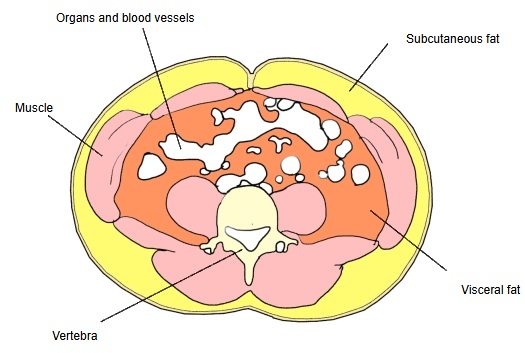
Visceral fat
Whereas subcutaneous fat lies under the skin, visceral fat lies around the internal organs. It collects more easily in men than in women, but tends to increase in women too after the menopause.
Too much visceral fat contributes to lifestyle diseases such as diabetes and dyslipidemia.
Functions and features
1. Protecting the organs. It shields the internal organs from physical and temperature stimuli and helps to keep them in position.
2. Storing energy. As with subcutaneous fat, surplus nutrients are stored as neutral fat and released into the blood when needed. It is generally used more readily than subcutaneous fat, which is why visceral fat is often said to be easier to lose.
3. Secreting physiologically active substances. As with subcutaneous fat.
- Protection : shields the organs and keeps them in position
- Energy storage : stored as neutral fat
- Secretion : physiologically active substances
Too little or too much
Both too much and too little body fat harm the body.
Too little
· Less resistance to cold and heat. A low body temperature in particular weakens immunity and makes infection more likely.
· Less protection from impact. A strong blow may injure the internal organs.
· Sagging of the organs. With too little visceral fat the organs cannot be held in position, as in a low-lying stomach.
· Breakdown of muscle. With little fat to use as fuel, the body breaks down muscle for energy.
· Loss of normal body function. Less secretion of physiologically active substances upsets normal function. In women, hormone imbalance can cause irregular menstruation.
Too much
Subcutaneous fat counts too, but excess visceral fat is the main problem.
It leads to metabolic syndrome, which in time can cause atherosclerosis and life-threatening disease.
Related terms
- Adipose tissue
- Depot fat
- Fat
- Blood lipids
- Adipocyte
- Neutral fat
- Subcutaneous tissue
- Metabolic syndrome
References and sources
- Further reading: Body fat percentage, Wikipedia.
- Further reading: Adipose tissue, Wikipedia.
- Federative International Programme for Anatomical Terminology (FIPAT). Terminologia Anatomica, 2nd ed. (TA2), 2019.