Synovial bursa (Latin: bursa synovialis)
Also called a bursa
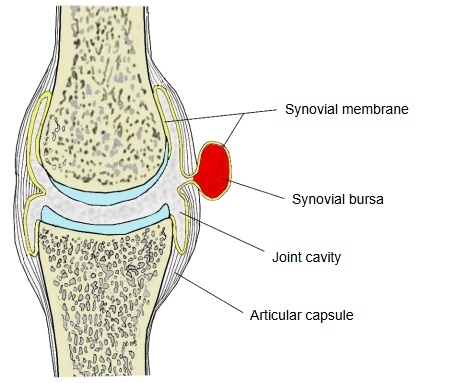
A synovial bursa is a flat sac of connective tissue with the following features. This page covers the bursa in general; see also the synovial bursa of a joint, the communicating synovial bursa and the synovial bursae around the knee joint.
Classification
Bursae can be classified by their form and by their location.
1. By form
- Unilocular bursa : a single cavity.
- Multilocular bursa : a cavity divided into several compartments.
2. By location
Bursae are small flat sacs between muscles or tendons and bones, cartilage or ligaments. Their membrane is the same kind as that of the articular capsule and of the tendon sheath; a tendon sheath is essentially a long bursa wrapped around a tendon. Many lie near muscle attachments and near joints, and some of those near a joint open into its cavity. Subcutaneous bursae in particular are found in only some people and vary widely between individuals.
Reference websites
[Wikipedia]
· Synovial bursa, Wikipedia.
Related terms
- Synovial bursa of joint
- Communicating synovial bursa
- Bursae around the knee joint
- Synovial membrane
- Synovial fluid
- Articular cavity
- Tendon sheath
References and sources
- Further reading: Synovial bursa, Wikipedia.
- Federative International Programme for Anatomical Terminology (FIPAT). Terminologia Anatomica, 2nd ed. (TA2), 2019.