Borders of the scapula (Latin: margines scapulae)
- Superior border
- Note: the suprascapular notch
- Medial border
- Lateral border
- Reference websites
- (Wikipedia, websites with illustrations)
- Where it is found
- Related terms
The scapula has three borders – superior, medial and lateral – which meet at its three angles.
Superior border
of the
scapula
- Medial border : the longest border; it runs almost parallel to the vertebral column.
- Lateral border : runs from the lower angle (inferior angle) up towards the axilla.
- Superior border : runs from the upper angle (superior angle) laterally and downwards.
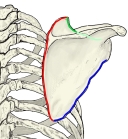 Borders and angles (posterior)
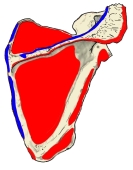 Muscle attachments (posterior)
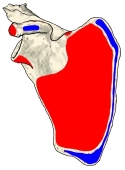 Muscle attachments (anterior)
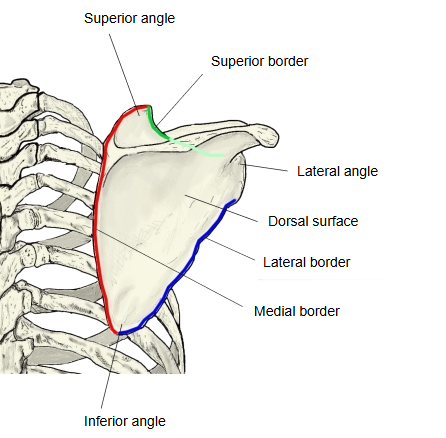
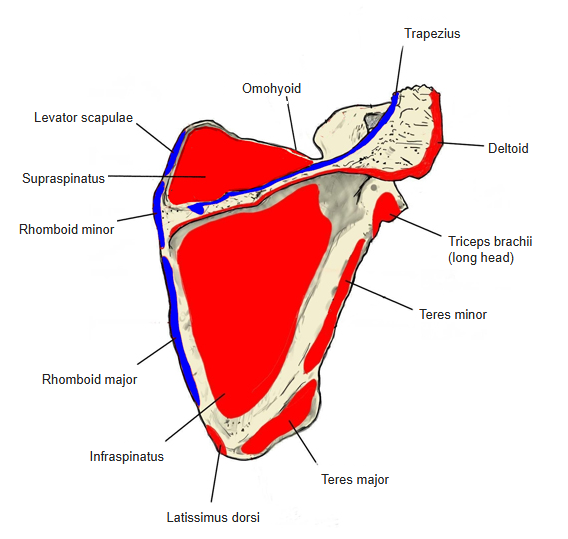
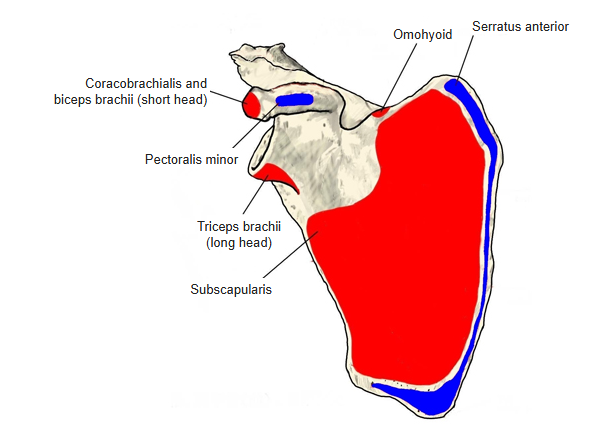
Note: the suprascapular notch
On the superior border, at the base of the coracoid process, lies the suprascapular notch. It is bridged by the superior transverse scapular ligament, and the suprascapular nerve passes beneath it. Sources differ on whether the notch counts as part of the superior border: some illustrations draw the border up to the coracoid process including the notch, others end it at the notch.
Medial border
Also called the vertebral border, it runs from the superior angle down to the inferior angle. Four muscles are attached to it. The serratus anterior is inserted along its whole length on the anterior (costal) lip. Three muscles are inserted on the posterior (dorsal) lip: the levator scapulae above the root of the spine, the rhomboid minor at the root of the spine and the rhomboid major below it.
Lateral border
Also called the axillary border, it is the thickest of the three borders. It begins just below the glenoid cavity at the infraglenoid tubercle, which gives origin to the long head of the triceps brachii, and runs obliquely downwards and backwards to the inferior angle. The teres minor and, lower down, the teres major arise from the dorsal surface along the border, and part of the subscapularis arises in front of it.
Reference websites
[Wikipedia]
· Scapula, Wikipedia.
[Websites with illustrations]
· Superior border of the left scapula (illustration) (Wikimedia Commons)

· Superior border, anterior view (illustration) (Wikimedia Commons)

· The scapula (TeachMeAnatomy)
· Scapula (Kenhub)
Where it is found
Related terms
- Superior angle of scapula
- Inferior angle of scapula
- Lateral angle of scapula
- Suprascapular notch
- Infraglenoid tubercle
- Costal surface of scapula
- Dorsal surface of scapula
References and sources
- Further reading: Scapula, Wikipedia.
- Federative International Programme for Anatomical Terminology (FIPAT). Terminologia Anatomica, 2nd ed. (TA2), 2019.