Neck of femur (Latin: collum femoris)
Also called the femoral neck
The slightly narrowed part of the femur that projects upwards and medially from the shaft of femur, joining the head of femur to the shaft. It is part of the proximal epiphysis.
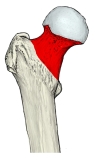 Right femur (upper end, anterior)
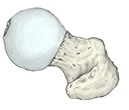 Right femur (upper end, from above)
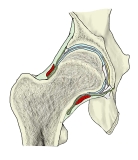 Right hip joint (coronal section)
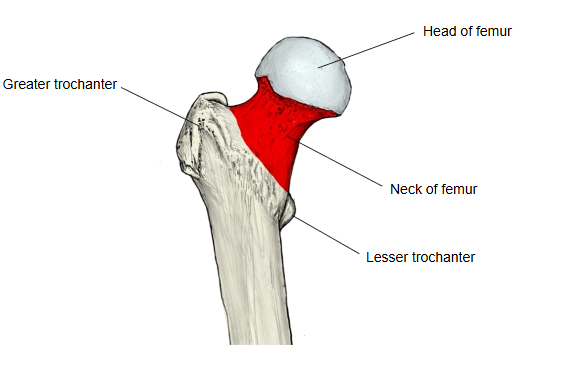
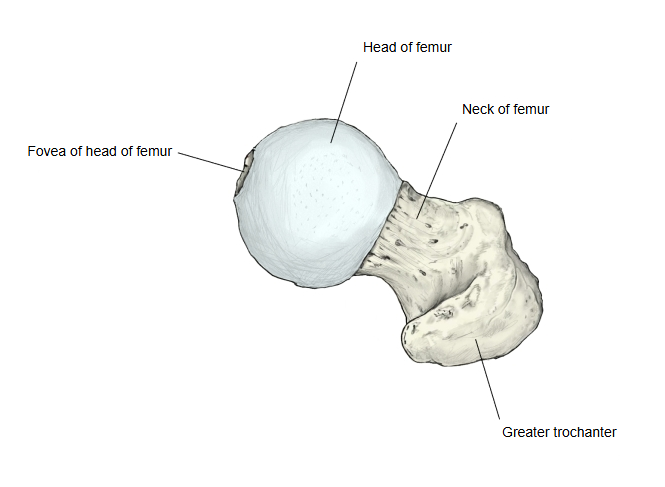
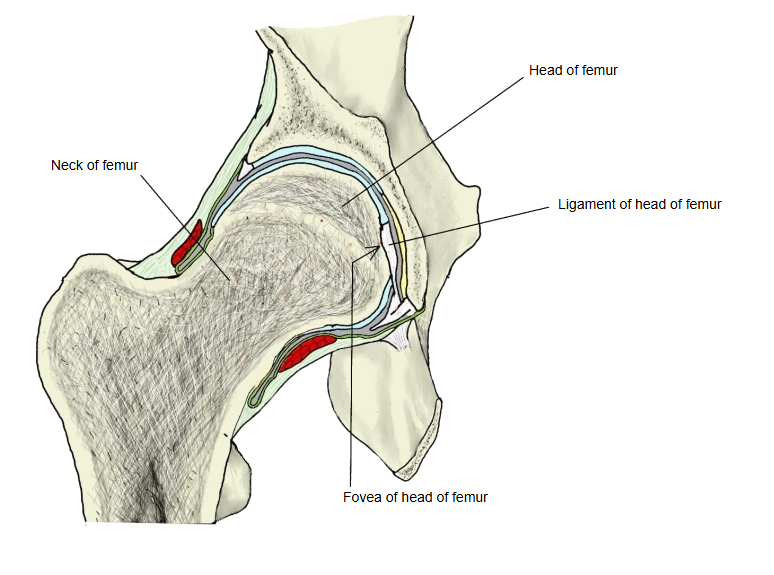
Body weight passes from the head through the neck to the shaft of femur, so the neck carries especially large mechanical loads; its medial (lower) part is loaded most, and the compact bone there is particularly thick. The angle between the neck and the shaft (the neck-shaft angle) changes with age and sex. At birth the angle is about 150 degrees; it becomes smaller during childhood as the pelvis widens, reaching about 125-130 degrees in adults. It is usually smaller in women, whose pelvis is wider and femur shorter. Seen from above, the neck is also turned slightly forwards (the angle of anteversion). The neck is flattened from front to back and widens towards the shaft; it is really the upper end of the shaft bent medially, and it is clearly marked off from the shaft by the greater and lesser trochanters and the intertrochanteric line. Fractures of the femoral neck are common in older people, especially with osteoporosis; the neck lies largely inside the capsule of the hip joint.
[See also]
Neck-shaft angle · Angle of anteversion
Reference websites
[Wikipedia]
· Femoral neck, Wikipedia.
· Hip fracture, Wikipedia.
[Websites with illustrations]
· Upper end of the femur, anterior view (photograph) (Wikimedia Commons)

· Upper end of the femur, posterior view (photograph) (Wikimedia Commons)

· The femur (TeachMeAnatomy)
Where it is found
Related terms
- Head of femur
- Greater trochanter
- Lesser trochanter
- Proximal epiphysis of femur
- Intertrochanteric line
- Shaft of femur
- Hip joint
References and sources
- Further reading: Femoral neck, Wikipedia.
- Further reading: Hip fracture, Wikipedia.
- Federative International Programme for Anatomical Terminology (FIPAT). Terminologia Anatomica, 2nd ed. (TA2), 2019.