Body of sternum (Latin: corpus sterni)
Also called: gladiolus; mesosternum
- Manubrium : the upper part, about a quarter of the sternum; it articulates with the clavicle (sternoclavicular joint).
- Body : between the manubrium and the xiphoid process; about 60% of the sternum.
- Xiphoid process : the cartilaginous process at the lower end; it ossifies in later life.
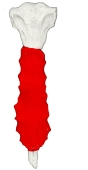 Sternum (anterior)
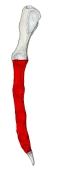 Sternum (left lateral)
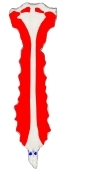 Muscle attachments (anterior)
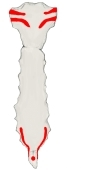 Muscle attachments (posterior)
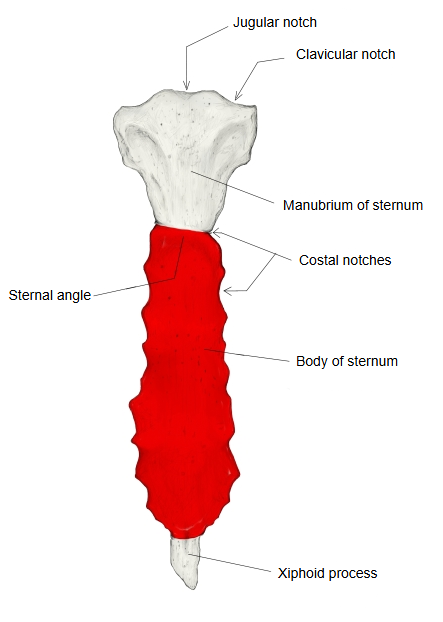
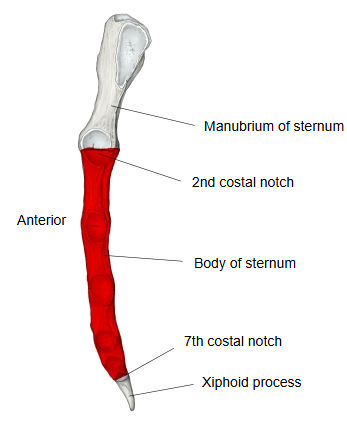
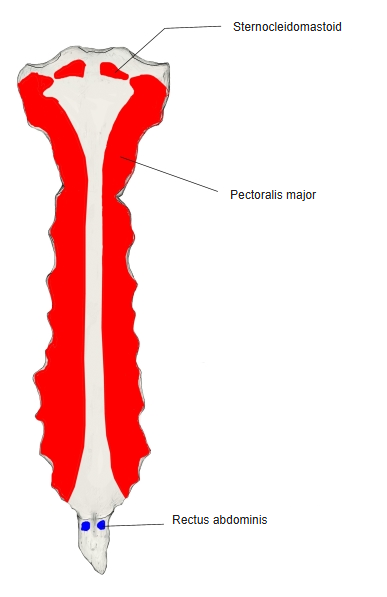
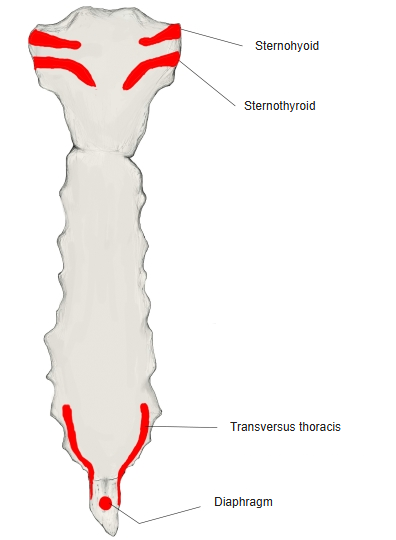
The lower end of the manubrium joins the body at the manubriosternal joint (at the sternal angle). This joint stays cartilaginous for a long time, usually for life, and fuses only in some people in later life; in dried bones of young people the manubrium and the body are therefore separate. The body is the longest part of the sternum, roughly three-fifths of its length. It is oblong; it widens slightly downwards and then narrows quickly near its lower end, where it meets the xiphoid process at the xiphisternal joint. The front is slightly convex and the back slightly concave. It forms from four bony segments (sternebrae) that fuse during childhood and youth; faint transverse ridges on the front mark the lines of fusion. Each lateral border has costal notches for the 2nd to 7th costal cartilages: the notch for the 2nd is shared with the manubrium and that for the 7th with the xiphoid process. Pectoralis major arises from the front on each side and transversus thoracis from the lower part of the back. A hole, the sternal foramen, is occasionally present in the lower part.
Reference websites
[Wikipedia]
· Body of sternum, Wikipedia.
· Sternum, Wikipedia.
[Websites with illustrations]
· The sternum (TeachMeAnatomy)
· Sternum: anatomy, parts and diagram (Kenhub)
· Anterior surface of the sternum and costal cartilages (Gray's Anatomy) (Wikimedia Commons)

Where it is found
Related terms
References and sources
- Further reading: Body of sternum, Wikipedia.
- Further reading: Sternum, Wikipedia.
- Federative International Programme for Anatomical Terminology (FIPAT). Terminologia Anatomica, 2nd ed. (TA2), 2019.