Crista galli (Latin: crista galli)
- Cribriform plate : the horizontal plate in the middle
- Perpendicular plate : the plate that projects downwards from the underside of the cribriform plate
- Ethmoidal labyrinth : the parts on both sides of the perpendicular plate, hanging down from the cribriform plate
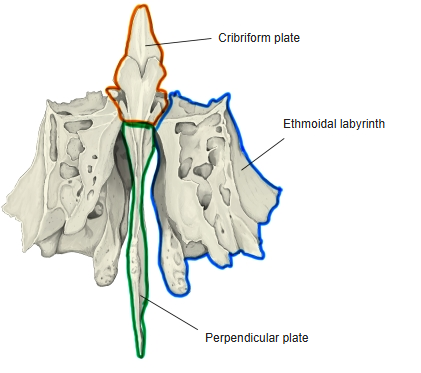
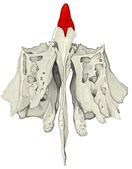 Ethmoid bone (anterior)
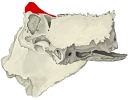 Ethmoid bone (left lateral)
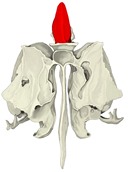 Ethmoid bone (posterior)
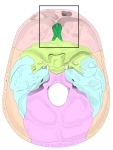 Anterior cranial fossa (from above)
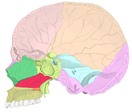 Skull (sagittal section, bones coloured)
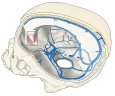 Falx cerebri and dural sinuses
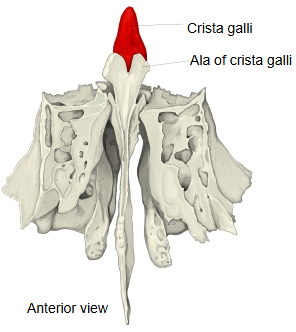
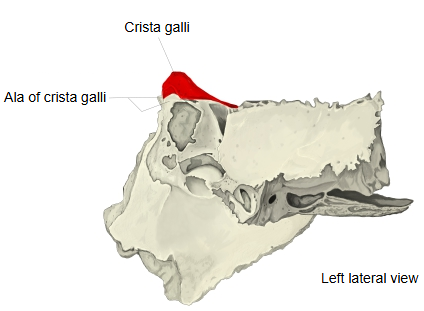
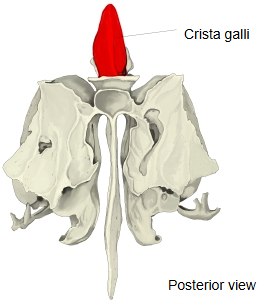
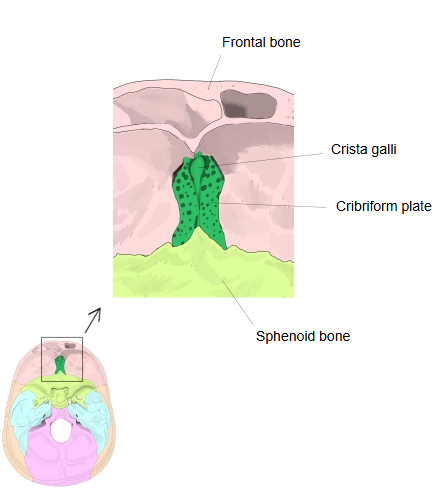
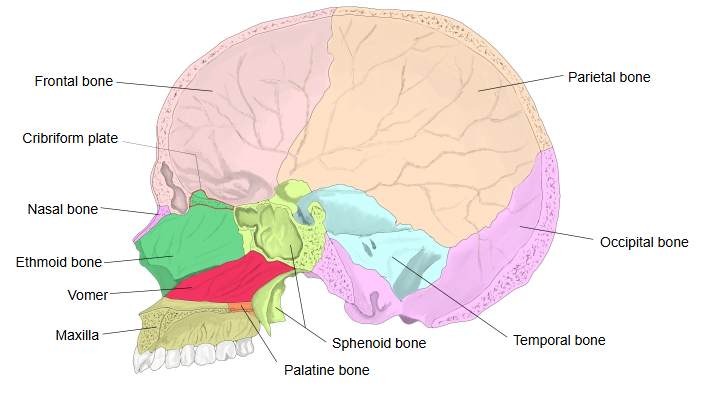
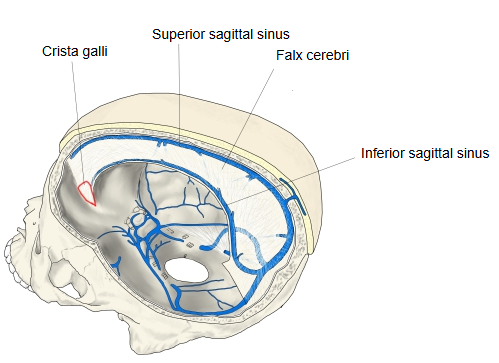
The crista galli is a triangular crest in the midline, standing above the cribriform plate in the anterior cranial fossa; it is the upward continuation of the perpendicular plate. Its name means "cock's comb", from its shape: thick and short in front, sloping and thin behind. The falx cerebri is anchored to its free edge. At its front border the two alae meet the frontal bone and close the foramen caecum. The olfactory bulbs lie on the cribriform plate on each side of it. Its height varies: in some skulls it lies almost wholly above the cribriform plate, in others it extends well below it.
Reference websites
[Wikipedia]
· Crista galli, Wikipedia.
· Ethmoid bone, Wikipedia.
[Websites with illustrations]
· Ethmoid bone from behind (Gray's Anatomy) (Wikimedia Commons)

· Lateral wall of the nasal cavity with the ethmoid bone (Gray's Anatomy) (Wikimedia Commons)

· Crista galli and cribriform plate (video) (Wikimedia Commons)
Where it is found
Related terms
References and sources
- Further reading: Crista galli, Wikipedia.
- Further reading: Ethmoid bone, Wikipedia.
- Federative International Programme for Anatomical Terminology (FIPAT). Terminologia Anatomica, 2nd ed. (TA2), 2019.