Accessory fissure
Also called the accessory fissure of lung or the accessory lobe
The horizontal fissure is found only in the right lung. On the front of the lung it runs almost horizontally along the 4th rib. Normally the right lung therefore has an oblique and a horizontal fissure (three lobes), and the left lung only an oblique fissure (two lobes).
Besides the oblique fissure and the horizontal fissure, an extra, often incomplete accessory fissure may be present, cutting off part of a lobe as an accessory lobe. Common examples are the inferior accessory fissure (cutting off a medial basal part of a lower lobe), the superior accessory fissure (separating the superior segment of a lower lobe) and a left horizontal fissure (a 'left middle lobe'). Another example:
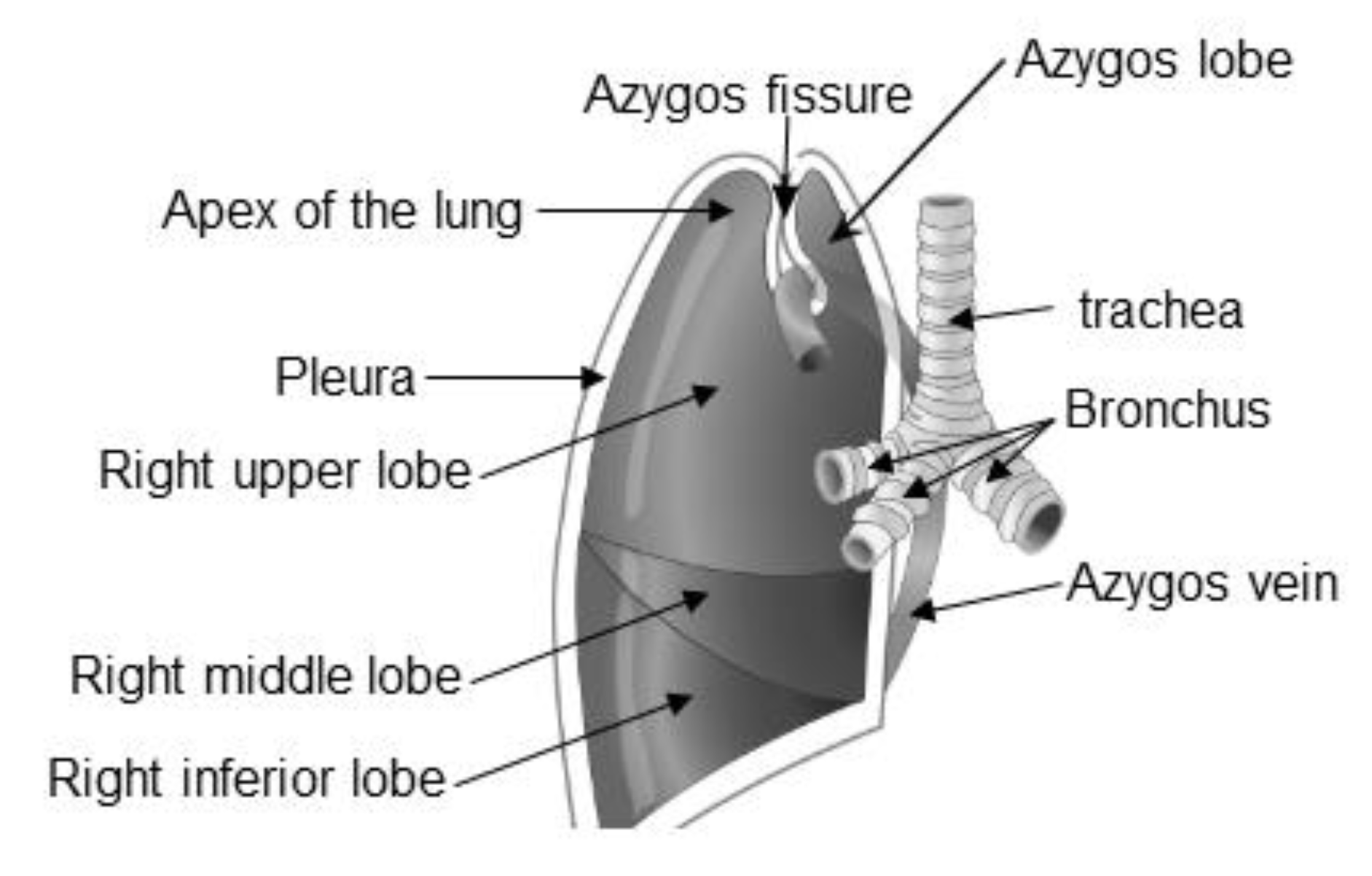
The azygos vein arches forward against the medial surface of the right superior lobe to open into the superior vena cava.
If the vein sinks deeply into the lung, the fold of pleura it drags with it marks off a small lobe, the azygos lobe.
Accessory fissures are developmental variants. They matter mainly when reading chest images, where they can mimic disease.
Reference websites
[Wikipedia]
· Lobes of the lung, Wikipedia.
· Azygos lobe, Wikipedia.
[Websites with illustrations]
· Accessory fissures of the lung (imaging figure) (European Journal of Radiology (Elsevier))

· Azygos lobe (imaging figure) (Diagnostics (MDPI))
Related terms
References and sources
- Further reading: Lobes of the lung, Wikipedia.
- Further reading: Azygos lobe, Wikipedia.
- Federative International Programme for Anatomical Terminology (FIPAT). Terminologia Anatomica, 2nd ed. (TA2), 2019.