Greater palatine foramen (Latin: foramen palatinum majus)
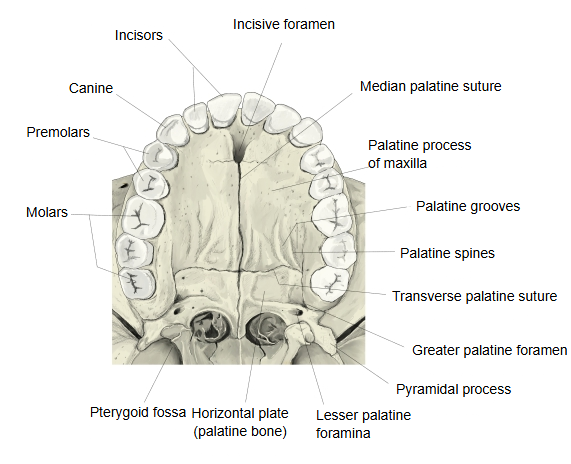
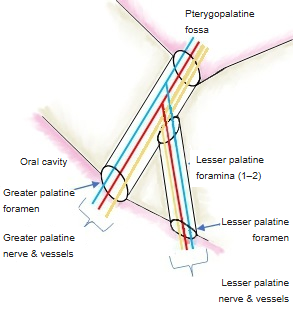
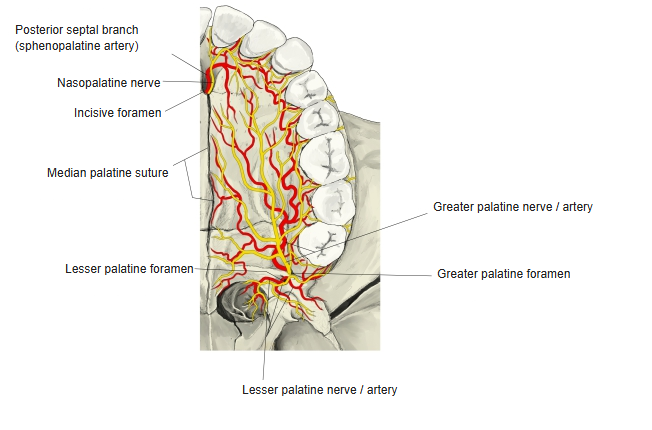
Near the lateral border of the horizontal plate of the palatine bone there is a notch which, together with the alveolar process of the maxilla, forms the greater palatine foramen, usually medial to the third molar. It is the lower opening of the greater palatine canal and transmits the greater palatine nerve and the greater palatine artery and vein, which then run forward in the palatine grooves on the underside of the hard palate. Just behind it, on the root of the pyramidal process, there are usually two small openings, medial and lateral, the lesser palatine foramina, for the lesser palatine nerves and vessels. The foramen is the landmark for the greater palatine nerve block used in dental and palatal surgery.
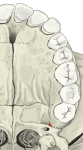 Greater palatine foramen (inferior)
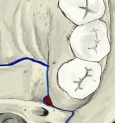 Variation in position
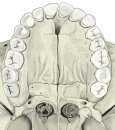 Hard palate (inferior)
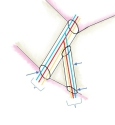 Greater and lesser palatine canals (diagram)
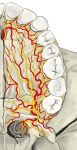 Nerves and arteries of the palate
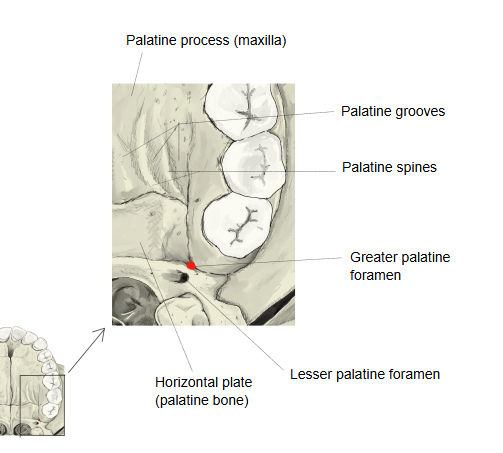
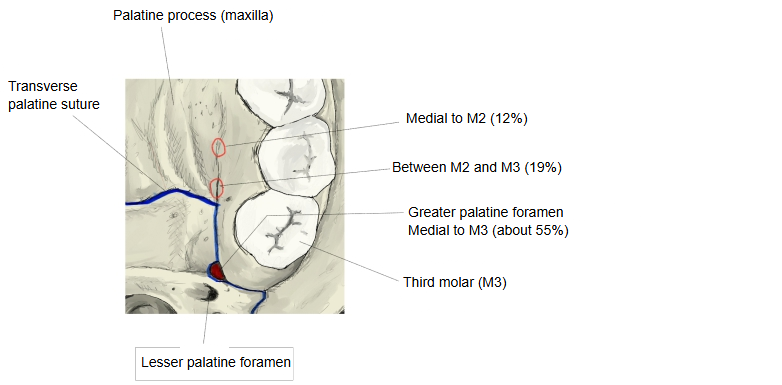
Variations
Its position varies: most often it lies opposite the upper third molar (about half of skulls), less often between the second and third molars, opposite the second molar or behind the third molar (retromolar). Sources differ on the exact proportions. The foramen is usually elongated from front to back; a crescent-shaped foramen is rare.
Related terms
- Greater palatine canal
- Lesser palatine foramina
- Hard palate
- Bony palate
- Pyramidal process
- Palatine grooves
- Transverse palatine suture
References and sources
- Further reading: Greater palatine foramen, Wikipedia.
- Federative International Programme for Anatomical Terminology (FIPAT). Terminologia Anatomica, 2nd ed. (TA2), 2019.