Centrosome
Also called the microtubule-organizing centre (MTOC) or the cell centre
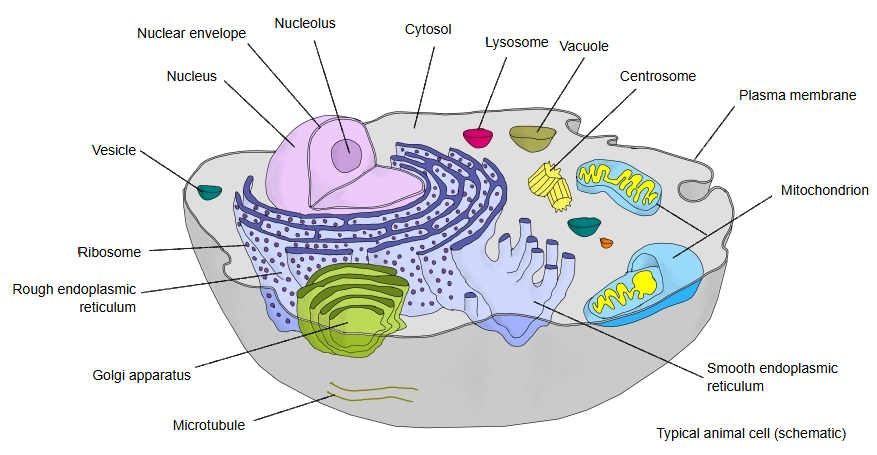
The centrosome is one of the organelles found in each cell of our body: a small structure in the cytoplasm made of a pair of centrioles surrounded by pericentriolar material. It has no membrane of its own, so it is not always counted as an organelle, though like one it has a specific structure and function.
of the
cell
- Cell membrane : phospholipid bilayer, membrane proteins, sugar chains
- Cytoplasm
- Cytosol : water, electrolytes, metabolic enzymes, free amino acids, metabolic intermediates
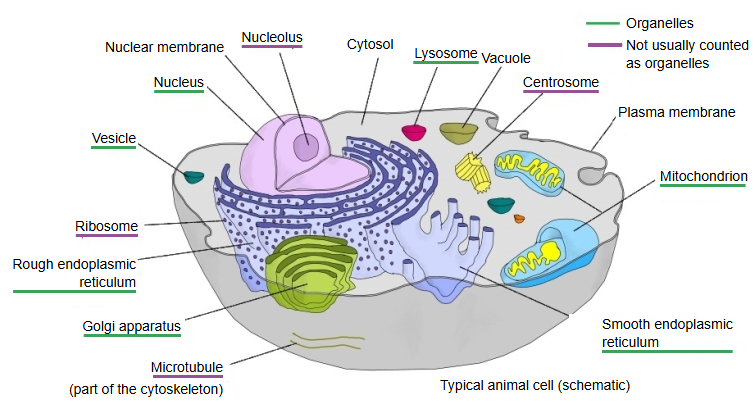
- Organelles : mitochondria, endoplasmic reticulum, centrosome (no membrane), Golgi apparatus, lysosomes, peroxisomes, vesicles
- Cytoskeleton (no membrane) : microtubules, actin filaments, intermediate filaments
- Nucleus : nuclear envelope, nucleoplasm, chromatin, nucleolus (no membrane)
- Note : the structures marked 'no membrane' are not usually counted as organelles, but like organelles they have particular functions
More details
· It is also called the microtubule-organizing centre (MTOC). Centrosomes are found in animal cells but not in the cells of higher plants.
· The centrosome usually lies near the nucleus.
Structure
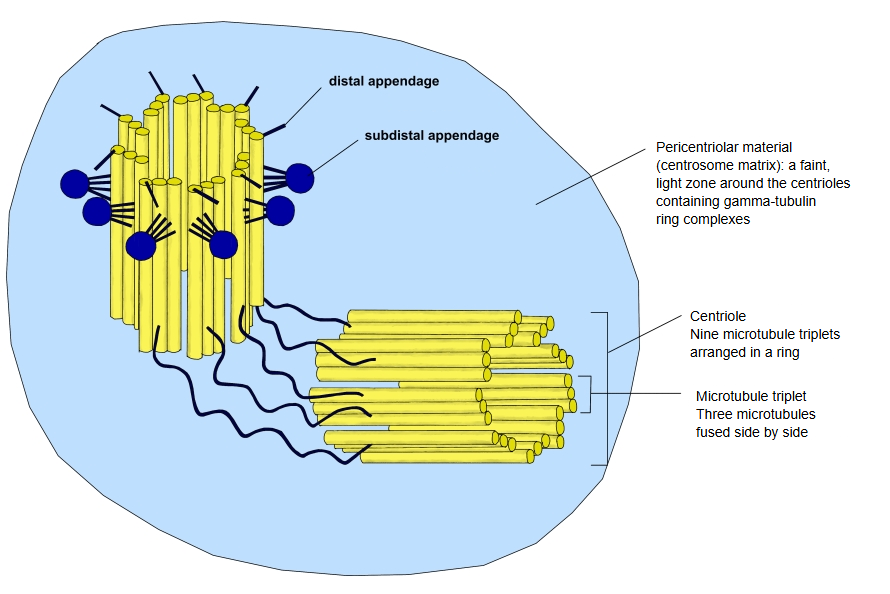
· A short cylinder whose wall is made of nine microtubule triplets arranged in a ring, is called a centriole; the centrosome is a pair of these centrioles lying at right angles to each other.
· The faint, light-staining zone around the centrioles is called the pericentriolar material (centrosome matrix). It contains proteins specific to the centrosome, including the gamma-tubulin ring complexes from which new microtubules grow.
Function
· Formation of microtubules: the centrosome is the main place where the microtubules of the cytoskeleton are formed.
· Before cell division the centrosome doubles; the two centrosomes move to opposite poles and organize the mitotic spindle. A centriole can also become the basal body of a cilium.
Related terms
References and sources
- Further reading: Centrosome, Wikipedia.
- Further reading: Centriole, Wikipedia.
- Federative International Programme for Anatomical Terminology (FIPAT). Terminologia Anatomica, 2nd ed. (TA2), 2019.