Cytosol
Also called the cytoplasmic matrix or the hyaloplasm
Overview
The cytosol (cytoplasmic matrix) is one of the components of a cell: the part of the cytoplasm that remains when the organelles are taken away, made mainly of fluid.
Cell = cell membrane + cytoplasm + nucleusWater makes up about 70–80%
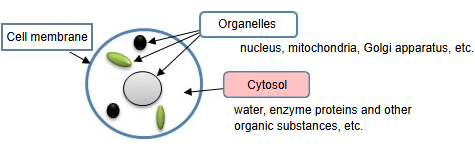
The organelles and the cytoskeleton lie in the cytosol. It is the site of many metabolic reactions, such as glycolysis, and of protein synthesis on free ribosomes; substances move through it by diffusion. It is so crowded with proteins that it behaves more like a gel than a dilute solution, and it is rich in potassium and poor in sodium and calcium, unlike the extracellular fluid. Some texts include the cytoskeleton in the cytoplasmic matrix, and some use 'cytosol' only for the soluble fraction obtained by centrifuging broken cells. Sources differ.
Structure
of the
cell
of the
cell
- Cell membrane : phospholipid bilayer, membrane proteins, sugar chains
- Cytoplasm
- Cytosol : water, electrolytes, metabolic enzymes, free amino acids, metabolic intermediates
- Organelles : mitochondria, endoplasmic reticulum, centrosome, Golgi apparatus, lysosomes, peroxisomes, vesicles (some sources do not count vesicles as organelles)
- Cytoskeleton : microtubules, actin filaments, intermediate filaments
- Nucleus : nuclear envelope, nucleoplasm, chromatin, nucleolus; the nucleus is also counted among the organelles
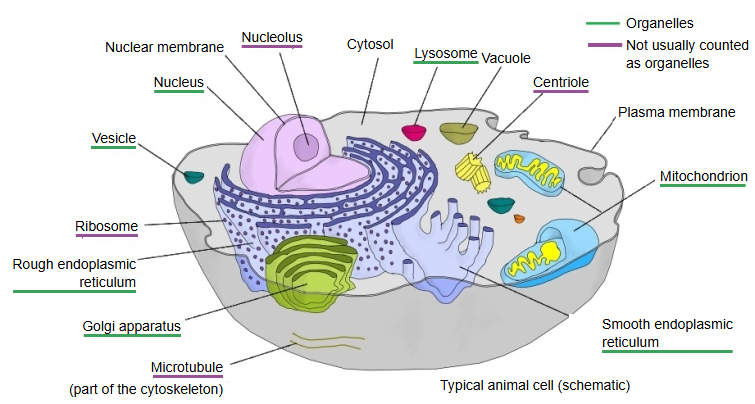
Components (approximate)
| Component | Proportion (guide) | Contents and examples | |
|---|---|---|---|
| 1 | Water | 70–80% | The solvent; the medium for diffusion and reactions |
| 2 | Proteins | 15–25% | Metabolic enzymes, structural proteins, signalling molecules |
| 3 | Small metabolites | 2–5% | Sugars (glucose), amino acids, intermediates of fatty acid metabolism, etc. |
| 4 | Inorganic ions | 1–2% | K⁺, Na⁺, Mg²⁺, Ca²⁺, Cl⁻, phosphate |
| 5 | Nucleic-acid molecules | <1% | mRNA, tRNA, free nucleotides |
| 6 | Cofactors and coenzymes | <1% | ATP/ADP, NAD⁺/NADH, FAD, CoA, etc. |
| 7 | Others | Traces | Vitamins, small signalling molecules, metal ions |