Sphenoidal emissary foramen (Latin: foramen venosum)
Also called the foramen of Vesalius
Note: when present, it carries a small emissary vein rather than a branch of the nerve or vessels of the nearby foramen ovale.
It lies in the floor of the middle cranial fossa, just in front of and medial to the foramen ovale, between it and the foramen rotundum, and opens below near the scaphoid fossa.
It is not always present; it may be found on one side, on both sides or not at all. Reported frequencies vary widely between studies (sources differ).
The emissary vein links the cavernous sinus inside the skull with the pterygoid plexus outside it. This venous route can carry infection from the face into the cavernous sinus, and the foramen must be avoided in needle procedures through the foramen ovale.
It is named after the anatomist Andreas Vesalius.
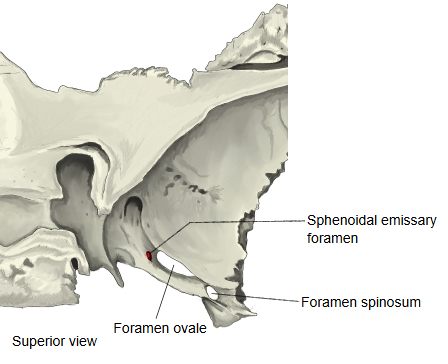
Reference websites
[Wikipedia]
· Sphenoidal emissary foramen, Wikipedia.
[Websites with illustrations]
· Sphenoid bone: anatomy, function and development (Kenhub)
· Sphenoid bone, upper surface (Gray's Anatomy, fig. 145) (Wikimedia Commons)

Related terms
- Foramen ovale
- Foramen spinosum
- Foramen rotundum
- Greater wing
- Sphenoid bone
- Emissary veins
- Cavernous sinus
References and sources
- Further reading: Sphenoidal emissary foramen, Wikipedia.
- Federative International Programme for Anatomical Terminology (FIPAT). Terminologia Anatomica, 2nd ed. (TA2), 2019.