Haversian canal (Latin: canalis centralis)
Also called Central canal (of osteon)
(= osteon)
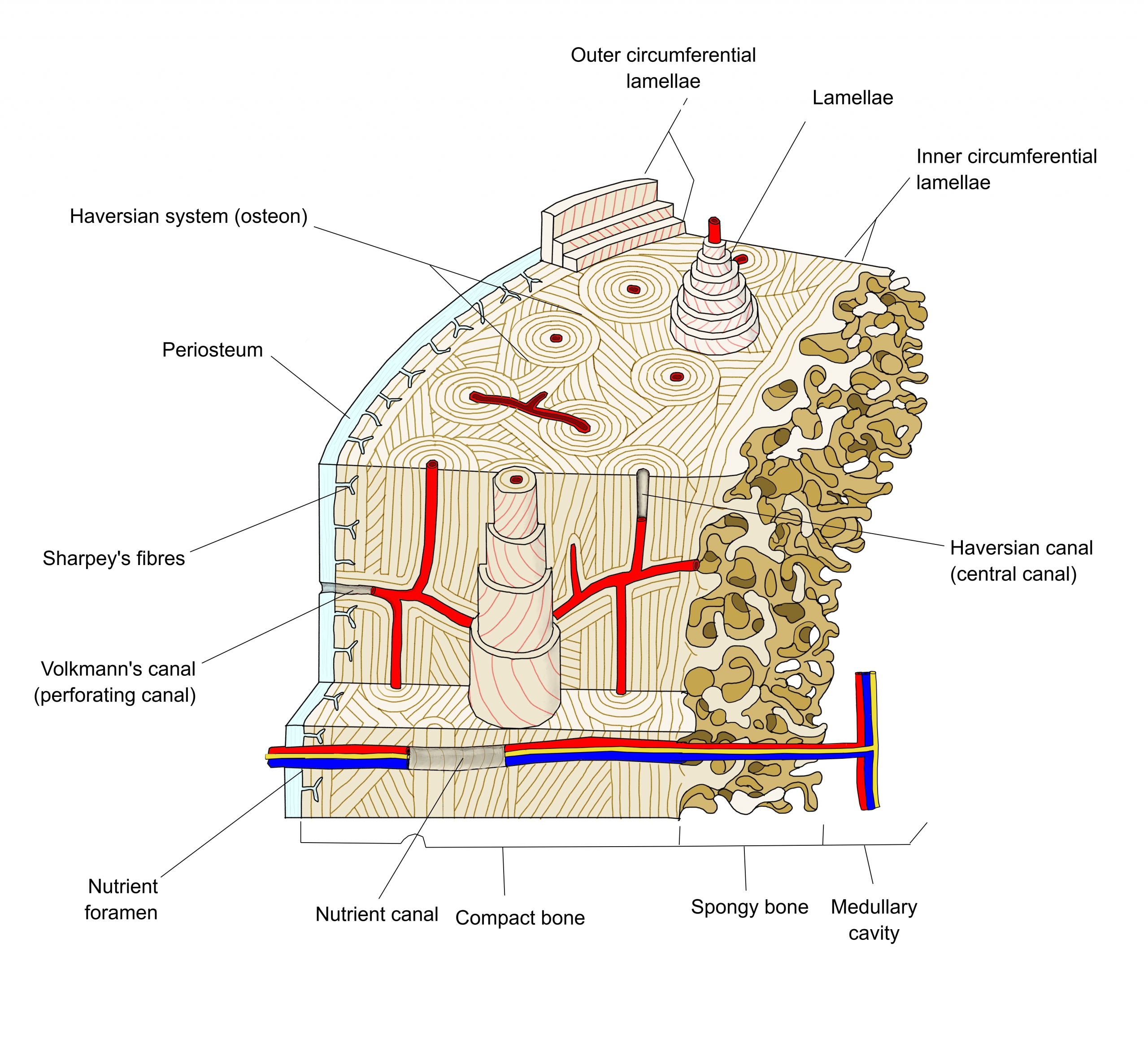
- Haversian lamellae : the set of concentric layers of bone lamellae.
- Haversian canal : the tunnel-like space in the centre of the Haversian lamellae, which carries the blood vessels and nerves.
· Each canal runs mostly along the long axis of the bone and is about 50 µm wide (sources give 20–100 µm).
· It usually contains one or two capillaries or small vessels, nerve fibres and a little loose connective tissue; it is lined by endosteum.
· Fine canaliculi run from the canal through the lamellae to the lacunae, so the osteocytes are supplied from the vessels in the canal. Between the osteons lie the interstitial lamellae.
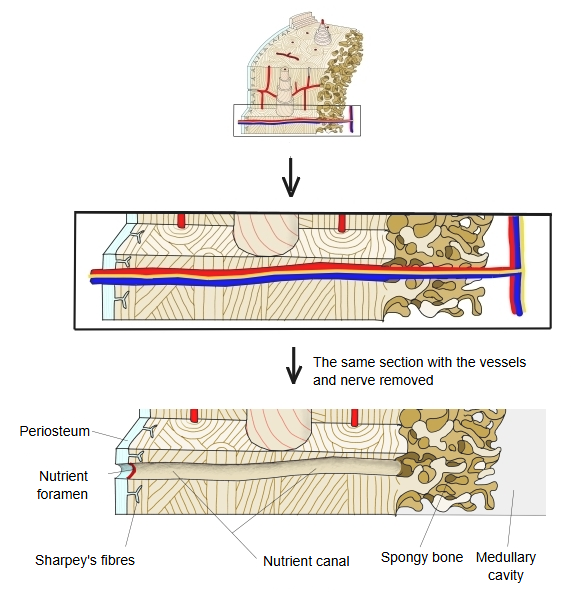
· The vessels reach the bone through the nutrient canal and Volkmann's canals. The canal is named after the English physician Clopton Havers.
⇒ Enlarged figure: compact bone and osteons
Reference websites
[Wikipedia]
· Haversian canal, Wikipedia.
· Osteon, Wikipedia.
[Websites with illustrations]
· Histology of compact bone (Wikimedia Commons)

Related terms
References and sources
- Further reading: Haversian canal, Wikipedia.
- Further reading: Osteon, Wikipedia.
- Federative International Programme for Anatomical Terminology (FIPAT). Terminologia Anatomica, 2nd ed. (TA2), 2019.