Natural killer cell
Also called NK cell
A kind of lymphocyte that attacks the cells in our body that are infected with viruses or have become cancerous.
- Dendritic cells
- Granulocytes
- Monocytes : become macrophages.
- Lymphocytes
- B cells : become plasma cells.
- NK cells
- T cells
More details
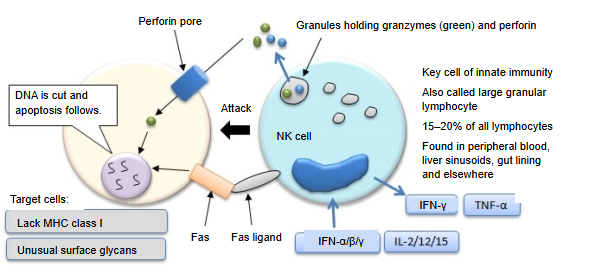
NK cells develop from hematopoietic stem cells in the bone marrow. They are cells of the innate immune system: from birth they can attack virus-infected and cancer cells without first having to meet a specific antigen. Because of their appearance (larger than most lymphocytes, with coarse granules in the cytoplasm) they are also called large granular lymphocytes. They make up roughly 5–20% of the lymphocytes in the blood (sources differ).
They patrol the body all the time and attack virus-infected and cancer cells on their own. Their targets are:
· cells that have lost their MHC class I molecules;
· cells that show unusual sugar chains or other unusual molecules on their surface.
Other notes
The killing activity of NK cells is reported to decline with age.
Killer T cells (cytotoxic T lymphocytes, CTLs), which recognise specific antigens, also kill tumour cells. Which of the two acts more strongly depends on the tumour and the situation; the two complement each other, because NK cells can attack tumour cells that have lost MHC class I and so escape the killer T cells.
Where they are found
NK cells are found not only in the peripheral blood but also in the liver sinusoids, the epithelium of the gut and lungs, the spleen, the lymph nodes and the lining of the pregnant uterus (placenta).
Surface markers
The table shows the typical surface markers that distinguish the lymphocytes (simplified).
| 1 | T cells | TCR, CD3, CD4 or CD8 |
| 2 | B cells | Surface immunoglobulin (Ig), CD19, CD20 |
| 3 | NK cells | CD56 and CD16, without CD3; also CD2, IL-2Rβ and LFA-1 (shared with T cells) |
Cytokines they produce
NK cells produce several cytokines; the two most important are:
| 1 | IFN-γ | Interferon-gamma, a type II interferon. It activates macrophages and increases the killing activity of the NK cells. |
| 2 | TNF-α | Tumour necrosis factor alpha. It suppresses the growth of tumour cells. |
Cytokines that activate them
NK cells are activated by the following cytokines:
| 1 | IFN-α | Interferon-alpha; made by white blood cells and fibroblasts. |
| 2 | IFN-β | Interferon-beta; made by white blood cells and fibroblasts. |
| 3 | IFN-γ | Interferon-gamma; made by T cells and NK cells. |
| 4 | IL-2 | Interleukin-2; made by T cells (especially Th1 cells). |
| 5 | IL-12 | Interleukin-12; made mainly by dendritic cells and monocytes/macrophages. It induces the production of IFN-γ. |
| 6 | IL-15 | Interleukin-15; made by many kinds of cells. Essential for the development and differentiation of NK cells. |
Receptors
The main receptors and surface molecules of NK cells are listed below (simplified).
| 1 | NK cell receptor (target-recognition unit) | Lectin-like receptors on the NK cell surface, such as CD161 (NKR-P1), were long thought to recognise sugar chains on the target cell (a lectin is a protein that binds particular sugar structures). |
| 2 | Receptors for MHC class I | Receptors that bind MHC class I molecules; through them the NK cell recognises cells that do not express MHC class I and attacks them (a normal amount of MHC class I switches the attack off). · KIR (killer cell immunoglobulin-like receptors, CD158) · CD94:NKG2A (binds HLA-E) The activating receptor NKG2D binds stress-induced molecules on infected or cancer cells instead. |
| 3 | LFA-1 | Lymphocyte function-associated antigen-1, an adhesion molecule. To bind (adhere to) the target cell, the NK cell also needs LFA-1 to bind ICAM-1 on the target cell surface. |
| 4 | Fc receptor | The NK cell surface carries an Fc receptor (FcγRIII, CD16) that binds the Fc part of immunoglobulin G (IgG). Destruction of target cells through antibodies in this way is called ADCC (antibody-dependent cell-mediated cytotoxicity); monocytes and macrophages can do it too. |
| 5 | Fas ligand | Fas ligand on the NK cell surface binds the Fas antigen on the target cell surface and leads it into apoptosis. |
| 6 | CD57 (HNK-1 sugar antigen) | The HNK-1 sugar antigen is expressed on human NK cells and some other cells; it is also called CD57 or Leu-7 (different names given by the makers of the monoclonal antibodies for the same antigen). |
Further receptors for MHC class I molecules:
| 1 | CD94:NKG2 (heterodimer) | C-type lectin receptors conserved in rodents and primates. They recognise the non-classical (non-polymorphic) MHC class I molecule HLA-E. Because HLA-E reaches the cell surface only when leader peptides of the classical MHC class I molecules are present, this indirectly measures how much classical HLA the cell expresses. |
| 2 | Ly49 (homodimer) | An older C-type lectin receptor family for classical (polymorphic) MHC class I molecules; mice have several genes, humans only one pseudogene. |
| 3 | KIR | Killer cell immunoglobulin-like receptors: a recently evolved multigene family with Ig-like extracellular domains. In primates they are the main receptors for the classical MHC class I molecules (HLA-A, -B, -C) and for the non-classical HLA-G; some KIRs are specific for particular HLA subtypes. |
| 4 | LIR (ILT) | Leukocyte immunoglobulin-like receptors (LIR, also called ILT, immunoglobulin-like transcripts): a family of Ig-like receptors with both inhibitory and activating members; inhibitory members such as LIR-1 (ILT2) bind many MHC class I molecules. |
How they kill target cells
| 1 | Perforin and granzymes | The NK cell uses the proteins perforin and granzyme stored in the granules of its cytoplasm: perforin opens pores in the target cell membrane, and granzymes enter and lead the cell into apoptosis. |
| 2 | Antibody-dependent cell-mediated cytotoxicity (ADCC) | Destruction of the target cell through antibodies bound by the Fc receptor (CD16). |
| 3 | Fas ligand | Fas ligand on the NK cell surface binds Fas on the target cell and leads it into apoptosis. |
⇒ Scanning electron micrograph of a human NK cell (NIAID, Wikimedia Commons)

Reference websites
[Wikipedia]
· Natural killer cell, Wikipedia.
Related terms
- Immune system
- Apoptosis
- Lymphocyte
- White blood cell
- Macrophage
- B lymphocyte
- Dendritic cell
- Hematopoietic stem cell
- Bone marrow
References and sources
- Further reading: Natural killer cell, Wikipedia.
- Federative International Programme for Anatomical Terminology (FIPAT). Terminologia Anatomica, 2nd ed. (TA2), 2019.