Intestinal trunk (Latin: truncus intestinalis)
Also called the intestinal lymphatic trunk
- Overview
- List of lymphatic trunks
- Does the intestinal trunk run in the mesentery?
- Reference websites
- (Wikipedia, websites with illustrations)
- Related terms
Overview
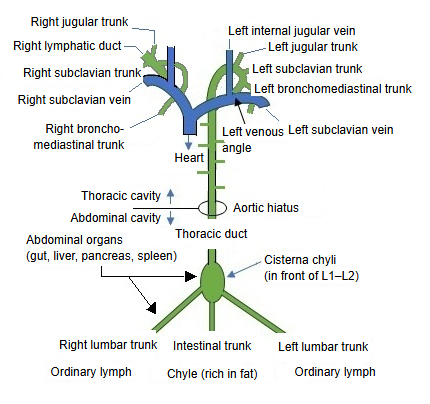
From lymph capillaries to the veins
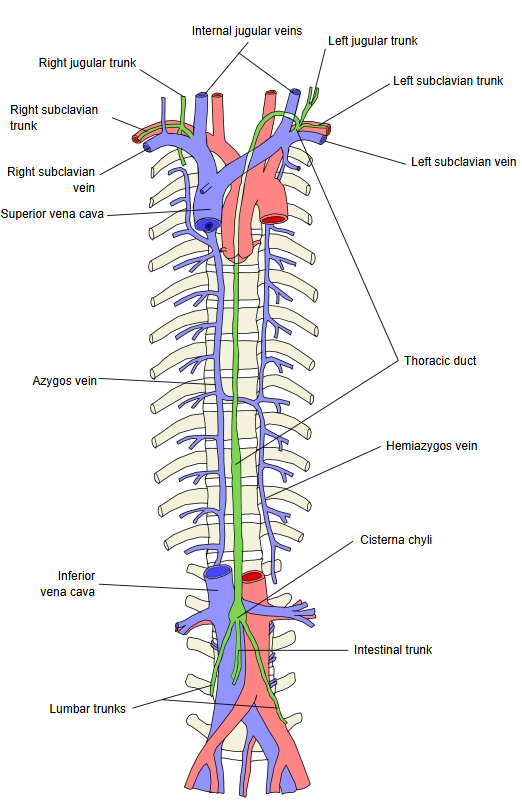
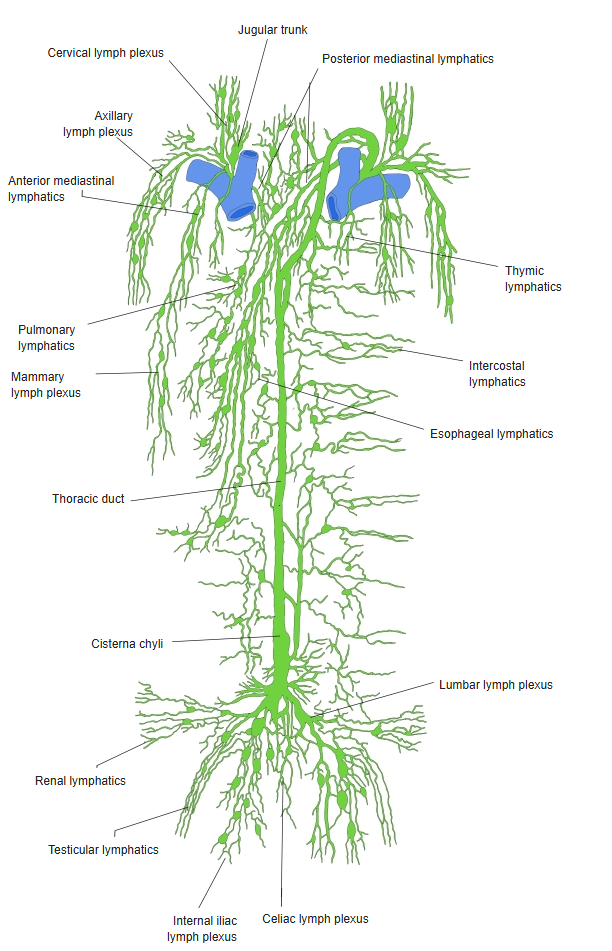
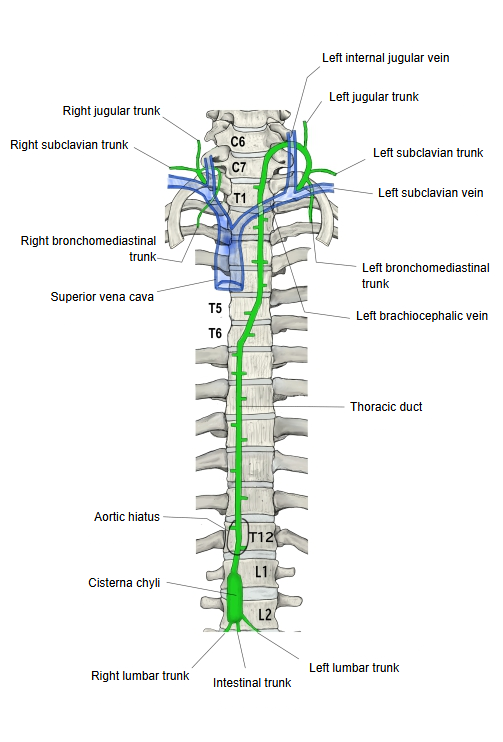
The lymphatic trunks are the right and left jugular, subclavian, bronchomediastinal and lumbar trunks and the intestinal trunk. The thoracic duct begins with a dilatation, the cisterna chyli, and carries about three quarters of the body's lymph to the veins.
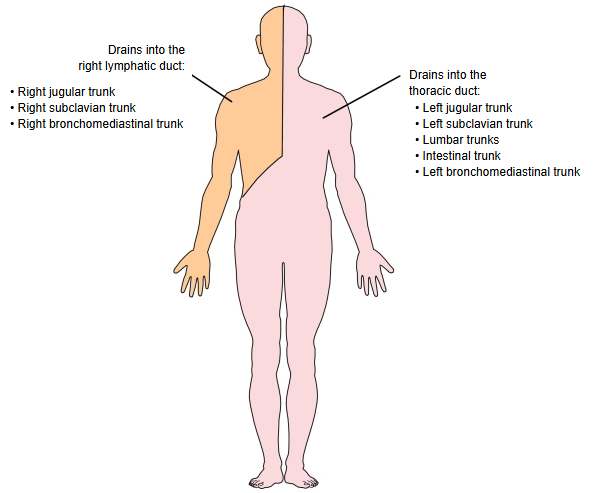
List of lymphatic trunks
| Opens into | Name | Notes | |
|---|---|---|---|
| Right venous angle | 1 | Right jugular trunk | Collects lymph from the right side of the head and neck |
| 2 | Right bronchomediastinal trunk | Collects lymph from the right lung and bronchi and the right side of the mediastinum | |
| 3 | Right subclavian trunk | Collects lymph from the right upper limb, part of the right chest wall and the right breast | |
| Left venous angle | 1 | Left jugular trunk | Collects lymph from the left side of the head and neck |
| 2 | Left bronchomediastinal trunk | Collects lymph from the left lung and bronchi and the left side of the mediastinum | |
| 3 | Left subclavian trunk | Collects lymph from the left upper limb, the left chest wall and the left breast | |
| 4 | Lumbar trunks (right and left) | Collect lymph from the lower limbs, the pelvic organs, the retroperitoneal organs (such as the kidneys) and the lower abdominal wall | |
| 5 | Intestinal trunk | Collects lymph from the large intestine and small intestine (and the stomach, liver, pancreas and spleen); unpaired |
Does the intestinal trunk run in the mesentery?
Q: Does the intestinal trunk, like the other lymph vessels of the gut, run in the mesentery?
A: Only the vessels that form it do; the trunk itself lies behind the peritoneum. In more detail:
1. 1. Position and course of the intestinal trunk
The intestinal trunk is the main thick lymph vessel that collects the lymph of the small intestine and the large intestine. After a fatty meal its lymph is milky chyle, because fat absorbed in the central lacteals of the villi passes through it.
Lymph capillaries (about 10–50 µm across) in the gut wall drain into collecting vessels in the mesentery (the mesenteric lymph vessels). These pass through the mesenteric lymph nodes; the efferent vessels of the coeliac and superior and inferior mesenteric nodes join to form the trunk.
So the vessels that form the trunk run in the mesentery, while the trunk itself runs behind the peritoneum, near the root of the mesentery and in front of the aorta, to the cisterna chyli at about the level of L1–L2 in the lumbar region.
2. 2. Summary of the flow: mesenteric lymph vessels (in the mesentery) ⇒ lymph nodes ⇒ intestinal trunk (behind the peritoneum, at the root of the mesentery) ⇒ cisterna chyli (on the posterior abdominal wall) ⇒ thoracic duct (about 2–5 mm wide and 38–45 cm long) ⇒ left venous angle
3. 3. Additional points
Near the cisterna chyli the trunk lies well outside the mesentery, on the posterior abdominal wall, and it joins the right and left lumbar trunks there.
Sources differ: the intestinal trunk is usually described as a single vessel, but it is often double or multiple, and it may open into the left lumbar trunk instead of directly into the cisterna chyli.
 Lymphatic trunks
 Lymph vessels of the trunk
 Lymphatic trunks, 2
Reference websites
[Wikipedia]
· Lymphatic vessel, Wikipedia.
· Cisterna chyli, Wikipedia.
[Websites with illustrations]
· Lymphatic pathways: thoracic duct, cisterna chyli and trunks (Pharmacy180)
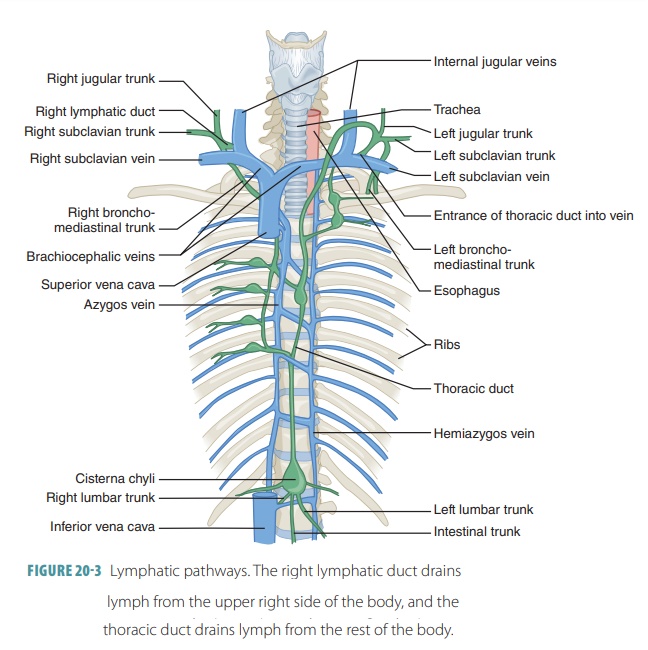
· Thoracic duct and lymph trunks (figure) (SpringerLink)

· Cisterna chyli with the intestinal and lumbar trunks (bodterms)

Related terms
- Lymphatic trunk
- Cisterna chyli
- Thoracic duct
- Central lacteal
- Root of mesentery
- Lymph node
- Small intestine
References and sources
- Further reading: Lymphatic vessel, Wikipedia.
- Further reading: Cisterna chyli, Wikipedia.
- Federative International Programme for Anatomical Terminology (FIPAT). Terminologia Anatomica, 2nd ed. (TA2), 2019.