Intrinsic muscles of tongue (Latin: musculi interni linguae)
Also called the intrinsic lingual muscles or the intrinsic muscles
All the muscles of the tongue are striated (skeletal) muscles. They form two groups: the extrinsic muscles, which arise outside the tongue and mainly move it as a whole, and the intrinsic muscles. The intrinsic muscles of the right and left halves are separated by the lingual septum. Their bundles are divided by connective tissue rich in fat, and the muscles receive many blood vessels and nerves.
A simple overview of the muscles of the tongue:
of the
tongue
- Extrinsic muscles
- Genioglossus : arises from the mental spine of the mandible and fans out backwards and upwards in the sagittal plane into the mucosa of the tongue.
- Hyoglossus : a thin, four-sided muscle lateral to genioglossus; it arises from the hyoid bone and attaches to the mucosa of the side of the dorsum of the tongue.
- Styloglossus : arises from the styloid process and the stylomandibular ligament, reaches the side of the tongue lateral to hyoglossus and runs forwards towards the tip.
- Chondroglossus : arises from the lesser horn of the hyoid bone and runs forwards and upwards. Some sources list palatoglossus instead.
- Intrinsic muscles
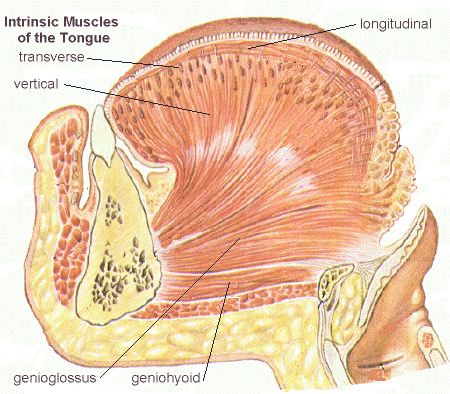
- Superior longitudinal muscle : just beneath the mucosa of the dorsum, running from the root to the apex. Shortens the tongue and turns the apex and sides upward.
- Inferior longitudinal muscle : a narrow band near the inferior surface, between genioglossus and hyoglossus, from the root to the apex. Shortens the tongue and turns the apex downward.
- Transverse muscle : mostly from the lingual septum outward to the margins of the tongue and the mucosa of the dorsum. Narrows and lengthens the tongue.
- Vertical muscle : in the front and side parts of the tongue, running from the dorsum down to the inferior surface. Flattens and widens the tongue.
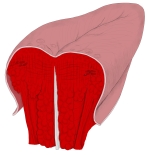 Muscles of the tongue (model of a section)
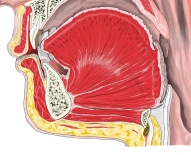 Oral cavity and tongue (median section)
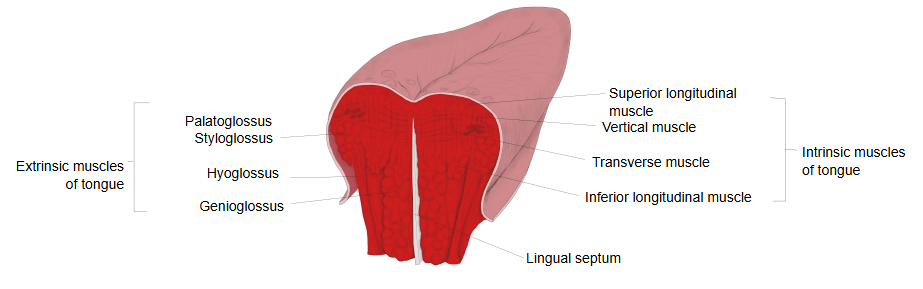
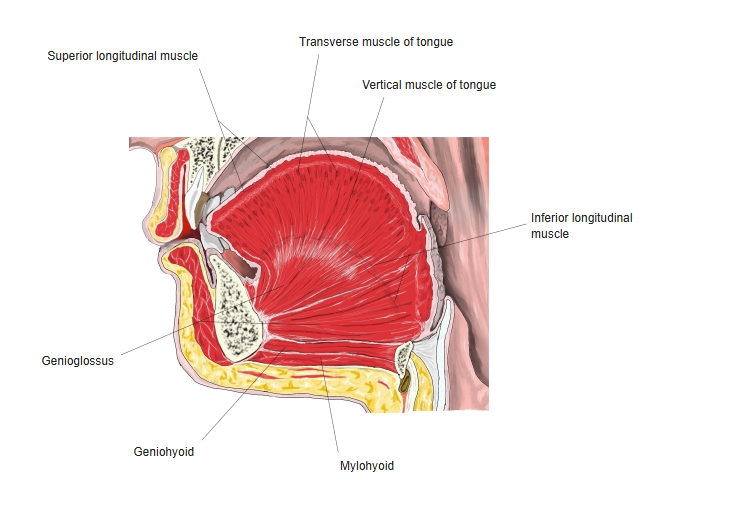
Working together the intrinsic muscles lengthen, shorten, curl, flatten and narrow the tongue, which is important for speech, chewing and swallowing. All are supplied by the hypoglossal nerve.
Reference websites
[Wikipedia]
· Tongue (Muscles), Wikipedia.
[Websites with illustrations]
· Tongue (median section) (York University)
· Extrinsic muscles of the tongue (lateral view) (York University)

Related terms
- Extrinsic muscles of tongue
- Lingual septum
- Superior longitudinal muscle of tongue
- Inferior longitudinal muscle
- Transverse muscle of tongue
- Vertical muscle of tongue
- Tongue
References and sources
- Further reading: Tongue (Muscles), Wikipedia.
- Federative International Programme for Anatomical Terminology (FIPAT). Terminologia Anatomica, 2nd ed. (TA2), 2019.