Muscles of tongue (Latin: musculi linguae)
Also called the lingual muscles
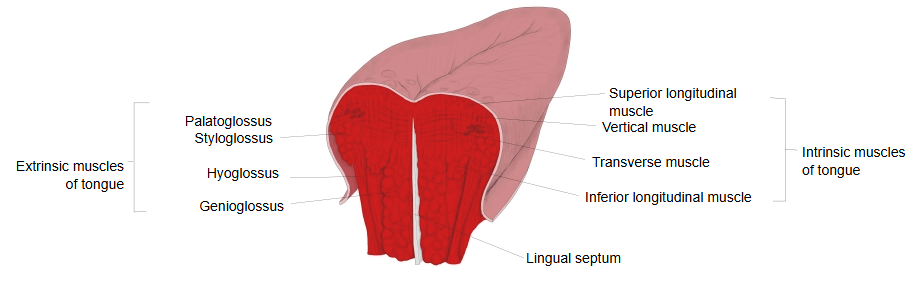
All the muscles of the tongue are striated muscle and consist of the extrinsic and the intrinsic muscles. Inside the tongue, all of them are split into small bundles by connective tissue that contains much fat, and the lingual septum separates the two halves. The muscles have a rich supply of blood vessels and nerves.
Below is a short list of the muscles of the tongue, following one textbook.
of
tongue
- Extrinsic muscles
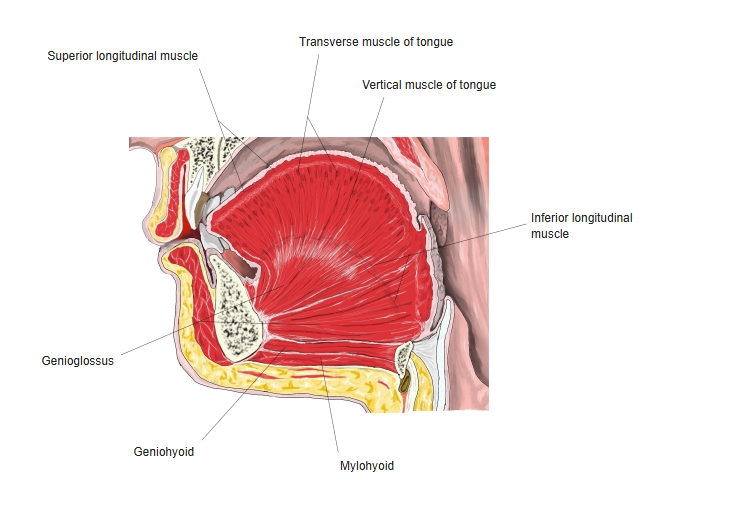
- Genioglossus : arises from the superior mental spine of the mandible and fans upwards and backwards in the sagittal plane into the mucosa of the tongue.
- Hyoglossus : a thin, four-sided muscle lateral to genioglossus; arises from the hyoid bone and ends in the mucosa of the side of the tongue.
- Styloglossus : arises from the styloid process and the stylomandibular ligament, passes lateral to hyoglossus to the lateral margin of the tongue and runs towards the apex.
- Chondroglossus : arises from the lesser horn of the hyoid bone and runs forwards and upwards. Some sources list palatoglossus here instead.
- Intrinsic muscles
- Superior longitudinal : (paired) a thin layer that runs just under the mucosa of the dorsum from the root to the apex.
- Vertical : runs vertically from the dorsum to the inferior surface in the front and lateral parts of the tongue.
- Transverse : a strong muscle that arises mostly from the lingual septum and ends in the lateral margin and the mucosa of the dorsum.
- Inferior longitudinal : (paired) a weak muscle near the inferior surface, between genioglossus and hyoglossus, running from the root to the apex.
Caution: sources differ about which muscles are counted as extrinsic muscles of the tongue.
This list follows one textbook, but sources differ about which muscles the term extrinsic muscles of the tongue covers:
1. 1. Lists that leave chondroglossus out
Some sources count only three extrinsic muscles and do not include chondroglossus.
Whether chondroglossus is an extrinsic muscle of its own is debated. It is sometimes treated as part of hyoglossus, but it is separated from it by fibres of genioglossus and differs in origin and direction. It is not always present; it has been found in roughly 80 % or more of cases.
2. 2. Lists that include palatoglossus instead of chondroglossus
Most English sources count palatoglossus instead of chondroglossus as the fourth extrinsic muscle, and the figures below follow them. Unlike the other muscles of the tongue, palatoglossus is supplied through the pharyngeal plexus by the vagus nerve, not by the hypoglossal nerve.
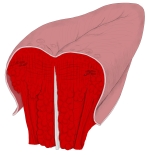 Muscles of the tongue (model of a section)
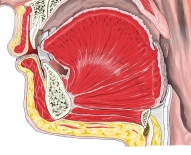 Oral cavity and tongue (median section)
Reference websites
[Wikipedia]
· Tongue, Wikipedia.
[Websites with illustrations]
· Tongue: anatomy, muscles, neurovasculature and histology (Kenhub)
· Extrinsic muscles of the tongue, left side (Gray's Anatomy, fig. 1019) (Wikimedia Commons)

Related terms
- Extrinsic muscles of tongue
- Intrinsic muscles of tongue
- Lingual septum
- Styloglossus
- Striated muscle
- Tongue
References and sources
- Further reading: Tongue, Wikipedia.
- Federative International Programme for Anatomical Terminology (FIPAT). Terminologia Anatomica, 2nd ed. (TA2), 2019.