Maxillary process of inferior nasal concha (Latin: processus maxillaris conchae nasalis inferioris)
processes
- Lacrimal process : front: meets the lower end of the lacrimal bone
- Maxillary process : middle: meets the lower edge of the maxillary hiatus
- Ethmoidal process : back: meets the tip of the uncinate process of the ethmoid bone
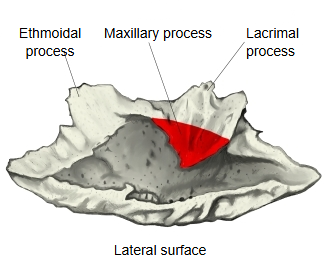
The maxillary process is a triangular plate of bone that bends downwards and laterally from the middle of the upper border; it covers the lower half of the maxillary hiatus and attaches to its lower margin.
It lies just behind the lacrimal process. Fitting into the lower edge of the maxillary hiatus, it closes the maxillary sinus from the medial side, leaving only a small opening into the nasal cavity above. It also helps to fix the concha to the lateral wall of the nasal cavity.
Reference websites
[Wikipedia]
· Inferior nasal concha, Wikipedia.
[Websites with illustrations]
· Right inferior nasal concha, lateral surface (Gray's Anatomy, fig. 172) (Wikimedia Commons)

· Right inferior nasal concha, medial surface (Gray's Anatomy, fig. 171) (Wikimedia Commons)

· Lateral wall of the right nasal cavity with the inferior concha in place (Gray's Anatomy, fig. 170) (Wikimedia Commons)

Related terms
- Inferior nasal concha
- Lacrimal process
- Ethmoidal process
- Maxillary hiatus
- Maxillary sinus
- Nasal cavity
- Viscerocranium
References and sources
- Further reading: Inferior nasal concha, Wikipedia.
- Federative International Programme for Anatomical Terminology (FIPAT). Terminologia Anatomica, 2nd ed. (TA2), 2019.