Medial bicipital groove (Latin: sulcus bicipitalis medialis)
Also called Ulnar bicipital groove
· Also called the ulnar bicipital groove.
The pulse of the brachial artery can be felt in this groove. Do not confuse it with the bicipital groove of the humerus (intertubercular groove), a bony groove for the tendon of the long head of biceps. On the outer side of the arm is the lateral bicipital groove; the triceps brachii lies behind the septum.
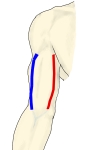 Bicipital grooves of the arm
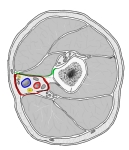 Cross-section of the arm
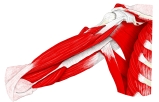 Muscles of the arm (medial)
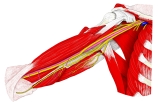 Vessels and nerves of the arm (medial)
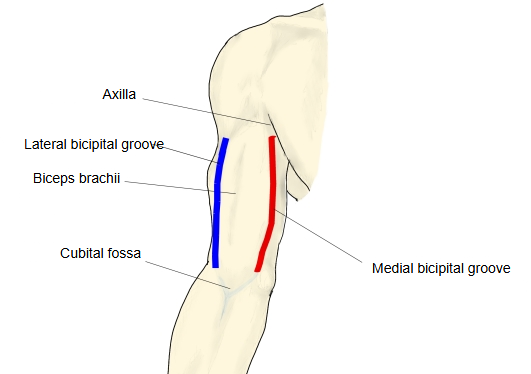
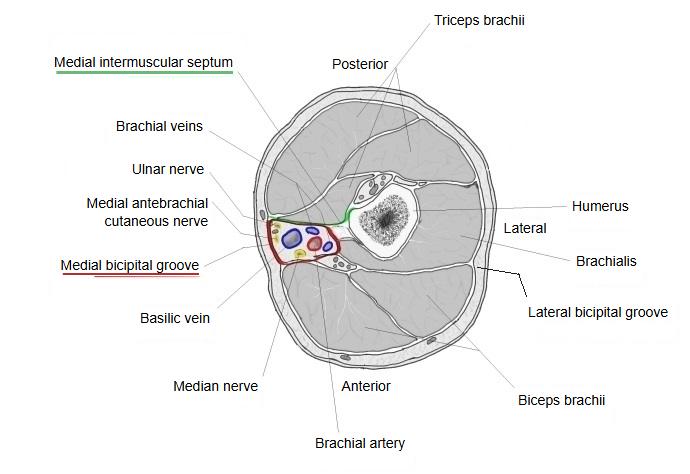
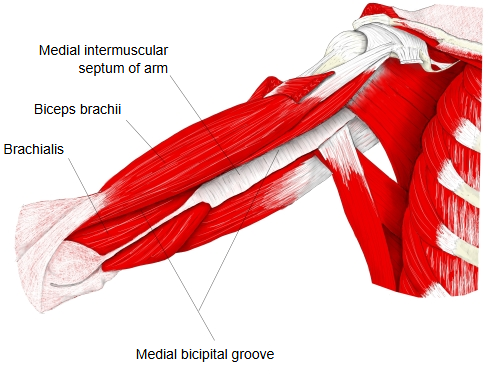
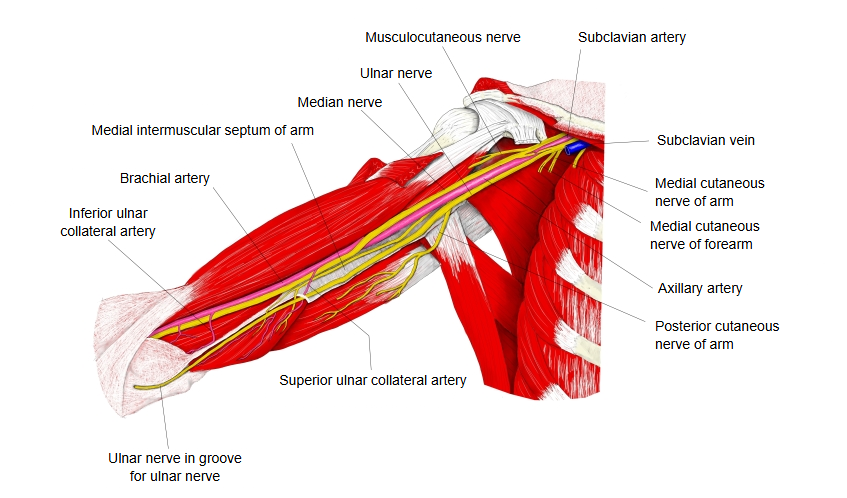
The medial bicipital groove is a furrow running lengthwise under the skin of the inner side of the arm, bounded by biceps brachii, brachialis and the medial intermuscular septum. It marks the main neurovascular route of the arm from the axilla to the cubital fossa. The most superficial structure is the medial antebrachial cutaneous nerve, which leaves the groove with the basilic vein through an opening in the deep fascia (the basilic hiatus). The most medial is the ulnar nerve, which at first runs in front of the medial intermuscular septum; at about the middle of the arm (near the level of the insertion of coracobrachialis) it pierces the septum, passes behind it and enters the groove for the ulnar nerve on the medial epicondyle of the humerus. Deep in the groove runs the main artery of the arm, the brachial artery, accompanied by the median nerve from the axilla to the cubital fossa.
Reference websites
[Wikipedia]
· Medial bicipital groove, Wikipedia.
Related terms
- Biceps brachii
- Brachial artery
- Median nerve
- Ulnar nerve
- Basilic vein
- Lateral bicipital groove
- Intertubercular groove
References and sources
- Further reading: Medial bicipital groove, Wikipedia.
- Federative International Programme for Anatomical Terminology (FIPAT). Terminologia Anatomica, 2nd ed. (TA2), 2019.