Omentum (Latin: omentum)
of the
peritoneum
reaching into
the abdominal
cavity
- Mesentery : a double layer of peritoneum that joins an organ to the parietal peritoneum of the wall; the path of its vessels and nerves. Examples: the mesentery of the small intestine, the transverse mesocolon and others.
- Peritoneal folds : mostly a single layer: ridges on the inner surface of the anterior abdominal wall raised by vessels and cords. Examples: the median, medial and lateral umbilical folds.
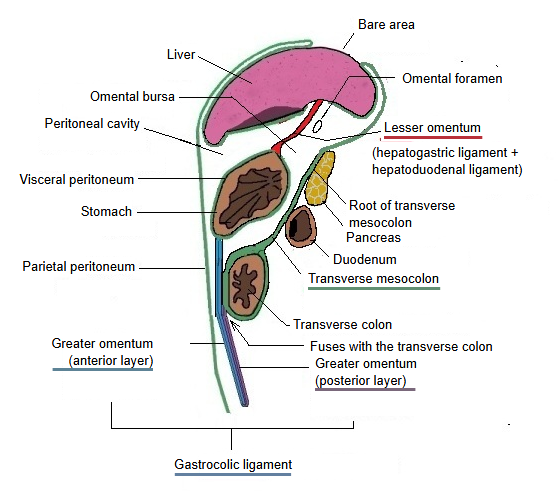
- Omentum : peritoneum that wraps the stomach and continues up and down from its borders. Lesser omentum: stomach to liver, a double layer. Greater omentum: hangs down like a curtain; the double layer is folded back on itself, so its central part is a fused four-layered sheet.
- Peritoneal ligaments : a double layer that joins an organ to the abdominal wall or to another organ and holds it in place. Examples: the falciform ligament, the gastrosplenic ligament.
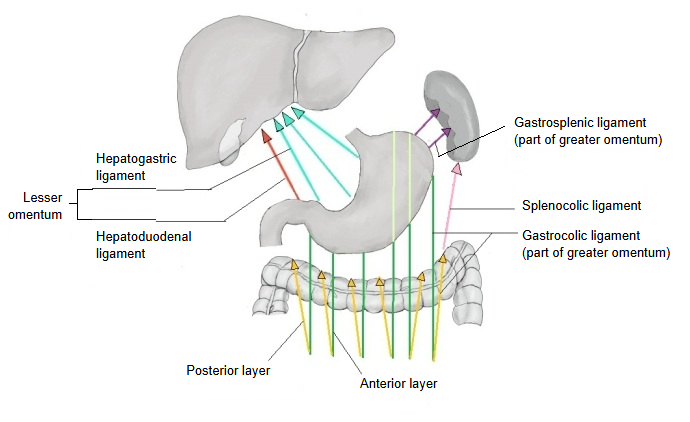
- Lesser omentum : the membrane between the stomach (lesser curvature), the duodenum (upper part) and the liver (porta hepatis).
- Hepatogastric ligament : the larger part of the lesser omentum, between the stomach and the liver.
- Hepatoduodenal ligament : the narrow right end of the lesser omentum, between the duodenum and the liver.
- Greater omentum : the membrane that spreads from the greater curvature of the stomach to the surrounding organs; in the narrow sense = the gastrocolic ligament.
- Gastrocolic ligament : the curtain-like fold that hangs down and forms most of the greater omentum; rich in fat.
- Gastrosplenic ligament : between the upper part of the greater curvature (especially from the fundus to the upper greater curvature) and the spleen (hilum).
- Gastrophrenic ligament : from near the uppermost part of the greater curvature to the underside of the left part of the diaphragm.
- Splenorenal ligament : between the spleen (medial side, near the hilum) and the front of the left kidney. Some sources count it as part of the greater omentum, because it develops from the same structure; others call it one of the peritoneal ligaments.
Lesser omentum
The lesser omentum runs from the lesser curvature of the stomach and the first part of the duodenum to the liver at the porta hepatis and the fissure for the ligamentum venosum. It is a simple two-layered sheet. Its thick right free edge, the hepatoduodenal ligament, carries the portal vein, the hepatic artery proper and the common bile duct, and forms the front boundary of the omental foramen. Vessels, nerves, lymph vessels and fat run between the two layers. See Lesser omentum.
Greater omentum
The greater omentum hangs from the greater curvature of the stomach like an apron in front of the intestines, then folds back up to the transverse colon. Because the apron folds back on itself, it has four layers of peritoneum; in adults they usually fuse into one sheet. The splenorenal ligament is counted with it by some sources because it develops from the same embryonic mesentery (dorsal mesogastrium). See Greater omentum.
Related terms
- Greater omentum
- Lesser omentum
- Gastrocolic ligament
- Gastrosplenic ligament
- Hepatogastric ligament
- Hepatoduodenal ligament
- Peritoneal ligaments
References and sources
- Further reading: Omentum, Wikipedia.
- Further reading: Greater omentum, Wikipedia.
- Further reading: Lesser omentum, Wikipedia.
- Federative International Programme for Anatomical Terminology (FIPAT). Terminologia Anatomica, 2nd ed. (TA2), 2019.