Pectineal line of femur (Latin: linea pectinea femoris)
A raised line on the back of the femur that runs down from below the lesser trochanter and continues down into the linea aspera (it is the intermediate of the three ridges into which the linea aspera divides above; the medial one, the spiral line, joins the medial lip). It gives insertion to pectineus, which is how it gets its name.
In the upper third of the shaft the linea aspera divides into three ridges: the gluteal tuberosity laterally, the pectineal line (the intermediate ridge) in the middle, and the spiral line medially. The pectineal line continues up to the base of the lesser trochanter and gives attachment to pectineus. The upper part of adductor brevis inserts just beside it, between the pectineal line and the linea aspera. It is part of the proximal epiphysis region of the femur. Not to be confused with the pectineal line of the pubis (pecten pubis), a ridge on the hip bone from which pectineus arises.
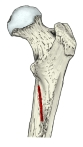 Right femur, upper part (posterior)
 Right femur (posterior)
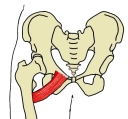 Pectineus
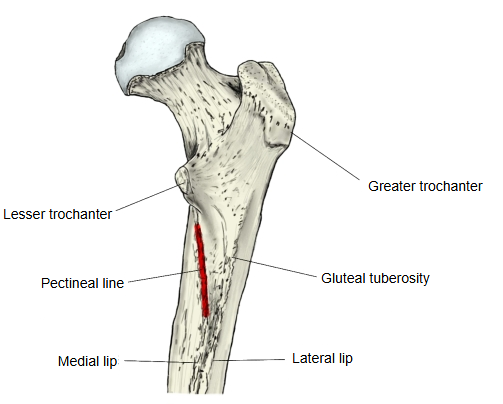
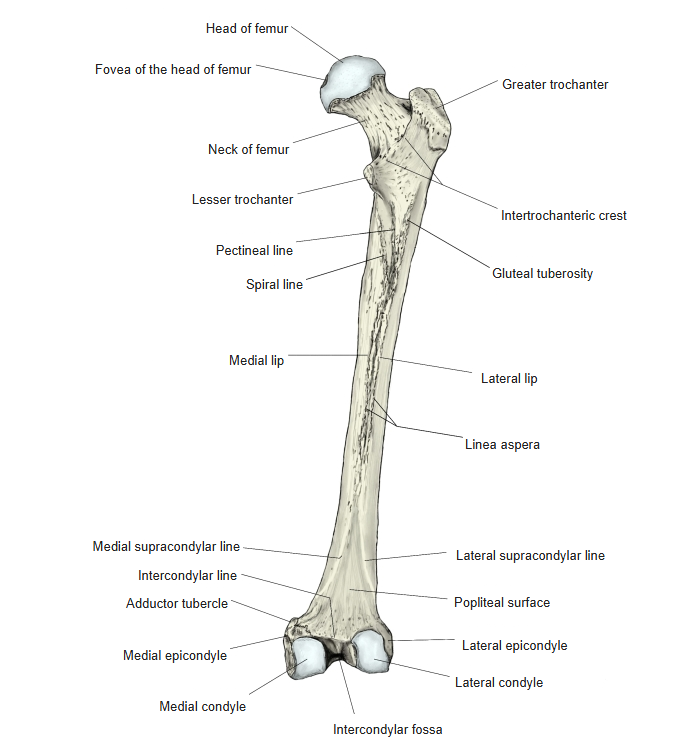
[Attachments]
| Muscle | 1 | Pectineus |
Reference websites
[Wikipedia]
· Pectineal line (femur), Wikipedia.
· Femur, Wikipedia.
· Pectineus muscle, Wikipedia.
[Websites with illustrations]
· Upper end of the femur, posterior view (photograph) (Wikimedia Commons)

· The femur (TeachMeAnatomy)
Where it is found
Related terms
- Linea aspera
- Lesser trochanter
- Gluteal tuberosity
- Medial lip of linea aspera
- Shaft of femur
- Proximal epiphysis of femur
- Femur
References and sources
- Further reading: Femur, Wikipedia.
- Further reading: Pectineus muscle, Wikipedia.
- Federative International Programme for Anatomical Terminology (FIPAT). Terminologia Anatomica, 2nd ed. (TA2), 2019.