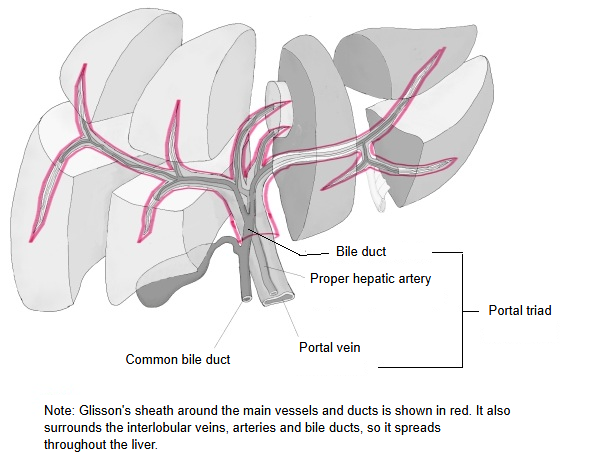
Perivascular fibrous sheath (Latin: capsula fibrosa perivascularis)
Also called the perivascular fibrous capsule
Where it is found
1. 1. Liver: it wraps the branches of the portal vein, the hepatic artery and the bile ducts as they enter the hepatic parenchyma. In anatomical terminology this is the perivascular fibrous capsule of the liver, usually called Glisson's sheath (in the narrow sense).
2. 2. Pancreas: fibrous tissue supports the regions through which many vessels and nerves run.
3. 3. Brain: the vessels entering the brain are surrounded by perivascular (Virchow-Robin) spaces. These are fluid-filled spaces bounded by the pia mater and glial membranes rather than a fibrous sheath, but they play a comparable role around the vessels.
4. 4. Kidney and lung: the fibrous tissue around the vessels is a common site of inflammation and fibrosis.