Bile duct (Latin: ductus biliaris)
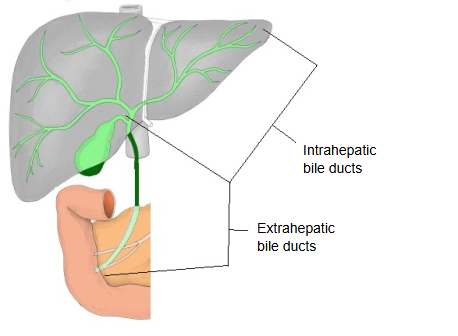
· The bile ducts can be divided broadly into intrahepatic ducts, inside the liver, and extrahepatic ducts, outside it.
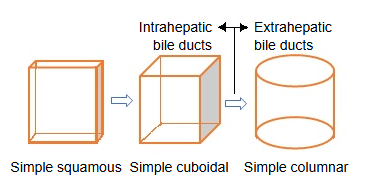
· Near the liver cells that make the bile the cells are flat; farther along they become cuboidal, and in the larger ducts columnar.
The path of bile
[Intrahepatic bile ducts]
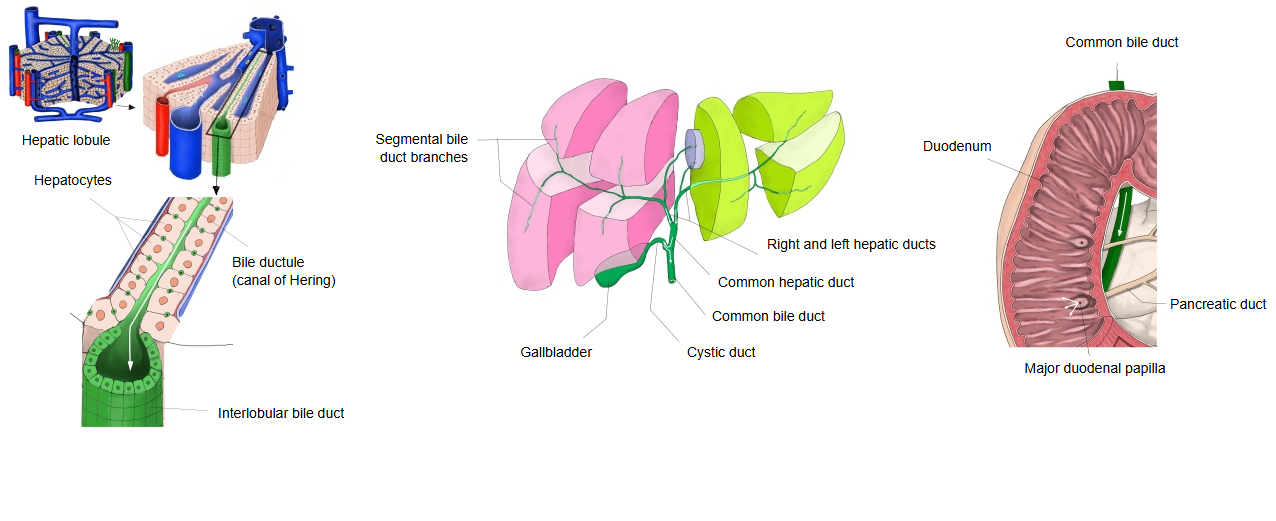
· Bile flows in the opposite direction to the blood in the liver lobule: from the centre of the lobule outward to its edges.
· Bile canaliculi: the smallest channels, formed only by grooves between neighbouring liver cells, with no wall of their own.
· Bile ductules and the canals of Hering: short channels lined by flat to cuboidal cells that link the canaliculi to the interlobular ducts. Sources differ on the names and order of these small channels.
· Interlobular bile ducts: in the portal areas between lobules, one part of the portal triad with a branch of the portal vein and of the hepatic artery.
· Segmental bile ducts: collect bile from each liver segment.
· Right hepatic duct and left hepatic duct: drain the right and left parts of the liver and leave it at the porta hepatis.
[Extrahepatic bile ducts]
· Common hepatic duct: formed by the union of the right and left hepatic ducts; about 2–4 cm long.
· Cystic duct: connects the gallbladder to the bile ducts; about 2–4 cm long. Bile passes along it into the gallbladder for storage and back out when the gallbladder contracts.
· Common bile duct: formed where the cystic duct joins the common hepatic duct; about 6–8 cm long. It opens into the second part of the duodenum at the major duodenal papilla, usually together with the pancreatic duct, though the two ducts sometimes open separately.
· In Terminologia Anatomica (TA2) the name bile duct (ductus biliaris) is also used for the common bile duct alone.
Related terms
- Fossa for gallbladder
- Common bile duct
- Common hepatic duct
- Cystic duct
- Interlobular bile duct
- Canal of Hering
- Segmental bile ducts
- Gallbladder
References and sources
- Further reading: Bile duct, Wikipedia.
- Further reading: Biliary tract, Wikipedia.
- Federative International Programme for Anatomical Terminology (FIPAT). Terminologia Anatomica, 2nd ed. (TA2), 2019.