Urogenital triangle
Also called the urogenital region
What is the urogenital triangle?
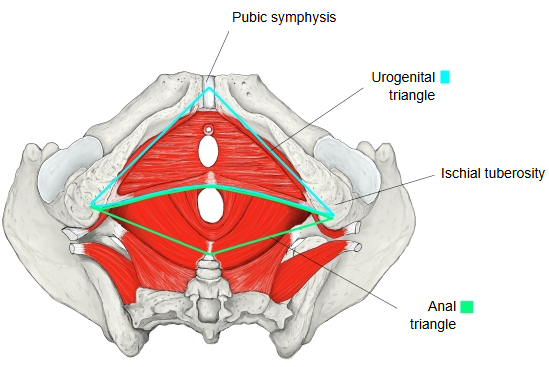
· Behind it, the triangular back part of the perineal region between the two ischial tuberosities and the tip of the coccyx is called the anal triangle.
· Its contents (muscles, nerves, blood vessels and others) naturally differ between the sexes; see the English Wikipedia article in the references for details.
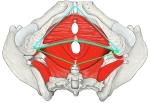 Urogenital and anal triangles
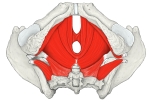 Female pelvic floor muscles
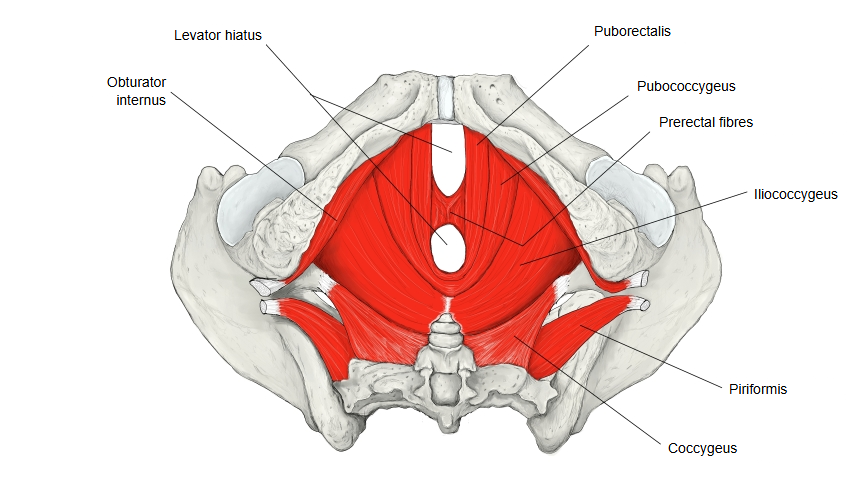
In more detail:
The urogenital triangle is the triangle joining the pubic symphysis and the two ischial tuberosities, the front part of the perineum; the back part is the anal triangle. Deep in it lie the superficial perineal fascia and the urogenital diaphragm, a triangular fibromuscular sheet stretched across the pubic arch in front of and below the pelvic diaphragm. It is described as having an upper and a lower layer of fascia (fasciae of the urogenital diaphragm); the lower one, which is relatively thick and strong, is also called the perineal membrane. The urethra passes through it in males, and the urethra and the vagina in females. Sources differ: many modern texts describe a perineal membrane with the deep perineal pouch above it instead of a urogenital diaphragm with two fascial layers.
The English Wikipedia article describes it as follows, in summary:
The urogenital triangle is the front part of the perineum; in females it contains the vagina and the related parts of the external genitalia.
Structure
It is the area of a triangle with one corner at the pubic symphysis and the other two at the ischial tuberosities of the hip bones.
Components
Its contents differ greatly between males and females. They include:
· Posterior scrotal or posterior labial nerves (posterior scrotal branches / posterior labial branches)
· Urethra
· Vagina
· Bulbourethral glands (male) / greater vestibular (Bartholin's) glands (female)
Muscles
· Superficial transverse perineal muscle
· Crura of the penis / crura of the clitoris
· Bulb of the penis / vestibular bulbs
· Urogenital diaphragm (with the deep transverse perineal muscle)
Muscular part of the perineal body
Superficial and deep perineal pouches (separated by the perineal membrane)
Blood vessels and lymphatic vessels
Reference websites
[Wikipedia]
· Urogenital triangle, Wikipedia.
[Websites with illustrations]
· Urogenital triangle: superficial perineal pouch and its muscles (SlideServe)

· The perineum: boundaries and contents (TeachMeAnatomy)
Related terms
- Urogenital diaphragm
- Urogenital muscles
- Anal triangle
- Perineal region
- Perineum
- Perineal membrane
- Pubic arch
- Pudendal region
- Muscles of perineum
References and sources
- Further reading: Urogenital triangle, Wikipedia.
- Federative International Programme for Anatomical Terminology (FIPAT). Terminologia Anatomica, 2nd ed. (TA2), 2019.