Oblique arytenoid (Latin: musculus arytenoideus obliquus)
- Overview
- Illustrations
- Origin / insertion
- Action
- Nerve / blood supply
- Reference websites
- (Wikipedia, websites with illustrations)
- Related terms
Overview
- Superficial muscles of the neck
- Suprahyoid and infrahyoid muscles
- Deep muscles of the neck
- Muscles of the pharynx
- Intrinsic laryngeal muscles (9) : cricothyroid, posterior cricoarytenoid, lateral cricoarytenoid, thyroarytenoid, vocalis, transverse arytenoid, oblique arytenoid, aryepiglotticus, thyroepiglotticus
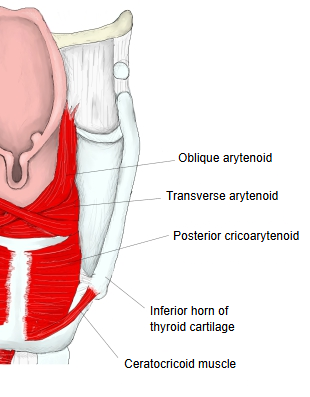
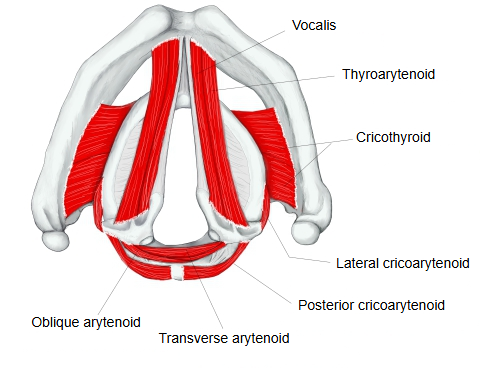
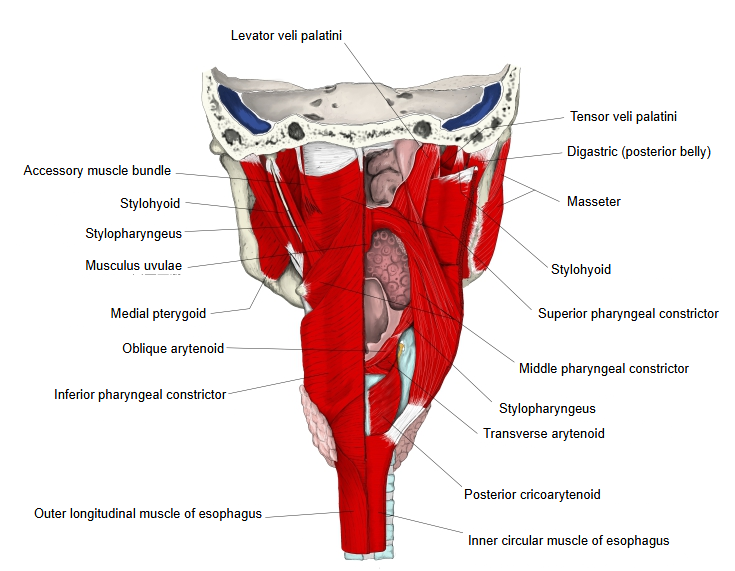
· A paired muscle lying on the back of the transverse arytenoid. Some texts call it the oblique part of the arytenoid muscle.
· Relation to the aryepiglotticus: sources differ. TA2 lists the aryepiglotticus as part of the oblique arytenoid (fibres that continue from the apex of the arytenoid cartilage into the aryepiglottic fold); other texts describe it as a separate muscle. Most illustrations draw it as the upward continuation of the oblique arytenoid.
The intrinsic laryngeal muscles at a glance (attachments simplified):
| Muscle | Origin | Insertion | Main action |
|---|---|---|---|
| Cricothyroid | front and side of the arch of the cricoid cartilage | lower border and inferior horn of the thyroid cartilage | tilts the thyroid cartilage forward: lengthens and tenses the vocal folds (the only one supplied by the superior laryngeal nerve) |
| Posterior cricoarytenoid | back of the lamina of the cricoid cartilage | back of the muscular process of the arytenoid cartilage | abducts the vocal folds: the only muscle that opens the rima glottidis |
| Lateral cricoarytenoid | upper border of the arch of the cricoid cartilage | front of the muscular process of the arytenoid cartilage | adducts the vocal folds |
| Thyroarytenoid | inner surface of the thyroid cartilage near the angle; cricothyroid ligament | anterolateral surface and muscular process of the arytenoid cartilage | shortens and relaxes the vocal folds; helps to close the glottis |
| Vocalis (deep part) | inner surface of the thyroid cartilage near the angle | vocal process and oblong fovea of the arytenoid cartilage | fine-tunes the tension of the vocal fold |
| Thyroepiglotticus (part) | with the thyroarytenoid | aryepiglottic fold and margin of the epiglottis | widens the laryngeal inlet |
| Transverse arytenoid | back and lateral border of one arytenoid cartilage | the same parts of the other arytenoid cartilage | draws the arytenoid cartilages together |
| Oblique arytenoid | back of the muscular process of one arytenoid cartilage | apex of the other arytenoid cartilage | draws the arytenoid cartilages together; narrows the laryngeal inlet |
| Aryepiglotticus (part) | continuation of the oblique arytenoid at the apex of the arytenoid cartilage | side of the epiglottis, through the aryepiglottic fold | narrows the laryngeal inlet |
Illustrations
More figures: Multi-muscle illustrations: Neck · Pharynx and esophagus (posterior view) · Muscles of the neck (list) · Larynx
Origin / insertion
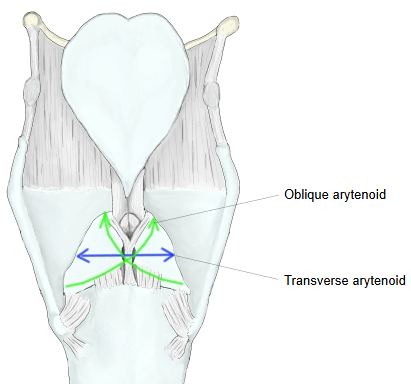
[Origin] : the back of the muscular process of one arytenoid cartilage.
[Insertion] : the apex of the other arytenoid cartilage (some texts give its upper border). Some fibres go on round the apex into the aryepiglottic fold.
Action
Draws the arytenoid cartilages together and tilts their apices toward each other, helping to close the rima glottidis. Through its aryepiglottic fibres it pulls the aryepiglottic folds together and narrows the laryngeal inlet like a sphincter during swallowing.
Nerve / blood supply
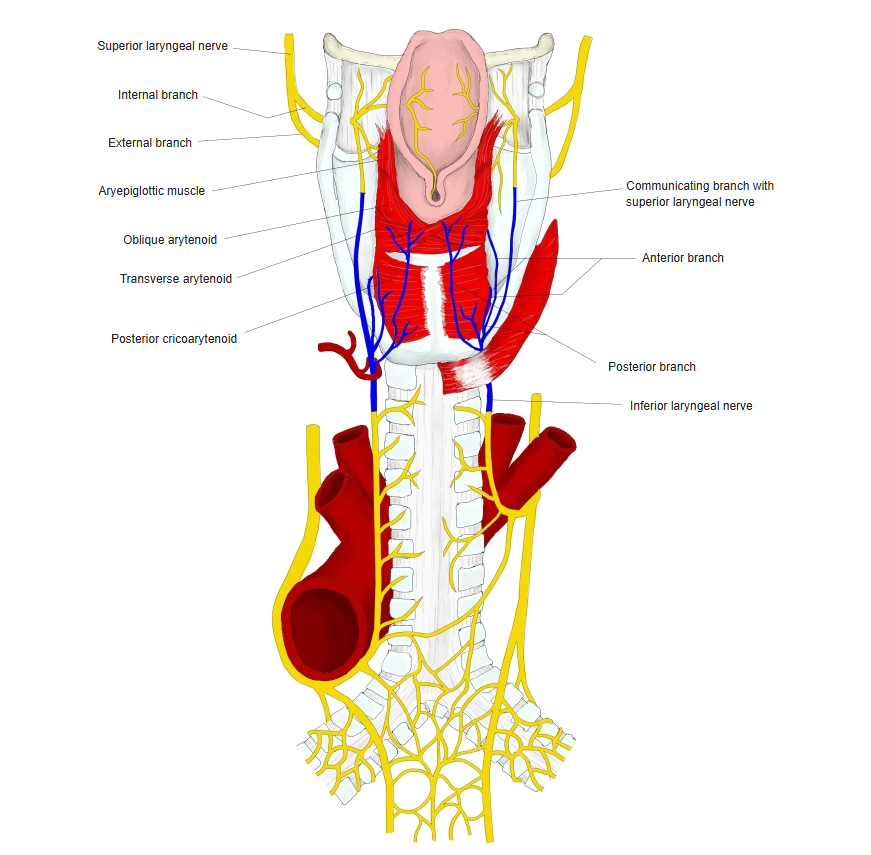
· Nerve : recurrent laryngeal nerve (its end part is called the inferior laryngeal nerve), a branch of the vagus nerve (cranial nerve X).
· Arteries : laryngeal branches of the superior laryngeal artery (from the superior thyroid artery) and the inferior laryngeal artery (from the inferior thyroid artery).
· Veins : the superior laryngeal vein to the superior thyroid vein, and the inferior laryngeal veins to the inferior thyroid veins.
 Laryngeal nerves (posterior view)
Reference websites
[Wikipedia]
· Oblique arytenoid, Wikipedia.
[Websites with illustrations]
· Oblique arytenoid (Kenhub)
Related terms
- Intrinsic laryngeal muscles
- Arytenoid cartilage
- Apex of arytenoid cartilage
- Aryepiglottic fold
- Laryngeal inlet
- Transverse arytenoid
- Aryepiglotticus
- Recurrent laryngeal nerve
References and sources
- FIPAT. Terminologia Anatomica, 2nd ed. (TA2), 2019: musculus arytenoideus obliquus.
- Oblique arytenoid, Wikipedia.