Sphenoethmoidal recess (Latin: recessus sphenoethmoidalis)
Note on this page
The original data for this term were missing, so this is a provisional explanation prepared with the help of AI. Please check the details against the original sources (see the references below).
· The sphenoethmoidal recess is a small hollow at the upper back part of the nasal cavity: a narrow, slit-like space above and behind the superior nasal concha, in front of the front surface of the body of the sphenoid, facing the nasal septum medially. The sphenoidal sinus opens into it through the aperture of the sphenoidal sinus.
· Textbooks describe it as the narrow part at the upper back end of the nasal cavity, between the superior nasal concha and the nasal septum, in front of the body of the sphenoid. Its depth varies a lot between people.
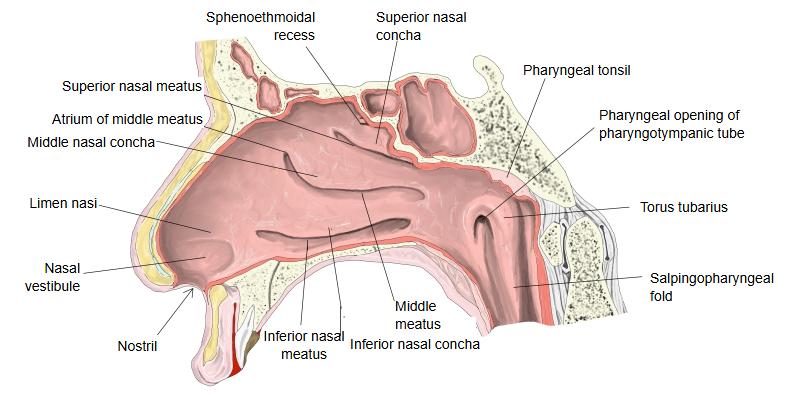
[Position and opening]
· The aperture of the sphenoidal sinus is a small hole in the front wall of the body of the sphenoid (the posterior wall of the recess); through it the sphenoidal sinus opens into the sphenoethmoidal recess.
· The other paranasal sinuses open into nasal meatuses: the frontal sinus, the maxillary sinus and the anterior ethmoidal cells into the middle nasal meatus, and the posterior ethmoidal cells into the superior nasal meatus. The sphenoidal sinus alone opens into the sphenoethmoidal recess and not into any nasal meatus.
· When a supreme nasal concha is present, it sits on the lateral wall of the recess, and a posterior ethmoidal cell may open into the supreme nasal meatus below it.
· Together with the nasal meatuses, the sphenoethmoidal recess opens backwards into the nasopharyngeal meatus (the back part of the nasal cavity that leads into the pharynx).
· An older German textbook (Rauber-Kopsch) describes all four nasal meatuses and the sphenoethmoidal recess as opening backwards into the nasopharyngeal meatus. Between the front wall of the body of the sphenoid and the superior nasal concha lies the recess, very variable in depth, into which the sphenoidal sinus, lined with mucosa, opens from behind, in most cases through a small hole (the aperture of the sphenoidal sinus).
[Clinical significance]
· In endoscopic surgery of the nose and paranasal sinuses, the recess is the landmark used to find the aperture of the sphenoidal sinus.
· It is also the route in surgery that reaches the sella turcica through the nose and the sphenoidal sinus, for example for pituitary tumours (transnasal transsphenoidal surgery).
· When the sphenoidal sinus or the posterior ethmoidal cells are inflamed, pus drains from here backwards into the pharynx (nasopharynx) and causes postnasal drip (mucus running down the back of the throat).
[More detail]
· See also the pages on the aperture of the sphenoidal sinus, the sphenoidal sinus, the superior nasal meatus, the supreme nasal meatus and the common nasal meatus.
Reference websites
[Wikipedia]
· Sphenoethmoidal recess, Wikipedia.
[Websites with illustrations]
· Lateral wall of nasal cavity (Gray's Anatomy) (Wikimedia Commons)

· The nasal cavity (TeachMeAnatomy)
· The paranasal sinuses (TeachMeAnatomy)
Where it is found
Related terms
- Sphenoidal sinus
- Superior nasal concha
- Superior nasal meatus
- Common nasal meatus
- Nasal cavity
- Sella turcica
References and sources
- Further reading: Sphenoethmoidal recess, Wikipedia.
- Federative International Programme for Anatomical Terminology (FIPAT). Terminologia Anatomica, 2nd ed. (TA2), 2019.