Tail of pancreas (Latin: cauda pancreatis)
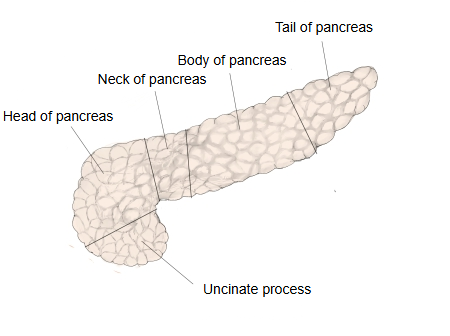
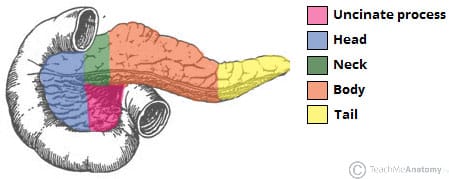
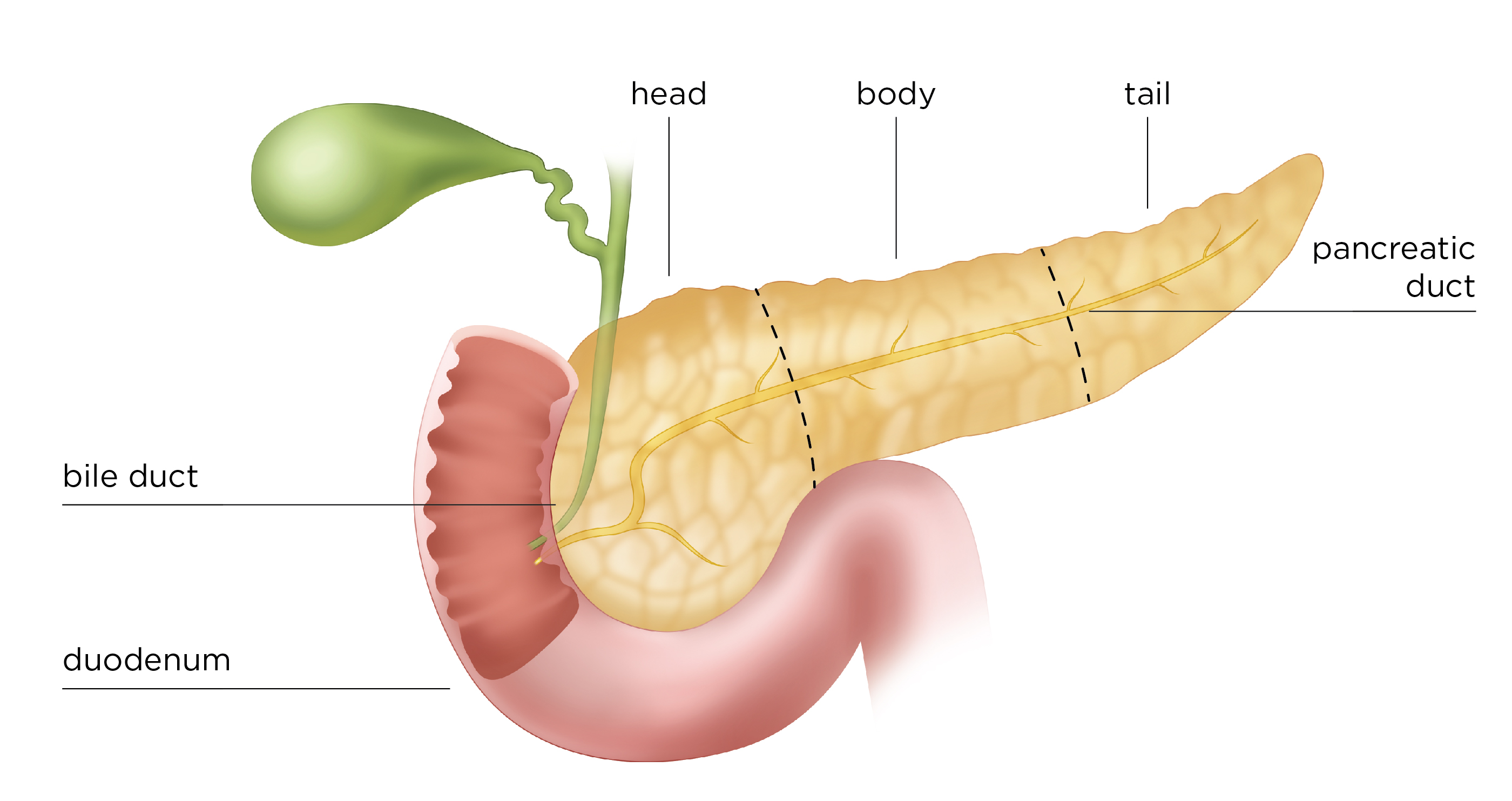
· The pancreas is divided into the head (with the uncinate process), the neck, the body and the tail, but there are no sharp boundaries between them. Sources differ on where the body ends and the tail begins, and some divide the pancreas into more than four parts.
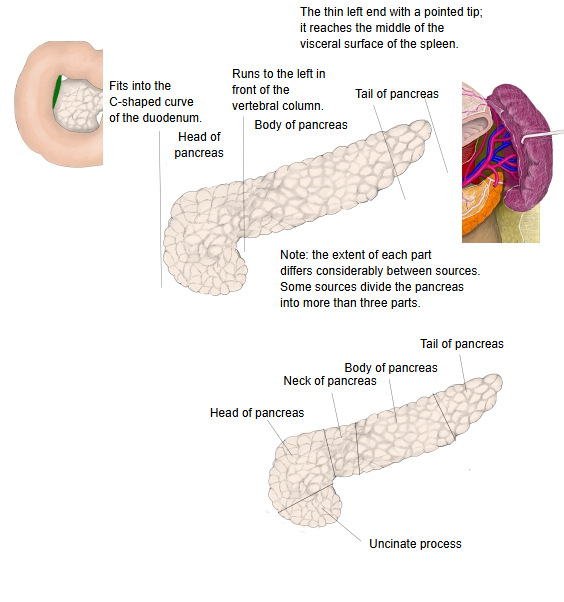
· The tail continues the body to the left and ends in a pointed tip at the hilum of the spleen, on the visceral surface of the spleen.
· Unlike the rest of the gland, which is retroperitoneal, the tail lies within the splenorenal ligament together with the splenic artery and splenic vein, so it is fairly mobile.
· Pancreatic islets are more densely packed in the tail than in the head, so the tail has a relatively large share of the endocrine tissue.
· Because it lies so close to the splenic hilum, the tail can be injured during removal of the spleen.
pancreas
- Head : the swollen right end, fitted into the C-shaped curve of the duodenum. Term: uncinate process (the part projecting below).
- Body : runs to the left across the front of the vertebral column; three surfaces and three borders are distinguished.
- Anterior surface : faces forward and upward, toward the back of the stomach across the omental bursa. Covered by parietal peritoneum.
- Posterior surface : flat; attached directly to the abdominal wall by loose connective tissue. Not covered by parietal peritoneum.
- Inferior surface : very narrow; faces forward and downward. Sometimes absent. Covered by parietal peritoneum.
- Anterior, superior and inferior borders : the anterior border is slightly sharp and gives attachment to the transverse mesocolon; the superior and inferior borders are blunt.
- Tail : the narrow part reaching farthest to the left; its tip is pointed and reaches about the middle of the visceral surface of the spleen, at its hilum.
Note: some sources divide the pancreas into five parts, adding two more to the three above: the neck (a short narrow part joining the head to the body, in front of the portal vein) and the uncinate process. Most texts use four parts (head, neck, body and tail).
[Differences in function between the parts]
| Part | Main features and tendencies (tendencies only: there are no clear boundaries or strict limits) | |
|---|---|---|
| 1 | Head | · Especially rich in acini (exocrine tissue), important for making pancreatic juice · Close to the outlet of the main pancreatic duct (the duodenal papilla), so closely related to the bile ducts |
| 2 | Body | Both exocrine and endocrine tissue in balance |
| 3 | Tail | The islets of Langerhans are somewhat denser here, so the tail is important for the endocrine function (especially insulin secretion) |
Reference websites
[Wikipedia]
· Pancreas, Wikipedia.
· Splenorenal ligament, Wikipedia.
[Websites with illustrations]
· Parts of the pancreas (figure) (TeachMeAnatomy)
· Head, body and tail of the pancreas (figure) (National Pancreas Foundation)
· The pancreas (TeachMeAnatomy)
Where it is found
Related terms
- Pancreas
- Body of pancreas
- Head of pancreas
- Pancreatic islets
- Spleen
- Vein of the pancreatic tail
- Pancreatic duct
References and sources
- Further reading: Pancreas, Wikipedia.
- Further reading: Splenorenal ligament, Wikipedia.
- Federative International Programme for Anatomical Terminology (FIPAT). Terminologia Anatomica, 2nd ed. (TA2), 2019.