Acinar cells
- Overview
- Acinar cells in other glands
- Small differences
- Reference websites
- (Wikipedia, websites with illustrations)
- Where it is found
- Related terms
Overview
· Acinar cells make up about 80–85% of the pancreas; the endocrine pancreatic islets form only a small part.
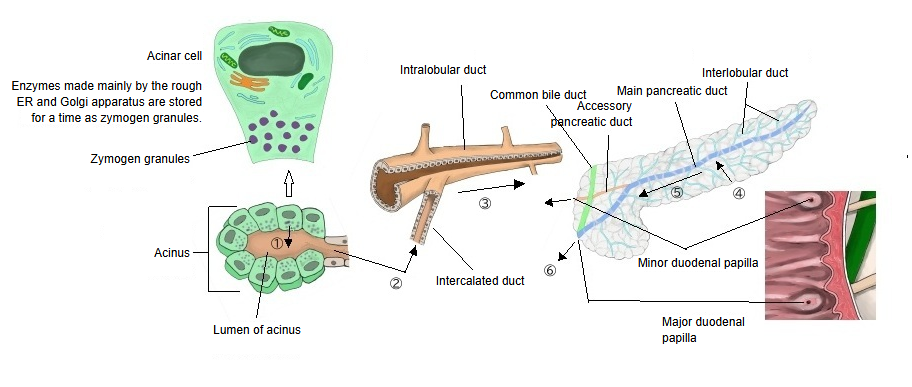
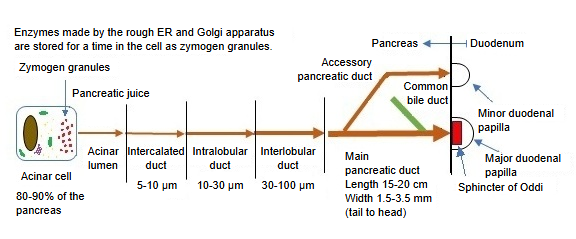
Each acinus is a cluster of pyramid-shaped cells around a tiny central lumen. The base of each cell is packed with rough endoplasmic reticulum and stains strongly basophilic; the apical part holds zymogen granules: enzymes such as amylase and lipase, and inactive precursors such as trypsinogen and chymotrypsinogen, which are activated only in the duodenum. The granules are released by exocytosis into the lumen when the cells are stimulated by cholecystokinin and by the vagus nerve. The juice then passes into the intercalated ducts, whose first cells (the centroacinar cells) lie inside the acinus, and on through the pancreatic duct.
Acinar cells in other glands
Where are acinar cells found besides the pancreas?
In the salivary glands: serous acinar cells are found in the parotid gland, the submandibular gland and others.
| Gland | Type of acinar cells | Remarks | |
|---|---|---|---|
| 1 | Pancreas | Serous only | Secrete digestive enzymes |
| 2 | Parotid gland | Mainly serous | The most serous of the salivary glands |
| 3 | Submandibular gland | Mixed (serous + mucous) | Mainly serous, with some mucous cells |
| 4 | Sublingual gland | Mixed (mainly mucous) | Mucous cells predominate |
Are the acinar cells of the pancreas and of the salivary glands much the same in shape and structure?
Their basic shape and properties are very similar, so they can be regarded as having almost the same structure.
Small differences
· Secretory products: the pancreas secretes many kinds of digestive enzymes (trypsinogen, lipase and others), while the salivary glands secrete mainly amylase.
· Duct structure: in the pancreas the centroacinar cells project into the acinus and continue into the intercalated duct; in the salivary glands the acini connect with clearly separate duct cells (striated ducts and others).
· Centroacinar cells: the pancreas has centroacinar cells, but the salivary glands normally do not.
Reference websites
[Wikipedia]
· Pancreatic acinar cell, Wikipedia.
· Acinus, Wikipedia.
[Websites with illustrations]
· Pancreatic acinus with acinar and centroacinar cells (micrograph) (Wikimedia Commons)

· The pancreas (TeachMeAnatomy)
Where it is found
Related terms
References and sources
- Further reading: Pancreatic acinar cell, Wikipedia.
- Further reading: Acinus, Wikipedia.
- Federative International Programme for Anatomical Terminology (FIPAT). Terminologia Anatomica, 2nd ed. (TA2), 2019.