Greater curvature (Latin: curvatura major gastris)
Also called the greater curvature of stomach
Its course:
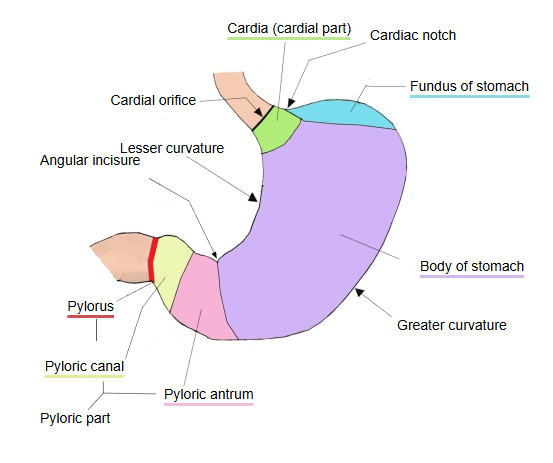
The greater curvature is longer than the lesser curvature. It begins on the left side of the cardia, arches over the upper border of the fundus, runs along the left border of the body and reaches the lower side of the pylorus.
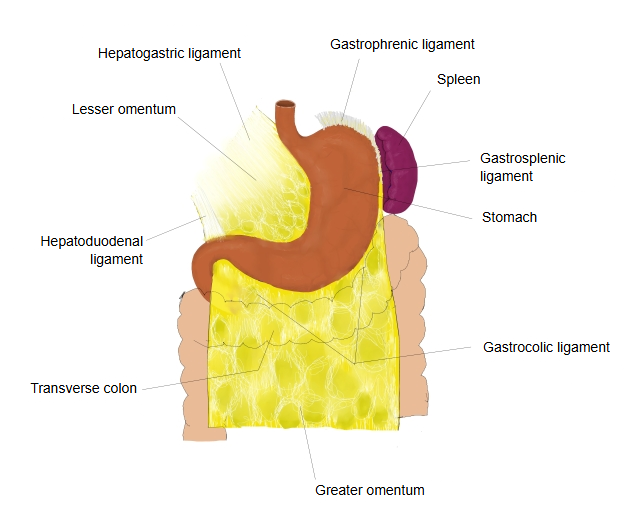
From its upper part the gastrosplenic ligament passes to the spleen, and from its lower part the greater omentum hangs down.
· It is several times longer than the lesser curvature: from the cardiac notch it arches up over the fundus, runs down along the left side of the body, and then turns to the right along the lower border of the pyloric part.
· Its upper part gives the gastrophrenic ligament (to the diaphragm) and the gastrosplenic ligament (to the spleen); its lower part gives the gastrocolic ligament, which hangs down as a fatty apron and joins the transverse colon.
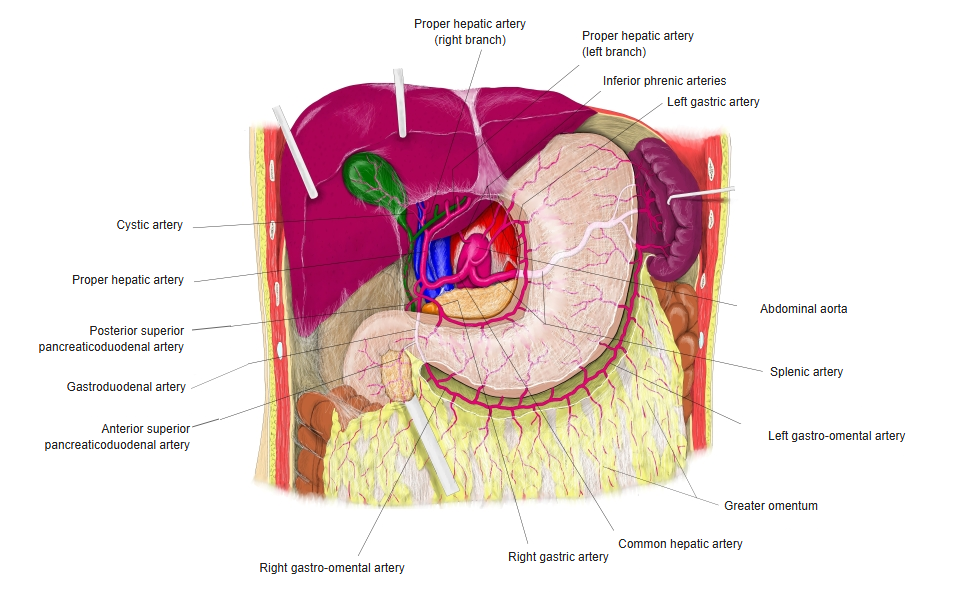
· The right and left gastro-omental (gastroepiploic) arteries run along it between the layers of the greater omentum; the short gastric arteries supply the fundus near its upper part.
· The matching veins drain along it: the right gastroepiploic vein, the left gastroepiploic vein and the short gastric veins.
of the
stomach
- Parts of the sac
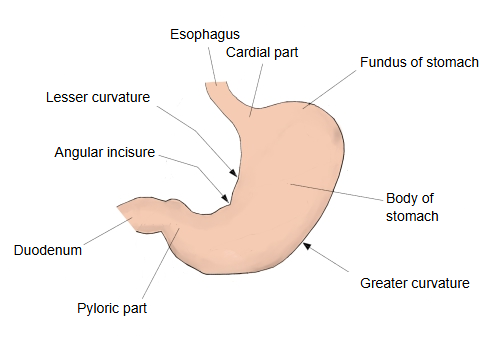
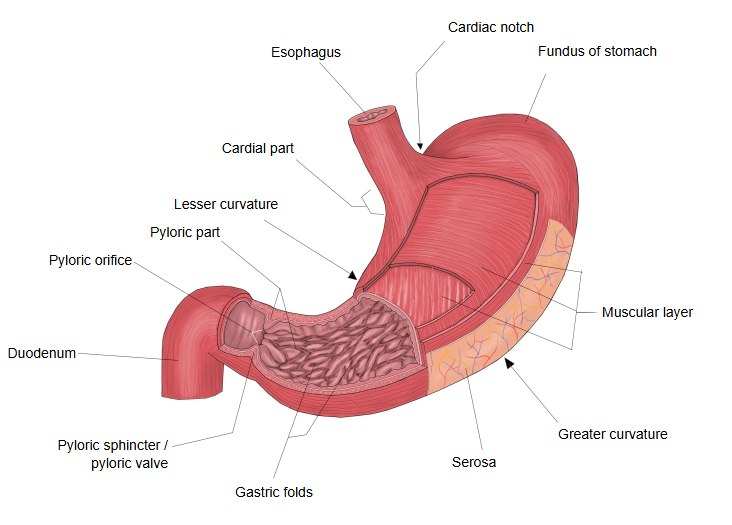
- Cardia : the area round the upper opening, where the oesophagus joins (cardial orifice, cardiac notch).
- Body : the large main part in the middle (with the gastric canal along the lesser curvature).
- Fundus : the part that bulges up and to the left of the body.
- Pyloric part : the area round the lower opening, leading to the duodenum (pylorus, pyloric orifice, pyloric valve).
- Curvatures
- Greater curvature : the lower (left) border joining the cardia and the pylorus, where the front and back walls meet.
- Lesser curvature : the upper (right) border joining the cardia and the pylorus, where the front and back walls meet.
- Walls
- Anterior wall : the surface between the two curvatures that faces forwards and upwards.
- Posterior wall : the surface between the two curvatures that faces backwards and downwards.
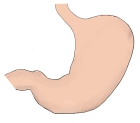 Stomach (anterior view)
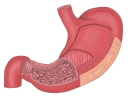 Structure of the stomach
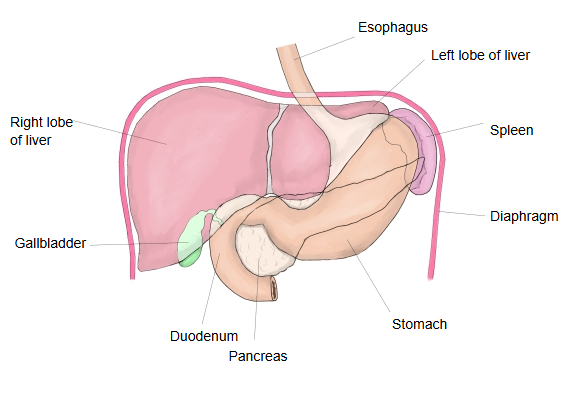
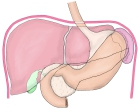 Stomach and nearby organs
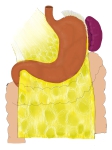 Stomach and omenta
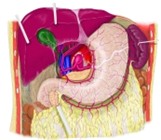 Stomach and greater omentum
Reference websites
[Wikipedia]
· Greater curvature of the stomach, Wikipedia.
· Stomach, Wikipedia.
[Websites with illustrations]
· Regions of the stomach (Wikimedia Commons)

· Stomach (Kenhub)
· The stomach (TeachMeAnatomy)
Where it is found
Related terms
- Lesser curvature
- Gastrocolic ligament
- Gastrosplenic ligament
- Gastrophrenic ligament
- Fundus of stomach
- Greater omentum
- Stomach
References and sources
- Further reading: Greater curvature of the stomach, Wikipedia.
- Further reading: Stomach, Wikipedia.
- Federative International Programme for Anatomical Terminology (FIPAT). Terminologia Anatomica, 2nd ed. (TA2), 2019.