Vestibular fold (Latin: plica vestibularis)
Also called Ventricular fold or the false vocal cord or the false vocal fold
· It is also called the ventricular fold or the false vocal fold (false vocal cord).
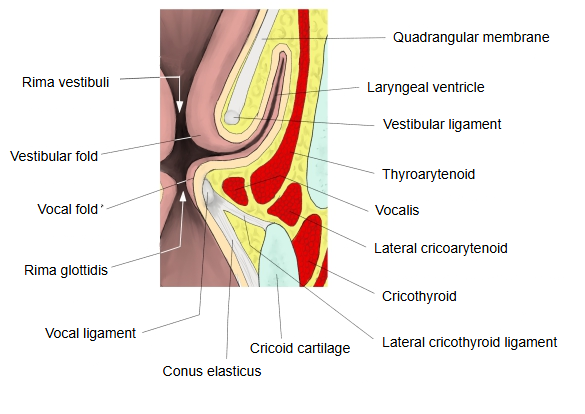
· The gap between the left and right vestibular folds is called the rima vestibuli.
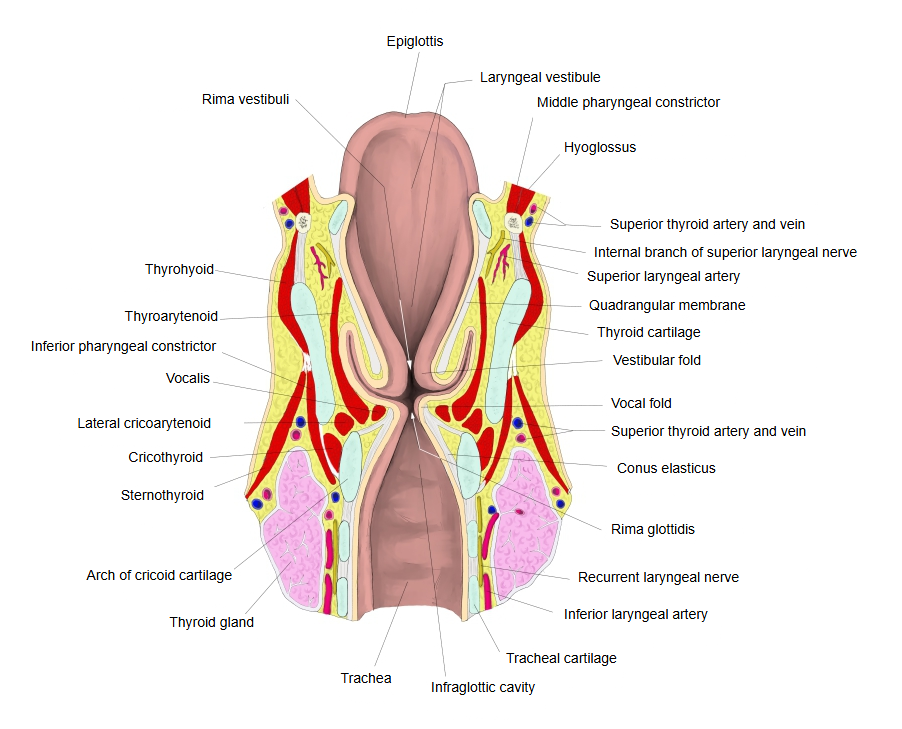
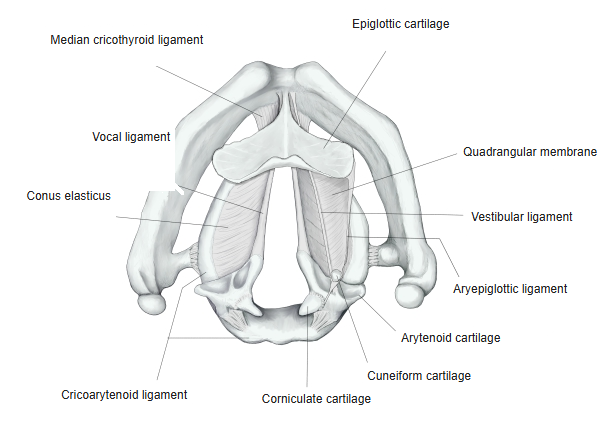
· Each fold contains the vestibular ligament, the thickened lower edge of the quadrangular membrane. It runs from the inner angle of the thyroid cartilage, just below the epiglottis, back to the front of the arytenoid cartilage, above the vocal process. Below each fold, the laryngeal ventricle separates it from the vocal fold. Unlike the vocal folds, the vestibular folds are pink, thick and fairly fixed; they are covered by respiratory epithelium and contain many mucous glands. The space above them is the laryngeal vestibule.
and
recesses
of the
larynx
- In the cavity
- Vestibular fold : a fold between the thyroid and arytenoid cartilages built on the vestibular ligament and the quadrangular membrane; also called the ventricular fold or false vocal cord.
- Vocal fold : a fold between the thyroid and arytenoid cartilages built on the vocal ligament and the conus elasticus; it produces the voice.
- At the inlet
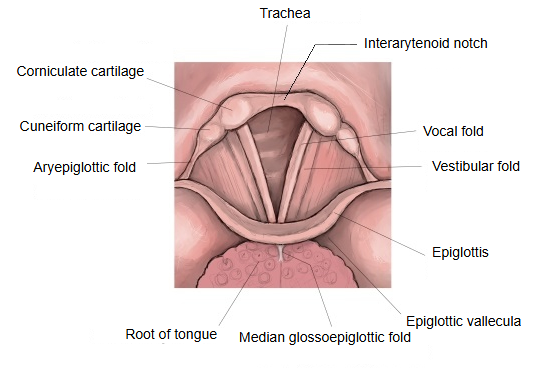
- Aryepiglottic fold : stretched between the epiglottis and the arytenoid cartilage; it forms the two sides of the laryngeal inlet and carries two tubercles (cuneiform and corniculate).
- In front
- Median glosso-epiglottic fold : between the midline of the root of the tongue and the epiglottic cartilage; the only unpaired fold.
- Lateral glosso-epiglottic fold : on the front of the epiglottis, on the outer side of the epiglottic vallecula.
- Others
- Fold of the superior laryngeal nerve : in the wall of the piriform recess, where the course of the superior laryngeal nerve (from upper lateral to lower medial) raises a fold.
- Pharyngo-epiglottic fold : runs from the side wall of the pharynx to the outer side of the epiglottic cartilage; it lies in the laryngeal part of the pharynx.
The vestibular folds are thought to play little part in producing the voice, but some sources, English Wikipedia among them, give them a supporting role:
they are said to help phonation by suppressing dysphonia (a disordered, hoarse voice). Sources differ on how much they help speech; some voice disorders involve vibration of the vestibular folds (ventricular phonation).
and
recesses
of the
larynx
- In the cavity
- Vestibular fold : a fold between the thyroid and arytenoid cartilages built on the vestibular ligament and the quadrangular membrane; also called the ventricular fold or false vocal cord.
- Vocal fold : a fold between the thyroid and arytenoid cartilages built on the vocal ligament and the conus elasticus; it produces the voice.
- At the inlet
- Aryepiglottic fold : stretched between the epiglottis and the arytenoid cartilage; it forms the two sides of the laryngeal inlet and carries two tubercles (cuneiform and corniculate).
- In front
- Median glosso-epiglottic fold : between the midline of the root of the tongue and the epiglottic cartilage; the only unpaired fold.
- Lateral glosso-epiglottic fold : on the front of the epiglottis, on the outer side of the epiglottic vallecula.
- Others
- Fold of the superior laryngeal nerve : in the wall of the piriform recess, where the course of the superior laryngeal nerve (from upper lateral to lower medial) raises a fold.
- Pharyngo-epiglottic fold : runs from the side wall of the pharynx to the outer side of the epiglottic cartilage; it lies in the laryngeal part of the pharynx.
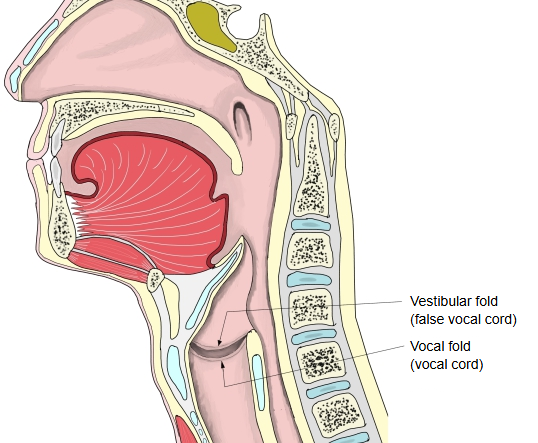
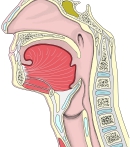 Nasal cavity to larynx (median section)
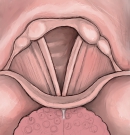 Larynx from above
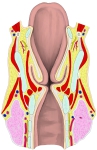 Larynx (coronal section)
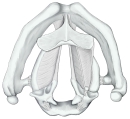 Laryngeal cartilages from above
 Vestibular and vocal folds (coronal section)
Reference websites
[Wikipedia]
· Vestibular fold, Wikipedia.
[Websites with illustrations]
· The larynx in coronal section (vestibular and vocal folds labelled) (ohsu.edu)

· Coronal section of the larynx (Gray's Anatomy) (Wikimedia Commons)

· Laryngoscopic view of the interior of the larynx (Gray's Anatomy) (Wikimedia Commons)

Function
The main role of the vestibular folds is protective: they can close the airway, helping to stop food and drink entering it during swallowing and to hold air in the chest during straining (for example when lifting or coughing). They take little part in normal voice. In some throat-singing and chanting styles (for example in Tuva, Mongolia, Tibet and Sardinia) the vestibular folds vibrate together with the vocal folds and produce very low or overtone-rich sounds.
Where it is found
Related terms
- Vestibular ligament
- Vocal fold
- Rima vestibuli
- Laryngeal ventricle
- Quadrangular membrane
- Laryngeal vestibule
- Larynx
References and sources
- Further reading: Vestibular fold, Wikipedia.
- Federative International Programme for Anatomical Terminology (FIPAT). Terminologia Anatomica, 2nd ed. (TA2), 2019.