Efferent nerve
Also called efferent nerve fibre
- Overview
- Use of the terms
- Afferent fibres in the autonomic nerves
- Reference websites
- (Wikipedia, websites with illustrations)
- Related terms
Overview
· "Efferent nerve" is almost the same as "motor nerve", but strictly it also includes the autonomic nerves that supply smooth muscle, cardiac muscle and glands, so efferent nerve and motor nerve are not the same thing. ("Motor nerve" usually means the nerve fibres that supply skeletal muscle: the somatic efferent fibres.)
· Efferent fibres are part of the peripheral nervous system and run in the spinal nerves and the cranial nerves, usually together with afferent fibres.
of the
peripheral
nerves
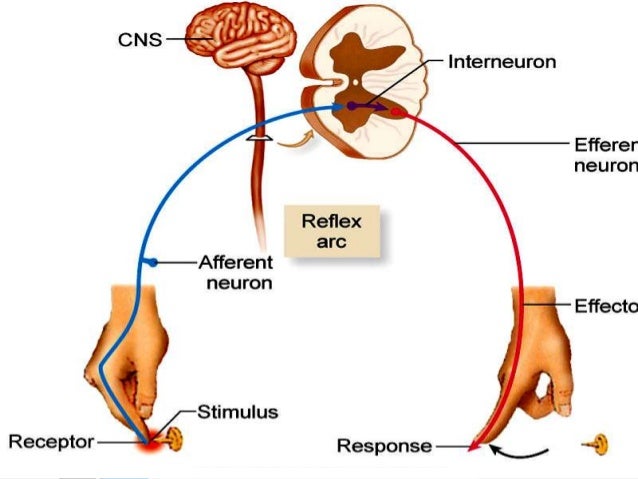
- Afferent nerves (= sensory nerves)
- Somatic afferent nerves : carry sensory information from the skin, muscles, joints and so on to the centre (pressure, pain, sense of movement and so on).
- Visceral afferent nerves : carry sensory information from the internal organs (stomach, heart, lungs and so on) to the centre (fullness, pain and so on).
- Efferent nerves (somatic efferent = motor nerves; the autonomic efferent fibres are also included)
- Somatic efferent nerves : carry information to skeletal muscle.
- Autonomic nerves : the sympathetic and parasympathetic nerves carry information to smooth muscle, cardiac muscle and glands. The autonomic nerves that supply smooth and cardiac muscle are usually not called motor nerves.
Direction in which information travels
Use of the terms
Are the nerves of the central nervous system also divided into afferent and efferent?
For the circuits inside the brain and spinal cord, the words afferent and efferent are not often used:
· inside the central nervous system the neurons are connected in complex ways, so they cannot be sorted as simply as in the periphery into an input direction and an output direction;
· instead, terms such as ascending and descending tracts, and inhibitory and excitatory neurons, are used.
Afferent fibres in the autonomic nerves
The autonomic nerves (sympathetic and parasympathetic) were once thought to be made only of efferent fibres, but they are now known to contain many afferent fibres as well. In the vagus nerve most of the fibres are afferent (some sources give about 75%), and some sources give about half for the splanchnic nerves. So the autonomic nerves are not purely efferent.
Reference websites
[Wikipedia]
· Efferent nerve fiber, Wikipedia.
[Websites with illustrations]
· Reflex arc: afferent and efferent neurons (SlideShare)
Related terms
- Peripheral nervous system
- Autonomic nervous system
- Spinal nerves
- Cranial nerves
- Vagus nerve
- Spinal cord
References and sources
- Further reading: Efferent nerve fiber, Wikipedia.
- Federative International Programme for Anatomical Terminology (FIPAT). Terminologia Anatomica, 2nd ed. (TA2), 2019.