Afferent nerve
Also called the sensory nerve
- Overview
- Neurons
- Synapse sites
- Classification
- Use of the terms
- Reference websites
- (Wikipedia, websites with illustrations)
- Related terms
Overview
of the
peripheral
nerves
- Afferent nerves (= sensory nerves)
- Somatic afferent nerves : carry sensory information from the skin, muscles, joints and so on to the centre (pressure, pain, sense of movement and so on).
- Visceral afferent nerves : carry sensory information from the internal organs (stomach, heart, lungs and so on) to the centre (fullness, pain and so on).
- Efferent nerves (somatic efferent = motor nerves; the autonomic efferent fibres are also included)
- Somatic efferent nerves : carry information to skeletal muscle.
- Autonomic nerves : the sympathetic and parasympathetic nerves carry information to smooth muscle, cardiac muscle and glands. The autonomic nerves that supply smooth and cardiac muscle are usually not called motor nerves.
Direction in which information travels
Neurons
Synapse sites
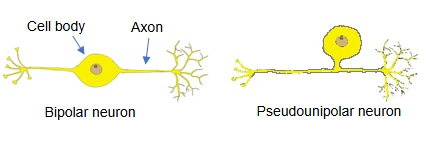
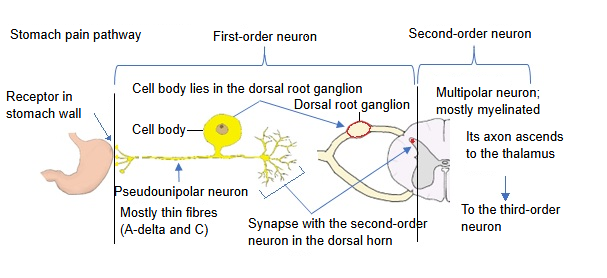
Somatic and visceral afferent nerves (pseudounipolar neurons)
Ganglion: the cell bodies lie in the dorsal root ganglia and in the sensory ganglia of the cranial nerves. No synapse is made in the ganglion; the impulse passes the cell body and goes on to the central nervous system.
Axon:
The peripheral branch receives the stimuli of the receptors in the periphery.
On entering the spinal cord or the brainstem, it forms the first synapse (these fibres are the primary afferent fibres).
Main sites of the synapses:
Somatic sensory fibres:
· Pain and temperature: synapse on second-order neurons in the dorsal (posterior) horn of the spinal cord.
· Fine touch, vibration and position sense: the fibres ascend in the dorsal columns and synapse on second-order neurons in the gracile and cuneate nuclei of the medulla oblongata.
Visceral sensory fibres:
· Thoracic and abdominal organs: synapse on second-order neurons mainly in the dorsal horn of the spinal cord.
· Organs supplied through the cranial nerves (the vagus and glossopharyngeal nerves): synapse on second-order neurons in the nucleus of the solitary tract in the medulla oblongata.
Special sensory nerves (bipolar neurons; optic nerve: retinal ganglion cells)
| Nerve | Synapse site | Notes | |
|---|---|---|---|
| 1 | Optic nerve | In the retina, on the ganglion cells | Retinal bipolar cells → ganglion cells → optic nerve → lateral geniculate body and other centres |
| 2 | Cochlear nerve | Cochlear nuclei | Direct synapse from the bipolar cells of the cochlear (spiral) ganglion |
| 3 | Vestibular nerve | Vestibular nuclei | Direct synapse from the bipolar cells of the vestibular ganglion |
| 4 | Olfactory nerve | Glomeruli of the olfactory bulb | The olfactory receptor cells are themselves bipolar neurons; their axons synapse on the neurons of the olfactory bulb |
Classification
By the site of the receptor
By where the receptors that send information from the periphery lie, afferent nerves can be divided into two groups:
· Receptors in the internal organs ⇒ visceral sensory afferent nerves (visceral afferent nerves)
· Receptors elsewhere ⇒ somatic sensory afferent nerves (somatic afferent nerves)
| Name | Notes | |
|---|---|---|
| 1 | Somatic sensory afferent nerves | Carry stimuli from the skin, muscles, joints and so on. Examples: touch, pain, temperature, proprioception (position and tension of joints and muscles). |
| 2 | Visceral sensory afferent nerves | Carry the state of the internal organs (the gastrointestinal tract, blood vessels, heart and so on). Examples: visceral pain, information from blood-pressure receptors and chemoreceptors. |
For the two names 'somatic afferent nerve' and 'somatic sensory afferent nerve', see 'Use of the terms' below.
By the kind of information
By the kind of information they carry from the periphery, afferent nerves can be divided into four groups (functional components):
| Name | Notes | |
|---|---|---|
| 1 | General somatic afferent | Skin sensation (touch, temperature, pain) and proprioception from muscles and joints. |
| 2 | Special somatic afferent | Vision, hearing and balance. |
| 3 | General visceral afferent | Sensation from the internal organs (stretch of the stomach, blood pressure and so on). |
| 4 | Special visceral afferent | Taste and smell (some texts treat smell separately). |
Note: the names above are short forms; strictly, each means 'afferent nerve fibres that carry ... sensation'.
By the source of the information
| Name | Notes | |
|---|---|---|
| 1 | Exteroceptive | Stimuli from the outside world (light, sound, touch and so on). |
| 2 | Interoceptive | Stimuli from the internal environment (blood pressure, blood oxygen level, stretch of the gastrointestinal tract and so on). |
| 3 | Proprioceptive | Information from muscles, tendons and joints (sense of the position and movement of the body). |
Use of the terms
Are the nerves of the central nervous system also divided into afferent and efferent?
For the circuits inside the brain and spinal cord, the words afferent and efferent are not often used:
· inside the central nervous system the neurons are connected in complex ways, so they cannot be sorted as simply as in the periphery into an input direction and an output direction;
· instead, terms such as ascending and descending tracts, and inhibitory and excitatory neurons, are used.
'Somatic afferent nerve' or 'general somatic afferent'?
The two names are close in meaning but are used in slightly different ways:
1. 1. Somatic afferent nerve: the broader, everyday name for the afferent nerves from the body wall (skin, muscles and the skeleton); it is often used in textbooks and in basic anatomy.
2. 2. General somatic afferent (GSA): the formal name used in the functional classification of the fibres of the spinal and cranial nerves and of their nuclei; it is stricter and more technical.
In short:
in general and textbook use → 'somatic afferent nerve';
as the formal name in the functional classification → 'general somatic afferent (GSA)'.
Reference websites
[Wikipedia]
· Afferent nerve fiber, Wikipedia.
[Websites with illustrations]
· Reflex arc: afferent and efferent neurons (SlideShare)

Related terms
- Efferent nerve
- Primary afferent fibers
- Motor nerve
- Dorsal root ganglion
- Spinal ganglion
- Sensory ganglion
- Cranial nerves
References and sources
- Further reading: Afferent nerve fiber, Wikipedia.
- Federative International Programme for Anatomical Terminology (FIPAT). Terminologia Anatomica, 2nd ed. (TA2), 2019.