Interarytenoid notch (Latin: incisura interarytenoidea)
laryngeal inlet
- In front
- Upper border of the epiglottis : the free edge that curves down from the top of the epiglottis.
- At the sides
- Aryepiglottic fold : the upper edge of the quadrangular membrane in it forms the aryepiglottic ligament.
- Cuneiform cartilage : its upper part forms the cuneiform tubercle.
- Behind
- Arytenoid cartilage : its upper end, the apex, takes part.
- Corniculate cartilage : its upper part forms the corniculate tubercle.
- Interarytenoid notch : the notch reaching down between the right and left arytenoid apices.
All of these parts are covered with mucous membrane.
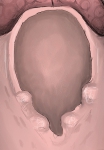 Laryngeal inlet
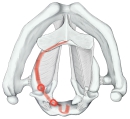 Parts of the laryngeal inlet
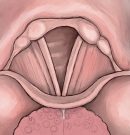 Vocal folds (from above)
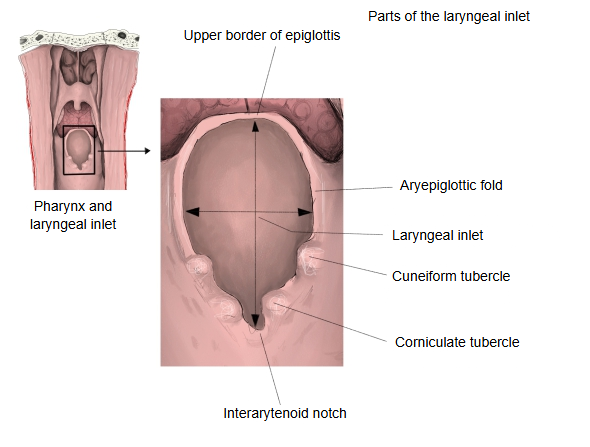
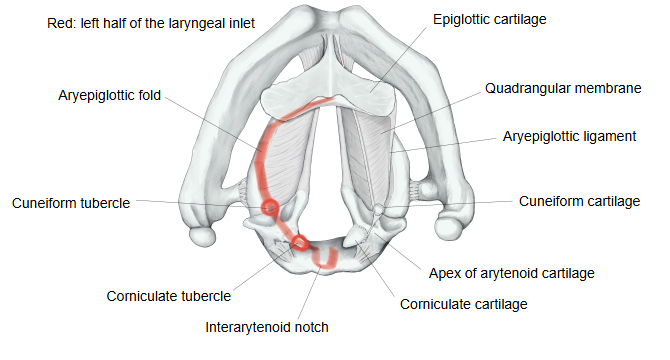
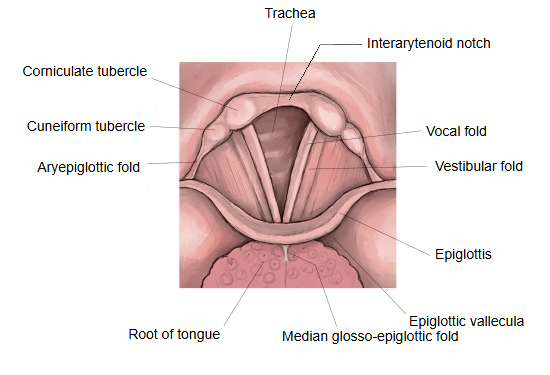
The laryngeal inlet is bounded in front by the upper border of the epiglottis, on each side by the aryepiglottic fold with its cuneiform tubercle, and behind by the corniculate tubercles (the apices of the arytenoid cartilages) and the interarytenoid notch between them. The notch dips down between the two arytenoid apices towards the transverse arytenoid muscle, which lies deep to its mucosa. Its depth changes as the arytenoid cartilages move: it narrows when they are drawn together to close the glottis. On laryngoscopy it is seen at the back of the inlet, just above the posterior end of the rima glottidis.
Reference websites
[Wikipedia]
· Larynx, Wikipedia.
[Websites with illustrations]
· Larynx seen from above and behind (figure) (Springer)

Related terms
- Corniculate tubercle
- Cuneiform tubercle
- Aryepiglottic fold
- Laryngeal vestibule
- Rima glottidis
- Glottis
- Larynx
References and sources
- Further reading: Larynx, Wikipedia.
- Federative International Programme for Anatomical Terminology (FIPAT). Terminologia Anatomica, 2nd ed. (TA2), 2019.