Arytenoid cartilage (Latin: cartilago arytenoidea)
- Unpaired
- Thyroid cartilage : hyaline cartilage; the largest of the laryngeal cartilages. It forms most of the front wall of the larynx.
- Cricoid cartilage : hyaline cartilage; the lowest of the laryngeal cartilages, joined to the tracheal cartilages by the cricotracheal ligament.
- Epiglottic cartilage : elastic cartilage; forms the framework of the epiglottis.
- Paired
- Corniculate cartilage : elastic cartilage; a very small cartilage on the apex of the arytenoid cartilage.
- Arytenoid cartilage : mostly hyaline cartilage; it sits on the upper border of the cricoid lamina and is the most important cartilage for voice production.
- Cuneiform cartilage : elastic cartilage; a small flat cartilage in front of the corniculate cartilage. It may be absent.
- Sesamoid cartilages : small, inconstant elastic cartilages; sometimes several are present.
· Base: the lower surface of the arytenoid cartilage. It has an articular surface for the lamina of the cricoid cartilage.
It also has two processes, the muscular process and the vocal process.
Muscles attached to the muscular process: part of the arytenoid muscle, and the lateral and posterior cricoarytenoid muscles.
· Apex: projects backward and medially and articulates with the corniculate cartilage.
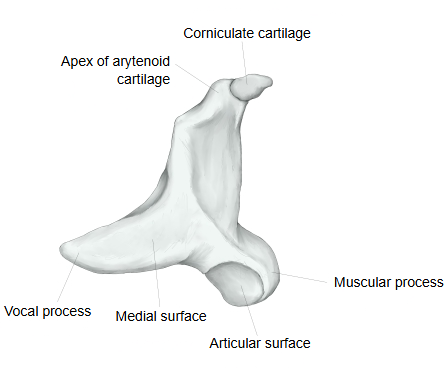
· Medial surface: smooth; it faces the cavity of the larynx.
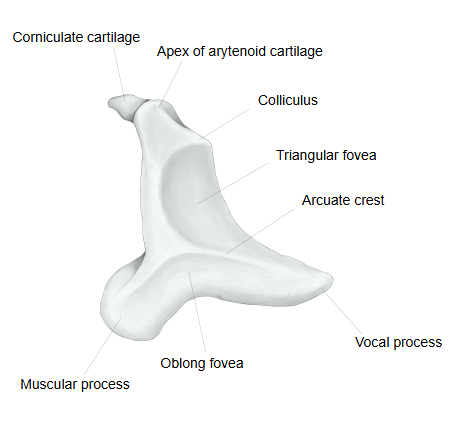
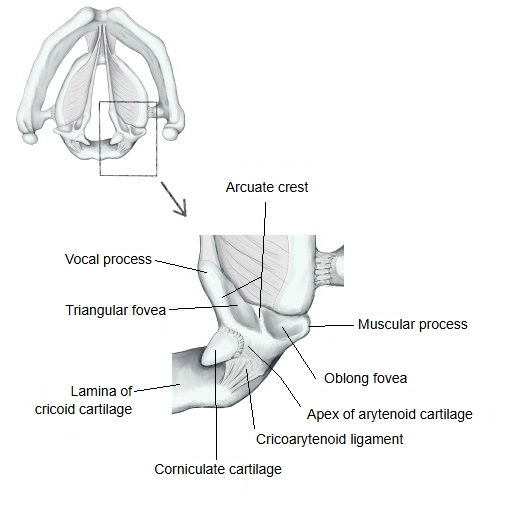
· Anterolateral surface: carries a ridge, the arcuate crest, whose upper end forms a small projection, the colliculus.
The lowest part of this surface is hollowed out as the oblong fovea. Above it lies a deep pit, the triangular fovea.
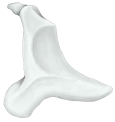 Arytenoid and corniculate cartilages (anterolateral surface)
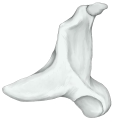 Arytenoid and corniculate cartilages (medial surface)
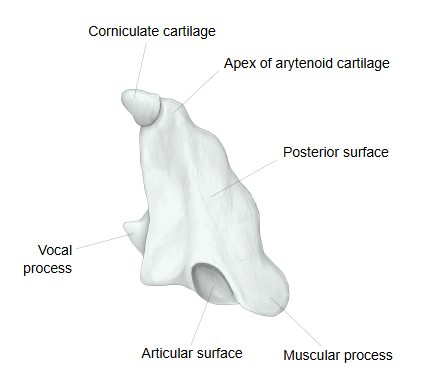
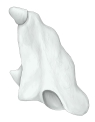 Arytenoid and corniculate cartilages (posterior surface)
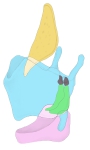 Laryngeal cartilages (colour-coded)
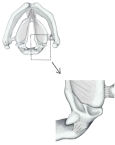 Arytenoid cartilage within the larynx
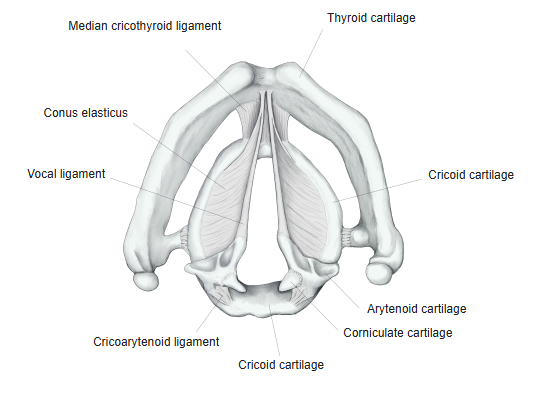
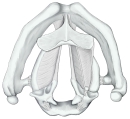 Laryngeal cartilages (from above)
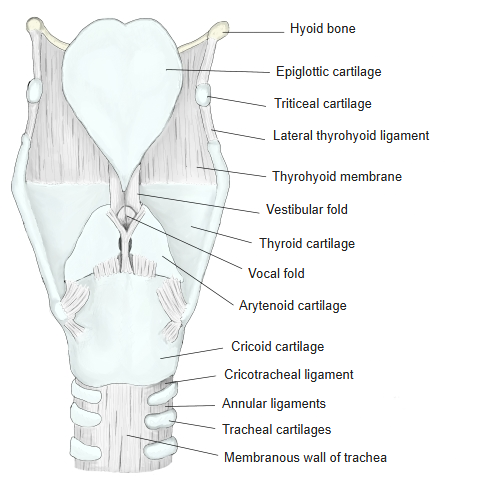
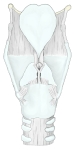 Larynx (posterior view)
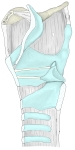 Larynx (median section)
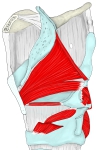 Intrinsic laryngeal muscles
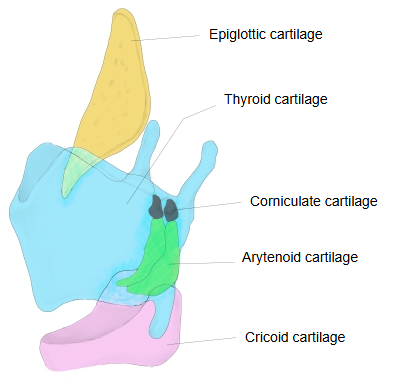
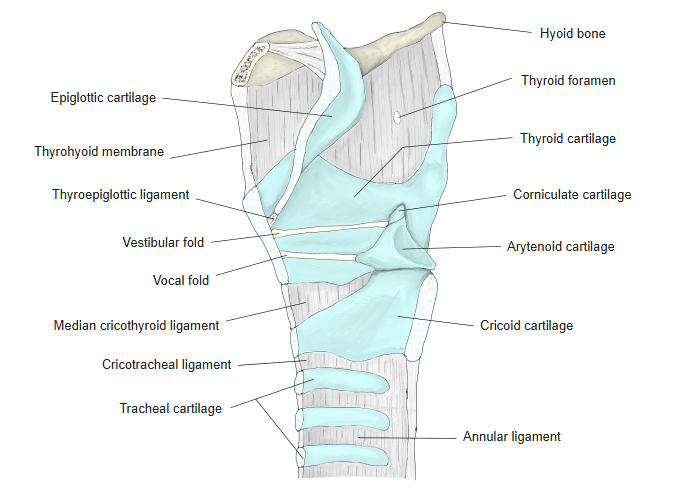
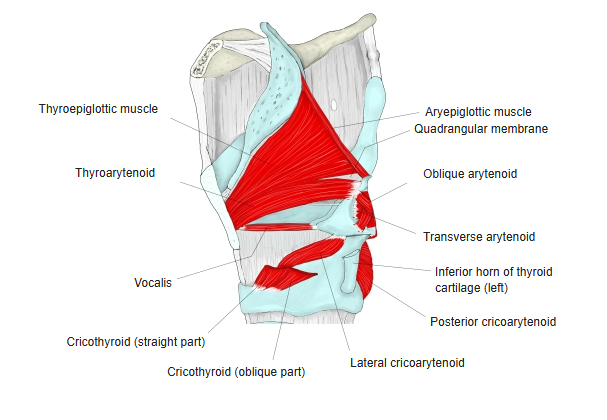
Below is a simple list of the laryngeal cartilages.
- Unpaired
- Thyroid cartilage : hyaline cartilage; the largest of the laryngeal cartilages. It forms most of the front wall of the larynx.
- Cricoid cartilage : hyaline cartilage; the lowest of the laryngeal cartilages, joined to the tracheal cartilages by the cricotracheal ligament.
- Epiglottic cartilage : elastic cartilage; forms the framework of the epiglottis.
- Paired
- Corniculate cartilage : elastic cartilage; a very small cartilage on the apex of the arytenoid cartilage.
- Arytenoid cartilage : mostly hyaline cartilage; it sits on the upper border of the cricoid lamina and is the most important cartilage for voice production.
- Cuneiform cartilage : elastic cartilage; a small flat cartilage in front of the corniculate cartilage. It may be absent.
- Sesamoid cartilages : small, inconstant elastic cartilages; sometimes several are present.
A standard anatomy textbook describes it as follows. The arytenoid cartilages are a pair of hyaline cartilages resting on the upper lateral corners of the cricoid lamina. Changes in their position directly alter the shape of the glottis and the tension of the vocal cords, so they matter most for voice production. Each is a three-sided pyramid with an apex, a base and three surfaces (medial, anterolateral and posterior). The base articulates with the cricoid lamina by the articular surface on its underside and sends out two processes, laterally and forward. The lateral one, the muscular process, is short, small and rounded; part of the arytenoid muscle and the lateral and posterior cricoarytenoid muscles attach to it. The forward one, the vocal process, is small and projects into the laryngeal cavity; the vocal ligament stretches between it and the midline of the thyroid cartilage. The apex projects backward and medially and joins the corniculate cartilage. The medial surface faces the cavity of the larynx and is smooth. The anterolateral surface carries an arched ridge, the arcuate crest, whose upper end is a small projection, the colliculus. The lowest part of this surface is hollowed out as the oblong fovea, where the vocalis muscle attaches; above it is another deep pit, the triangular fovea.
English Wikipedia describes it roughly as follows.
The arytenoid cartilages are a pair of small three-sided pyramids in the back of the larynx, to which the vocal folds are attached; they make the movements of the vocal folds possible. The name means "ladle-shaped" (Greek arytaina, ladle). They are made mainly of hyaline cartilage; the apex and the tip of the vocal process are elastic cartilage.
Surfaces: the posterior surface is triangular, smooth and concave, and gives attachment to the oblique and transverse arytenoid muscles. The anterolateral surface is slightly convex and rough; near the apex is the rounded colliculus, from which the arcuate crest curves back and then down and forward to the vocal process. The lower part of the crest separates two pits, the upper triangular fovea and the lower oblong fovea, which gives attachment to the vocalis muscle. The medial surface is narrow, smooth and flat, covered with mucosa, and forms the side of the back (intercartilaginous) part of the rima glottidis.
Base and apex: the base is broad and has a concave, smooth surface for the arytenoid articular surface of the cricoid cartilage; the joint is held from behind by the posterior cricoarytenoid ligament.
Its lateral angle is the muscular process, for the posterior and lateral cricoarytenoid muscles.
Its front angle is the vocal process, for the vocal ligament and the vocalis muscle.
The apex is pointed, curves backward and medially, and carries the small cone-shaped corniculate cartilage (corniculate tubercle); it also gives attachment to the aryepiglottic fold.
Function: the arytenoids let the vocal folds be tightened, relaxed and brought together. At the cricoarytenoid joints, on the upper lateral parts of the cricoid lamina, they can rotate, glide towards or away from each other and tilt forward or backward. Because the vocal ligament runs from the vocal process to the thyroid cartilage, these movements open and close the rima glottidis and change the tension of the vocal folds, which makes the arytenoids central to both voice production and breathing.
Reference websites
[Wikipedia]
· Arytenoid cartilage, Wikipedia.
· Cricoarytenoid joint, Wikipedia.
[Websites with illustrations]
· The cartilages of the larynx, posterior view (Gray's Anatomy) (Wikimedia Commons)

· Ligaments of the larynx, posterior view (Gray's Anatomy) (Wikimedia Commons)

· The Larynx (TeachMeAnatomy)
Related terms
- Corniculate tubercle
- Vocal fold
- Rima glottidis
- Glottis
- Vocal ligament
- Posterior cricoarytenoid ligament
- Larynx
References and sources
- Further reading: Arytenoid cartilage, Wikipedia.
- Further reading: Cricoarytenoid joint, Wikipedia.
- Federative International Programme for Anatomical Terminology (FIPAT). Terminologia Anatomica, 2nd ed. (TA2), 2019.