Perilymphatic space (Latin: spatium perilymphaticum)
The perilymphatic space is the space in the internal ear between the bony labyrinth and the membranous labyrinth; it is filled with perilymph.
The internal ear is both the organ of hearing and the organ of balance
From the perilymphatic space a small canal that drains the perilymph, the perilymphatic duct, runs to the subarachnoid space.
It runs in the cochlear aqueduct (cochlear canaliculus)
- Internal acoustic meatus : internal acoustic opening → fundus of the internal acoustic meatus (four areas: anterosuperior, posterosuperior, posteroinferior and anteroinferior; see superior vestibular area).
- Bony labyrinth : three parts: cochlea, vestibule, semicircular canals.
- Perilymphatic space : the space between the bony and membranous labyrinths, filled with perilymph; it gives off the perilymphatic duct, which connects with the subarachnoid space.
- Membranous labyrinth : hearing part: cochlear duct; balance part: saccule, utricle, semicircular ducts. Its inside (the endolymphatic space) is filled with endolymph.
- Note : the internal ear is also called the labyrinth; it serves both hearing and balance.
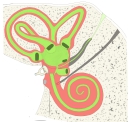 Perilymphatic space and membranous labyrinth
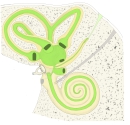 Bony and membranous labyrinth
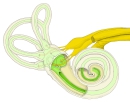 Perilymphatic and endolymphatic spaces
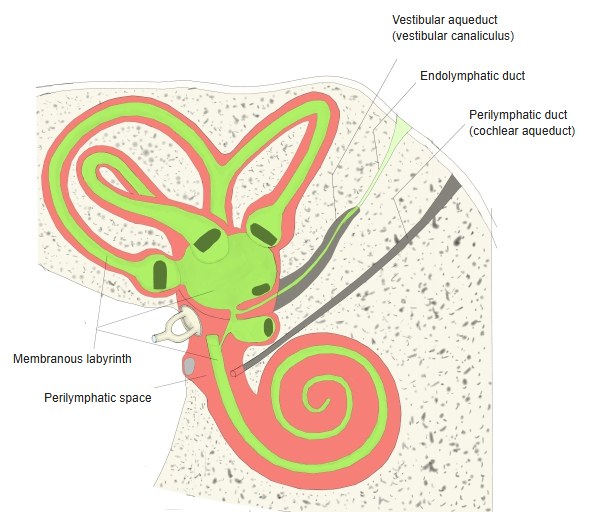
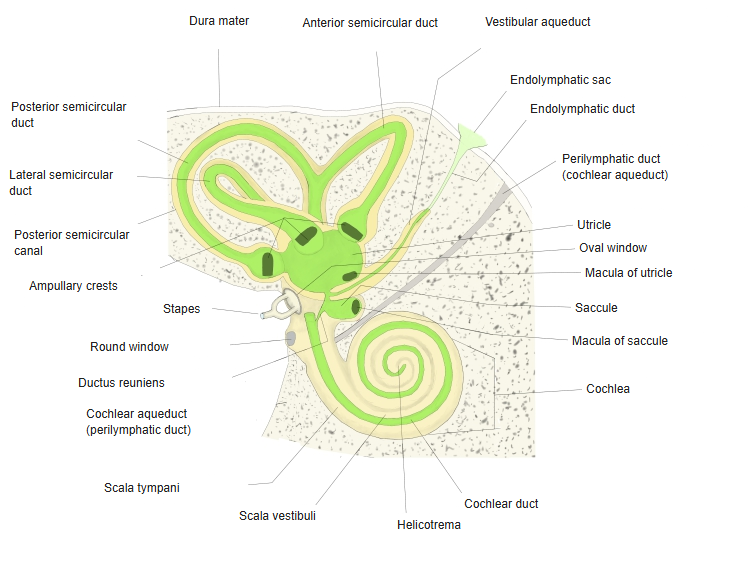
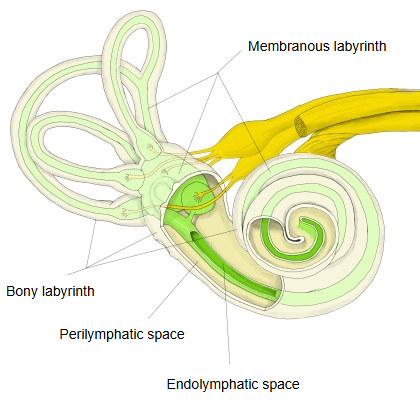
The perilymphatic space lies between the outer wall of the membranous labyrinth and the wall of the bony labyrinth and contains the perilymph. It surrounds every part of the membranous labyrinth: in the cochlea it forms the scala vestibuli and scala tympani, which meet at the helicotrema; in the vestibule it is the large space around the utricle and saccule. Perilymph resembles extracellular fluid (rich in sodium), unlike the potassium-rich endolymph inside the membranous labyrinth. Thin strands of connective tissue cross the space and help hold the membranous labyrinth in place.
Reference websites
[Wikipedia]
· Perilymph, Wikipedia.
· Bony labyrinth, Wikipedia.
Related terms
- Bony labyrinth
- Membranous labyrinth
- Cochlea
- Vestibule
- Semicircular canals
- Cochlear duct
- Internal ear
References and sources
- Further reading: Perilymph, Wikipedia.
- Further reading: Bony labyrinth, Wikipedia.
- Federative International Programme for Anatomical Terminology (FIPAT). Terminologia Anatomica, 2nd ed. (TA2), 2019.