Lateral mass of atlas (Latin: massa lateralis atlantis)
Also called the lateral mass
The lateral masses correspond to the superior and inferior articular processes of other vertebrae, and both their upper and lower surfaces bear joint surfaces. The upper one, the superior articular facet, is concave and kidney-shaped and receives the occipital condyle of the occipital bone at the atlanto-occipital joint. The lower one, the flatter, round inferior articular facet, meets the superior articular facet of the axis at the lateral atlanto-axial joint. The atlas has no superior or inferior vertebral notches. The transverse process projects laterally from the lateral mass and is pierced by a large transverse foramen. The vertebral foramen is very large; it is divided in two by the transverse ligament of atlas, which runs between small tubercles on the inner sides of the two lateral masses. The front part holds the dens of the axis, and the large, blunt-triangular back part, which corresponds to the vertebral foramen proper, holds the spinal cord.
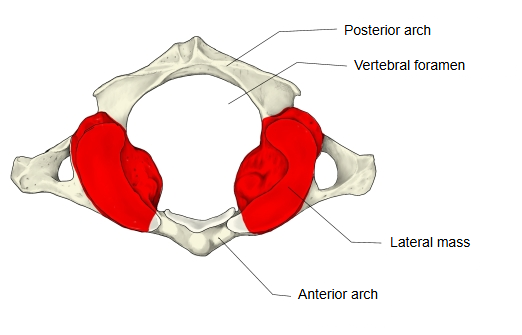
Note
A fairly large transverse process projects laterally from each lateral mass, and at its base is a relatively large transverse foramen.
Following that description, this page does not count the transverse process and the transverse foramen as part of the lateral mass. Sources differ, however: some count them as part of it, while others treat the transverse process as a separate projection from the lateral mass.
The lateral masses are the thick, bulky parts that form the whole side of the ring of the atlas, like pillars supporting the skull, with joint surfaces above and below. Laterally they continue into the transverse processes. Each of these is really made of two elements: the front wall of the transverse foramen is a costal (rib) element, a remnant that corresponds to a rib, and the back wall is the true transverse process. The term lateral mass is also used for other bones, such as the lateral part of the sacrum and the ethmoidal labyrinth; this page covers the atlas.
Related terms
- Atlas
- Occipital condyle
- Atlanto-occipital joint
- Atlanto-axial joint
- Transverse foramen
- Dens
- Transverse ligament of atlas
References and sources
- Further reading: Atlas (anatomy), Wikipedia.
- Federative International Programme for Anatomical Terminology (FIPAT). Terminologia Anatomica, 2nd ed. (TA2), 2019.