Mandibular notch (Latin: incisura mandibulae)
Also called: sigmoid notch
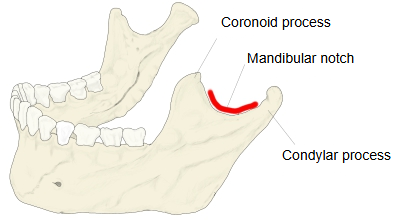
The mandibular notch is one of the parts of the ramus of the mandible: the deep notch between the coronoid process and the condylar process.
Ramus of the mandible: the back part of the mandible when the bone is divided into a front and a back part; one on each side
· The notch is concave upwards and gives the upper border of the ramus its S-shaped outline. The masseteric nerve (a branch of the mandibular nerve) and vessels pass through it from the infratemporal fossa to reach the deep surface of the masseter.
· The notch lies just below the zygomatic arch and is used as an entry point for injections into the infratemporal fossa (for example a mandibular nerve block).
Condylar
process
process
- Head of mandible : the enlarged upper end of the condylar process.
- Articular surface : oval; it articulates with the mandibular fossa of the temporal bone through the articular disc, forming the temporomandibular joint.
- Neck of mandible : the narrowed part below the head.
- Pterygoid fovea : a small pit on the front of the neck, where the lateral pterygoid inserts.
- Mandibular notch : the head and neck form its back edge.
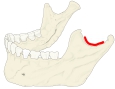 Mandibular notch
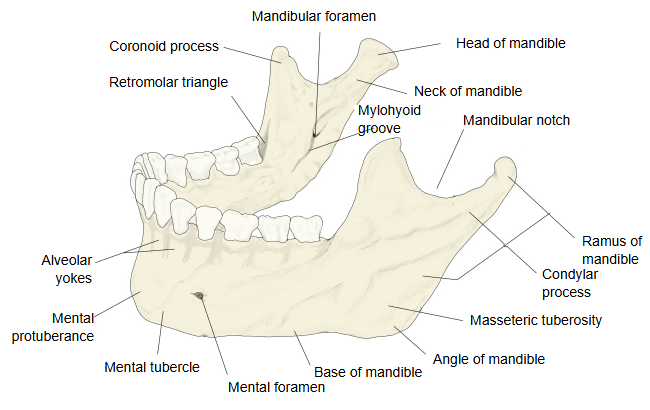
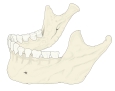 Mandible (lateral)
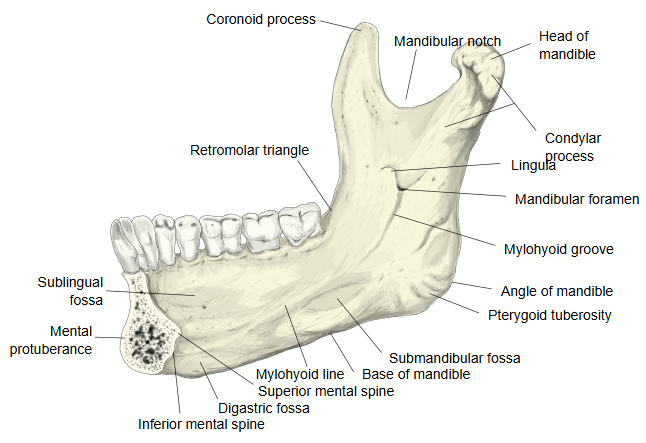
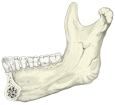 Mandible (medial surface)
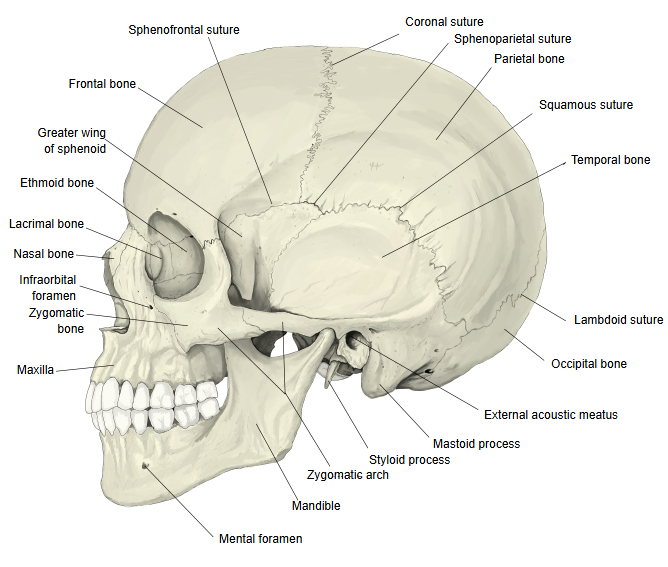
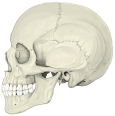 Skull (lateral)
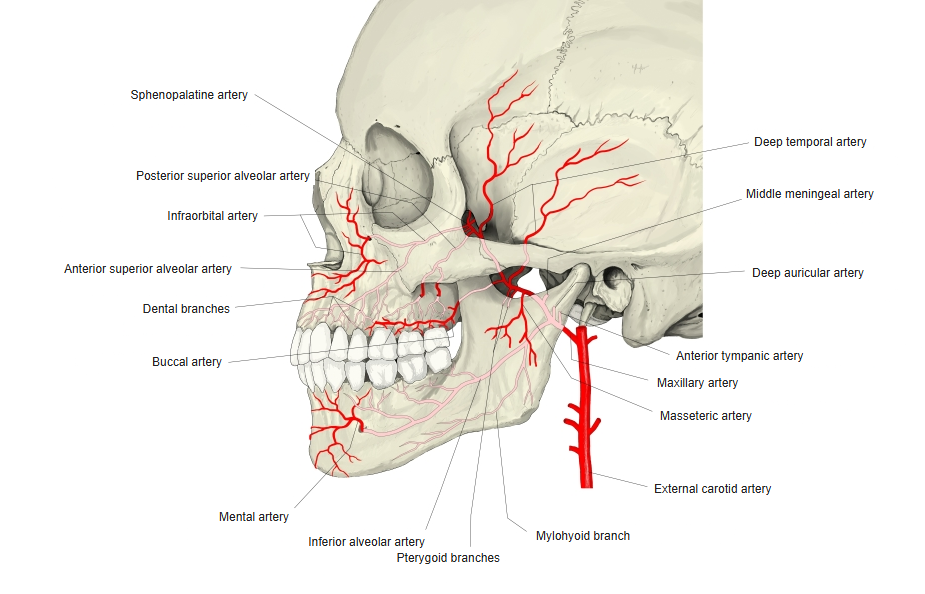
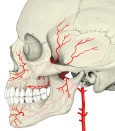 Maxillary artery and its branches
Reference websites
[Wikipedia]
· Mandibular notch, Wikipedia.
· Mandible, Wikipedia.
[Websites with illustrations]
· The mandible: structure and attachments (TeachMeAnatomy)
· The mandible: anatomy, structure, function (Kenhub)
Related terms
- Coronoid process
- Condylar process
- Ramus of mandible
- Masseteric nerve
- Masseteric artery
- Masseter
- Mandible
References and sources
- Further reading: Mandibular notch, Wikipedia.
- Further reading: Mandible, Wikipedia.
- Federative International Programme for Anatomical Terminology (FIPAT). Terminologia Anatomica, 2nd ed. (TA2), 2019.