Round window (Latin: fenestra cochleae)
Also called Cochlear window
· The oval and the round window are of about the same size, roughly 2–3 square millimetres; the entrance to the round window niche is often smaller.
The round window lies at the bottom of a funnel-shaped pit, the round window niche, and is separated from the oval window by the rounded bulge of the promontory. The secondary tympanic membrane has three layers: the mucosa of the tympanic cavity on the outside, a fibrous middle layer, and the lining of the scala tympani on the inside.
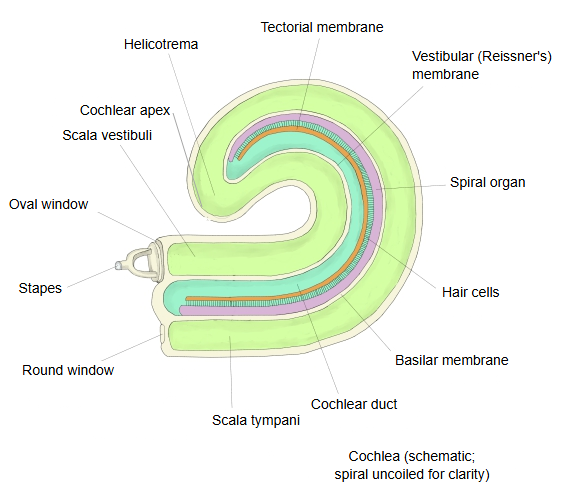
When the stapes pushes the oval window inwards, the round window membrane bulges outwards into the middle ear; this lets the perilymph move and the basilar membrane vibrate. Without this give the fluid of the internal ear could hardly move, and hearing would be much reduced. The tympanic membrane at the end of the external acoustic meatus is the 'first' tympanic membrane.
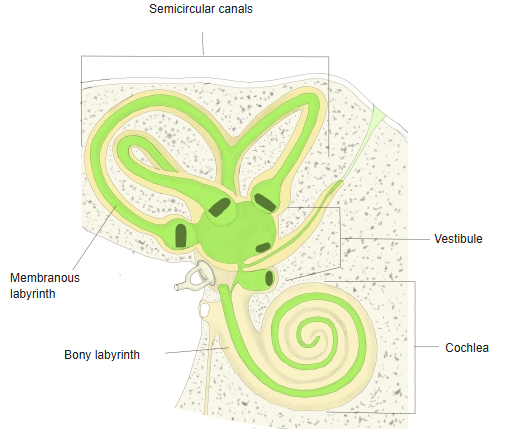
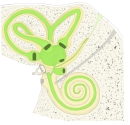 Bony and membranous labyrinth
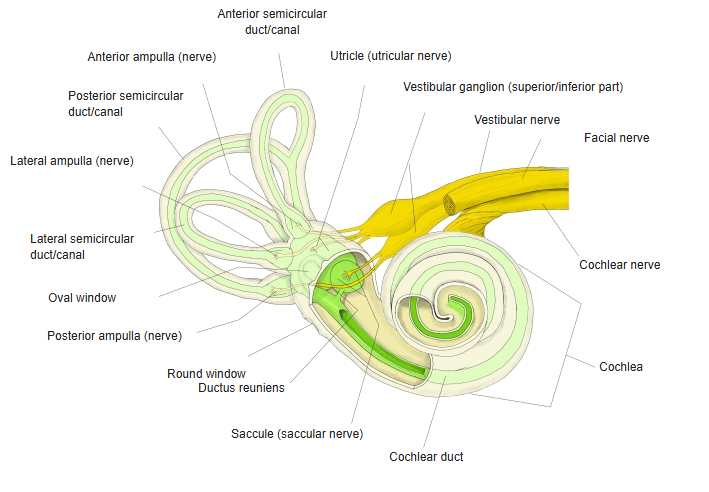
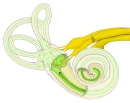 Bony and membranous labyrinth with the windows
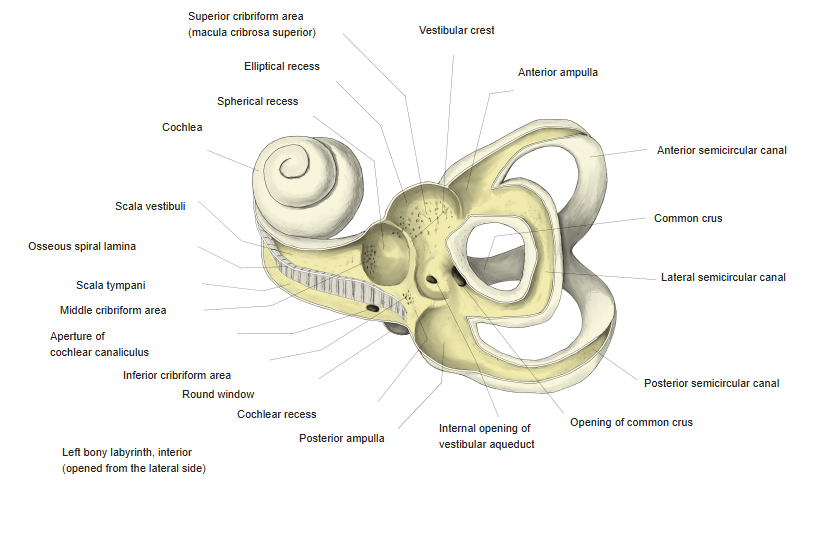
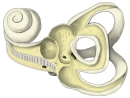 Bony labyrinth
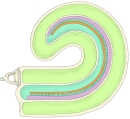 Spiral canal of the cochlea (model diagram)
Reference websites
[Wikipedia]
· Round window, Wikipedia.
· Secondary tympanic membrane, Wikipedia.
[Websites with illustrations]
· The middle ear (TeachMeAnatomy)
· Internal ear anatomy: cochlea, vestibule and canals (Kenhub)
· Interior of the right osseous labyrinth (Gray's Anatomy, fig. 921) (Wikimedia Commons)

Related terms
References and sources
- Further reading: Round window, Wikipedia.
- Further reading: Secondary tympanic membrane, Wikipedia.
- Federative International Programme for Anatomical Terminology (FIPAT). Terminologia Anatomica, 2nd ed. (TA2), 2019.