Crural intermuscular septa (Latin: septa intermuscularia cruris)
Also called the intermuscular septa of leg
As the name says, this is the intermuscular septum of the leg (between knee and ankle). The name itself is hardly used, though: standard texts and websites almost always add "anterior" or "posterior". So
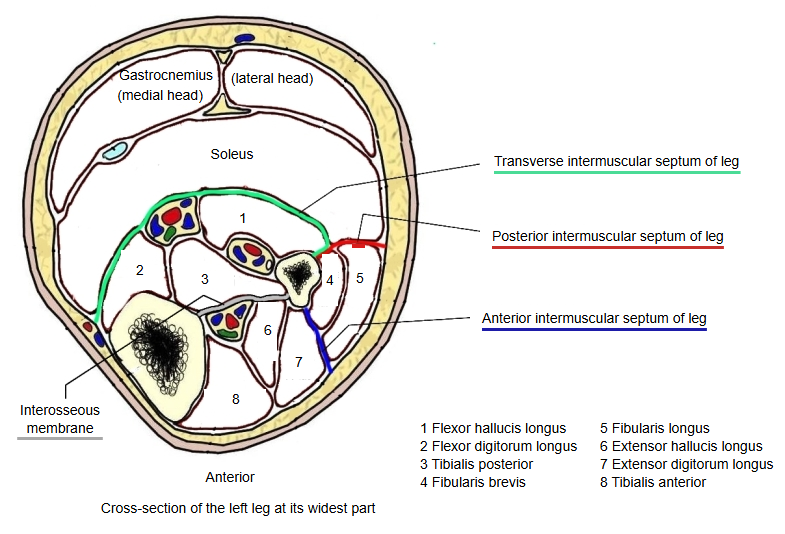
Standard texts name two septa, the anterior crural intermuscular septum and the posterior crural intermuscular septum, but some sources also list a transverse crural intermuscular septum.
intermuscular
septa
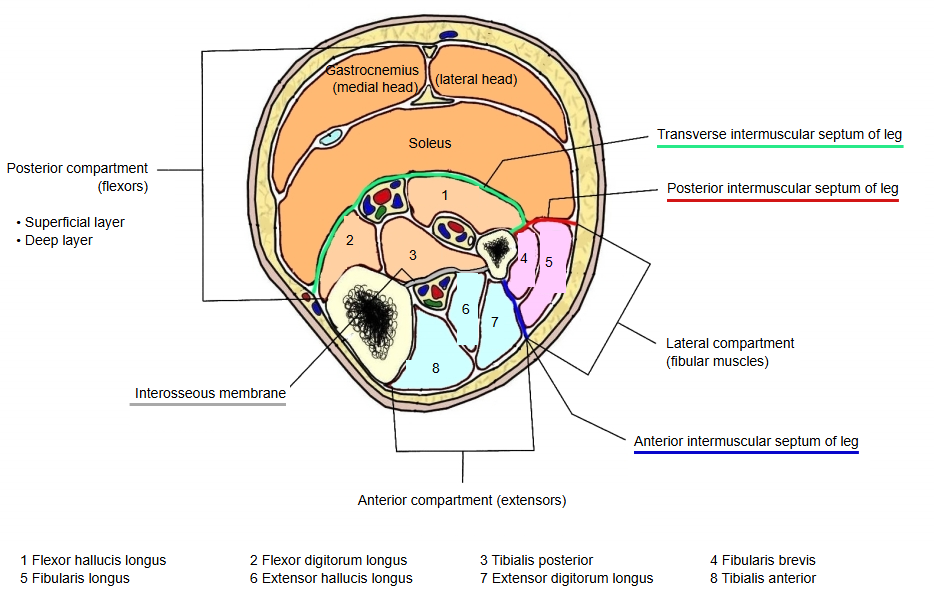
- Anterior crural intermuscular septum : between the anterior and the lateral compartments.
- Posterior crural intermuscular septum : between the lateral and the posterior compartments.
- Transverse crural intermuscular septum : between the superficial and the deep muscles of the posterior compartment (not listed in every source).
Anterior crural intermuscular septum
A connective-tissue septum that passes in from the deep fascia of the leg (crural fascia) between the extensor group (the anterior muscles of the leg) and the lateral muscles of the leg.
It runs from the deep fascia to the anterior border of the fibula and separates the anterior compartment (tibialis anterior, extensor hallucis longus, extensor digitorum longus) from the lateral compartment (fibularis longus and fibularis brevis). On the lateral side of the leg the deep fascia gives off two strong septa, the anterior and posterior septa, which enclose the fibular muscles and separate them from the muscles of the anterior and posterior crural regions; thinner sheets enclose the single muscles of each region.
Posterior crural intermuscular septum
A connective-tissue septum that passes in from the deep fascia of the leg between the lateral muscles of the leg and the flexor group (the posterior muscles of the leg).
It runs from the deep fascia to the posterior border of the fibula and separates the lateral compartment from the posterior compartment (on this side mainly soleus and flexor hallucis longus). With the anterior septum it encloses fibularis longus and fibularis brevis in the lateral crural region.
Transverse crural intermuscular septum
Not every list of anatomical terms names it; some describe it only as part of the deep fascia (it is also called the deep transverse fascia of the leg). It is described as follows.
The transverse septum is a fibrous sheet between soleus and the deep flexors, flexor hallucis longus and flexor digitorum longus, so it splits the posterior compartment into a superficial part (gastrocnemius, soleus, plantaris) and a deep part (popliteus, the long flexors and tibialis posterior). At the sides it is attached to the medial border of the tibia and the posterior border of the fibula. It is thick above, over popliteus, thin in the middle of the leg and thick again below, where it continues into the flexor retinaculum behind the medial malleolus.
Reference websites
[Wikipedia]
· Fascial compartments of leg, Wikipedia.
· Anterior intermuscular septum of leg, Posterior intermuscular septum of leg and Transverse intermuscular septum of leg, Wikipedia.
Reference websites
· Cross-section of the leg with the anterior and posterior intermuscular septa (oganatomy.org)

Related terms
- Fibula
- Tibia
- Fibularis longus
- Fibularis brevis
- Soleus
- Lateral region of leg
- Posterior border of fibula
References and sources
- Further reading: Anterior intermuscular septum of leg, Wikipedia.
- Further reading: Transverse intermuscular septum of leg, Wikipedia.
- Further reading: Fascial compartments of leg, Wikipedia.
- Federative International Programme for Anatomical Terminology (FIPAT). Terminologia Anatomica, 2nd ed. (TA2), 2019.